
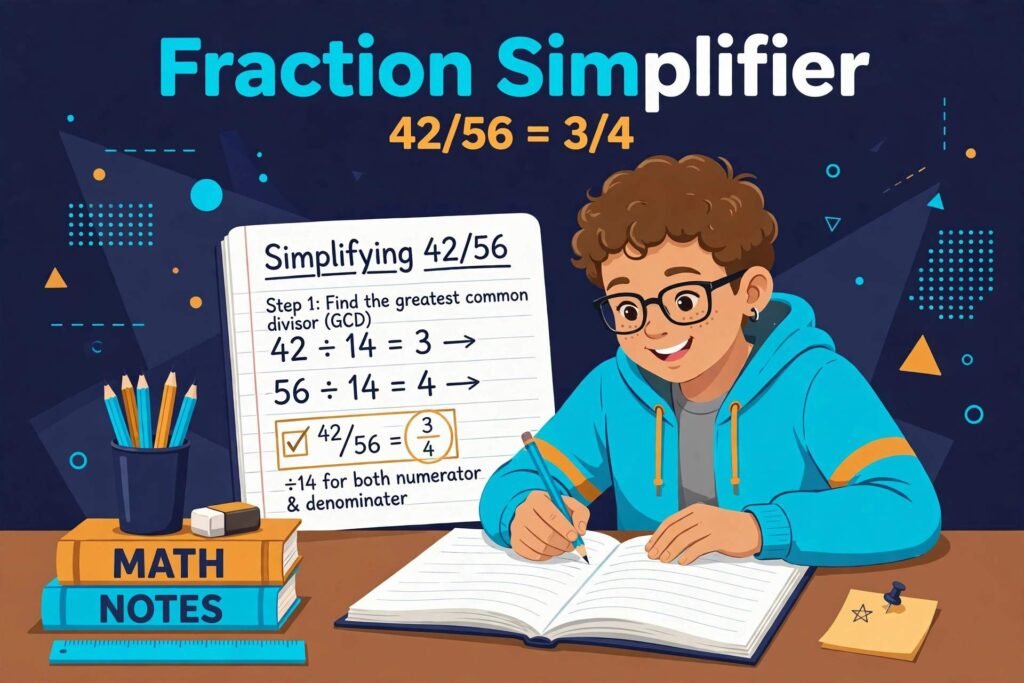
Your homework says simplify 42/56, and the answer key just says 3/4. I have been there, staring at two big numbers and wondering how anyone sees 3/4 hiding inside them. Simplifying a fraction is one move, and once you see it, you will spot it in every fraction you meet.
A fraction simplifier, whether it is a person or a calculator, does one job. It rewrites a fraction with smaller numbers while keeping the value exactly the same. 42/56 and 3/4 look different, but they name the same amount. Divide the top and the bottom by the same number.
What does simplest form actually mean?
A fraction is in simplest form, also called lowest terms, when the top number and the bottom number share no factor bigger than 1. The top number is the numerator, the bottom number is the denominator. In 3/4, the only number that divides both is 1, so 3/4 is finished. In 42/56, the number 14 divides both, so it is not finished yet.
How do you simplify a fraction in three steps?
Use the greatest common factor, the GCF. That is the biggest number that divides both the top and the bottom with nothing left over. Three steps, every time. First, find the GCF of the two numbers. Second, divide the top by it. Third, divide the bottom by it. Divide the top and the bottom by the same number.
Take 42/56. The factors of 42 are 1, 2, 3, 6, 7, 14, 21 and 42. The factors of 56 are 1, 2, 4, 7, 8, 14, 28 and 56. The biggest number on both lists is 14, so the GCF is 14. Now divide. 42 divided by 14 is 3, and 56 divided by 14 is 4. The simplified fraction is 3/4. Check it: 42 divided by 56 is 0.75, and 3 divided by 4 is 0.75. They match, so the value did not change.
Try It: simplify 45/75. List the factors of both numbers, find the biggest one they share, and divide the top and bottom by it. The answer is at the end of this guide.
What if you cannot spot the GCF?
Sometimes the GCF does not jump out at you. Then divide as you go, in small steps. Pick any small number that divides both the top and the bottom, divide, and repeat until nothing divides both except 1. Divide the top and the bottom by the same number.
Take 36/60 and work it two ways. The GCF way: the GCF of 36 and 60 is 12, so 36 divided by 12 is 3 and 60 divided by 12 is 5, giving 3/5. The divide-as-you-go way: divide both by 2 to get 18/30, by 2 again to get 9/15, then by 3 to get 3/5. Same answer, two roads.
Try It: simplify 28/42 by dividing as you go. Start by dividing both by 2, then see what divides both numbers next. The answer is at the end of this guide.
Can prime factors find the GCF for you?
Yes, and this is the most reliable method when the numbers are big. Break both numbers into prime factors, keep only the factors they share, and multiply them together. That product is the GCF. Take 48/72. The prime factors of 48 are 2 times 2 times 2 times 2 times 3. The prime factors of 72 are 2 times 2 times 2 times 3 times 3. They share three 2s and one 3, and 2 times 2 times 2 times 3 is 24. So the GCF is 24, and 48 divided by 24 is 2 while 72 divided by 24 is 3, giving 2/3.
Try It: simplify 30/45 with prime factors. The answer is at the end of this guide.
What about improper fractions and mixed numbers?
An improper fraction has a top number bigger than its bottom number, like 27/18. Simplify it the same way. The GCF of 27 and 18 is 9, so 27 divided by 9 is 3 and 18 divided by 9 is 2, giving 3/2. Turn it into a mixed number: 3 divided by 2 is 1 with 1 left over, so 3/2 is 1 1/2.
A mixed number works the other way round. Simplify only the fraction part, and leave the whole number alone. Take 2 4/6. The whole number 2 stays put, and the fraction 4/6 has a GCF of 2, so 4 divided by 2 is 2 and 6 divided by 2 is 3, giving 2/3. The answer is 2 2/3.
Try It: simplify 5 10/12. Leave the 5 alone and simplify 10/12. The answer is at the end of this guide.
How do you tell a fraction is already simple?
Not every fraction simplifies. Take 17/23. The number 17 is prime, and 23 is prime too. Their only shared factor is 1, so the GCF is 1. Dividing the top and bottom by 1 changes nothing. 17/23 is already in simplest form, and the correct answer is to leave it alone. The same goes for 7/11, 9/10 and 13/20.
Try It: is 21/34 already in simplest form? List the factors of 21 and 34 and see what they share. The answer is at the end of this guide.
What if the fraction has decimals or a minus sign?
Decimals need one extra step first. A fraction simplifier works with whole numbers, so clear the decimals before you simplify. Take 0.6/0.9. Multiply the top and bottom by 10 and you get 6/9. The GCF of 6 and 9 is 3, so 6 divided by 3 is 2 and 9 divided by 3 is 3, giving 2/3.
A minus sign is simpler than it looks. Simplify the numbers as if they were positive, then put the minus sign back on the answer. Take -15/25. The GCF of 15 and 25 is 5. 15 divided by 5 is 3, and 25 divided by 5 is 5, so the answer is -3/5. The sign stays on top by habit, so write -3/5, not 3/-5.
Try It: simplify -24/32. Ignore the minus sign, simplify 24/32, then put the sign back. The answer is at the end of this guide.
The mistake I see most often
Here is the wrong answer first, because it feels so right. Simplify 12/18 by dividing only the top number by 6. You get 2/18. It looks simpler, but the value changed. 12 divided by 18 is 0.666 repeating, while 2 divided by 18 is 0.111 repeating. Those are not the same amount at all. Divide the top and the bottom by the same number. Divide both by 6 and you get 2/3.
How do you check your answer on the calculator?
Work it by hand first, then let the Proportion Calculator check you. Type your original fraction into Solve mode as a proportion, for example 42/56 = x/4, and see whether x comes out as 3. Or use Check mode: enter 42/56 on one side and 3/4 on the other, and the calculator tells you whether they form a true proportion. For the bigger picture, the simplify calculator guide covers all four simplify jobs in one place, the mixed fraction calculator guide covers the four mixed-number jobs, and the equivalent fractions guide explains why two fractions with different numbers can name the same value.
Practice problems, with answers
Try It answers from above: 45/75 is 3/5, 28/42 is 2/3, 30/45 is 2/3, 5 10/12 is 5 5/6, and -24/32 is -3/4. 21/34 is already in simplest form.
Now three fresh ones. First, simplify 16/20. Second, simplify 33/44. Third, simplify the improper fraction 50/30 and write it as a mixed number. The answers: 4/5, 3/4, and 5/3, which is 1 2/3.
Fraction simplifier questions, answered
What does a fraction simplifier do? A fraction simplifier reduces a fraction to its lowest terms by dividing the top and bottom by their greatest common factor. The value stays exactly the same, but the numbers get smaller and easier to compare, add, and use in later steps.
How do you simplify a fraction step by step? Find the greatest common factor of the top and bottom numbers, then divide both by it. For 42/56, the greatest common factor is 14, so 42 divided by 14 is 3 and 56 divided by 14 is 4, giving 3/4.
How do you know a fraction is already in simplest form? Check whether the top and bottom share any factor bigger than 1. If their greatest common factor is 1, the fraction is already in simplest form and cannot be reduced any further. For 17/23, the greatest common factor is 1, so it stays as it is.
How do you simplify an improper fraction? Simplify it the same way, by dividing the top and bottom by their greatest common factor. Then turn it into a mixed number if you want one. For 27/18, dividing by 9 gives 3/2, which is 1 1/2. The method never changes, whatever kind of fraction you start with.
Can you simplify a fraction with decimals in it? Yes. First multiply the top and bottom by 10, or by 100, until both are whole numbers. Then simplify as usual. For 0.6/0.9, multiplying by 10 gives 6/9, which simplifies to 2/3. Multiplying by 10 clears one decimal place, and multiplying by 100 clears two.
What happens to the minus sign when you simplify a negative fraction? The minus sign stays with the fraction while you work. Simplify the numbers as if they were positive, then put the minus sign back on the answer. For -15/25, the simplified form is -3/5. Keep the sign on the top number, which is the form teachers expect.
Key takeaways
Simplifying a fraction means rewriting it with smaller numbers and the same value. Find the biggest number that divides the top and the bottom, divide both by it, and check with decimals. If you cannot see that number, divide in small steps or use prime factors.