
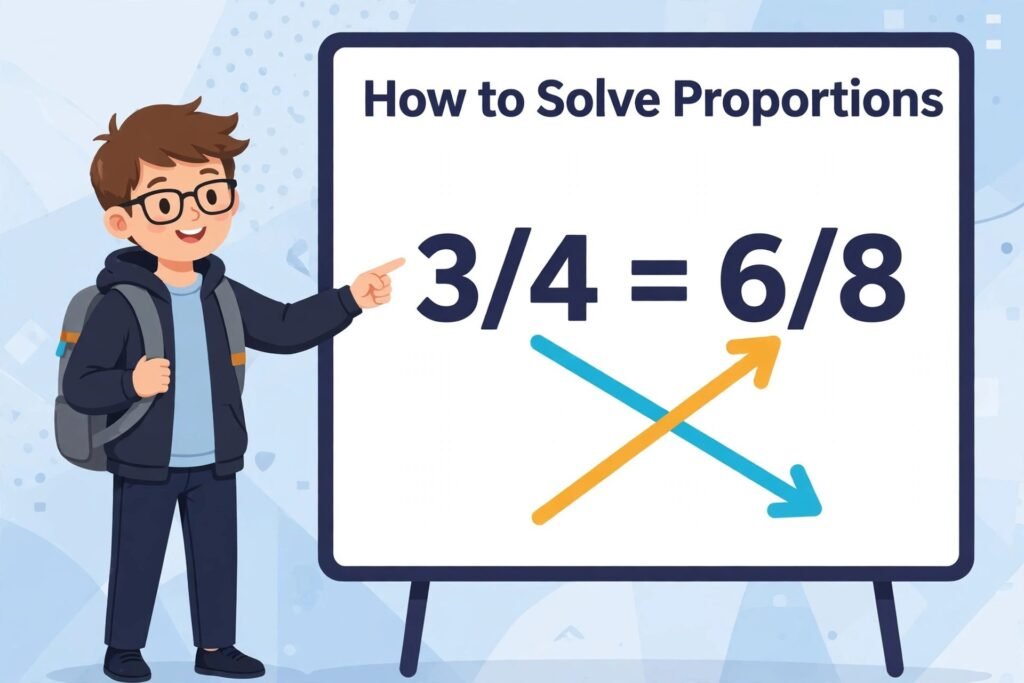
To solve a proportion, write the two equal ratios, cross-multiply, and divide to find the missing value. For example, in 3/4 = 6/x, cross-multiplication gives 3x = 24, so x = 8. The steps below show the full method, three worked examples, and the mistakes that most often cause a wrong answer.
A proportion states that two ratios are equal, so the relationship between the first pair of numbers matches the relationship between the second pair. You can check each example as you read by using the calculator on the homepage: try it in the proportion calculator with the same numbers and compare the steps it shows with the steps below.
The Cross-Multiplication Method
Cross multiplication turns a proportion into a plain multiplication equation. It works for whole numbers, decimals, and fractions, and it works no matter which position the unknown is in.
- Write the proportion with the unknown in place, keeping the same order on both sides: the first value over the second value equals the third value over the fourth value.
- Multiply the numerator on one side by the denominator on the other side, and do the same for the other pair. The two cross products are equal.
- Divide both sides by the number next to the unknown to isolate it.
- Check the answer by putting it back into the proportion and confirming that the two cross products match.
Worked Example 1: Solve 3/4 = 6/x
This is the most common homework form of a proportion problem: three numbers are known and the fourth is missing.
- Cross-multiply: 3 times x equals 4 times 6, so 3x = 24.
- Divide both sides by 3: x = 24 / 3 = 8.
- Check: 3 times 8 = 24 and 4 times 6 = 24. The cross products match, so x = 8 is correct.
You can solve it with the proportion calculator and see the same steps shown automatically.
Worked Example 2: Scale a Recipe
A recipe uses 2 cups of flour for 4 servings. How much flour is needed for 10 servings?
- Set up the proportion with servings and cups in the same order: 2 cups / 4 servings = x cups / 10 servings.
- Cross-multiply: 4x = 2 times 10 = 20.
- Divide by 4: x = 5 cups.
- Check: 2 times 10 = 20 and 4 times 5 = 20. The recipe needs 5 cups of flour for 10 servings.
Try it on the calculator: in Recipe scale mode, enter 4 servings, 10 servings, 2 cups, and flour, and confirm that the result is 5 cups.
Worked Example 3: Find a Unit Rate
Five notebooks cost $12.50. How much do 8 notebooks cost at the same unit rate?
- Set up the proportion: $12.50 / 5 notebooks = x / 8 notebooks.
- Cross-multiply: 5x = 12.50 times 8 = 100.
- Divide by 5: x = $20.00.
- Check: 12.50 times 8 = 100 and 5 times 20 = 100. Eight notebooks cost $20.00, which is $2.50 each.
Try it on the calculator: in Direct mode, enter 5, 12.50, and 8, with $ as the unit, and confirm that the answer is $20.00.
Common Mistakes to Avoid
- Multiplying straight across: multiplying the two numerators together does not solve a proportion. Always multiply diagonally, numerator by the opposite denominator.
- Mixing up the order: if cups are on top on the left, cups must be on top on the right. Keep the same units in the same positions.
- Dividing in the wrong place: finish the cross products first, then divide by the number beside the unknown.
- Rounding too early: keep the full value through the division step and round only the final answer, so a small early rounding error does not change the result.
- Skipping the check: put the answer back into the proportion. If the cross products do not match, the setup or the arithmetic has an error.
FAQ
What is the first step in solving a proportion?
Write the two ratios in the same order with the unknown in place, then cross-multiply. Keeping the same order on both sides is what makes the cross products equal.
Can the unknown be a denominator?
Yes, but the answer must not make a denominator zero. Solve the same way, then check that no denominator in the original proportion equals zero.
Do proportions work with decimals and fractions?
Yes. Cross multiplication works with whole numbers, decimals, and fractions. Keep fractions as fractions through the steps when you can, because the exact answer is easier to see.
How do I know my answer is right?
Substitute the answer into the proportion and compare the two cross products. If they are equal, the answer is correct.
With the method above, most proportion problems take four short steps: set up, cross-multiply, divide, and check. For longer homework sets, try it in the proportion calculator to verify each answer and see the steps written out.