
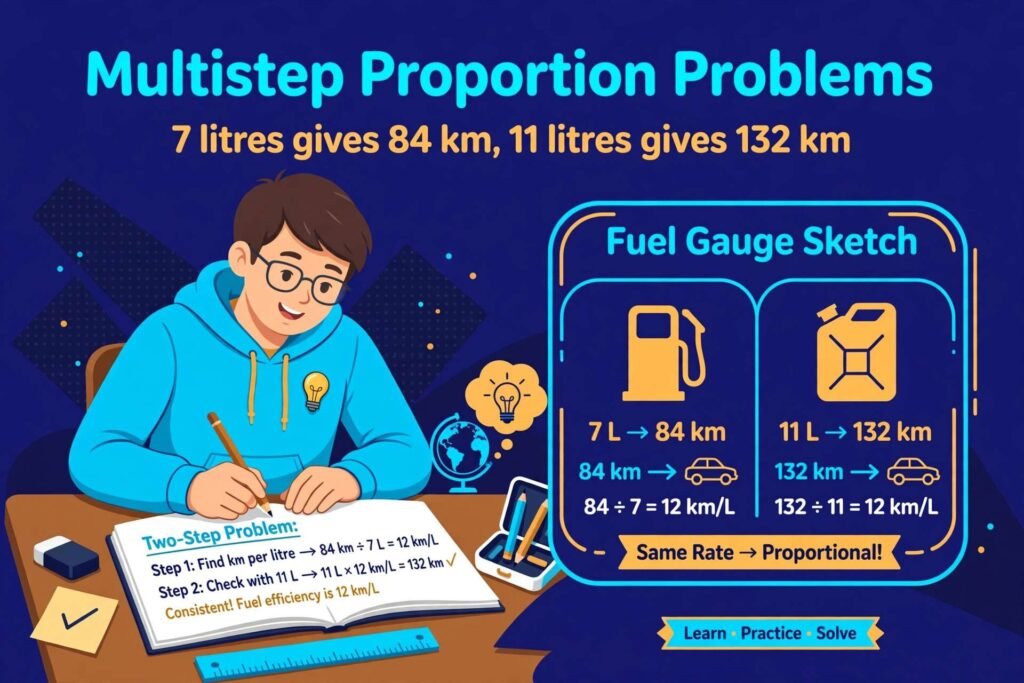
A car problem, two minutes, and a guess. Wrong, and the check says so the second it is done. Here is what was missed. The problem was not one problem. It was two.
Two jobs. One finds something that is missing. The other uses it to get the answer. That is all a multistep proportion problem is. The rest of this page is just that idea, four times, so you can spot it in a test before it spots you.
I always ask one question before I touch a calculator. Do I know the per-one value? If I know the price of one kilogram, the speed for one liter, the pears for one serving, job one is already done. Skip it. If I do not, that is job one. Find it, write it down, then move on. One line on your paper is enough. “First find the kilometers per liter.” The single step method is in the Math is Fun guide to proportions, and the single step versions of these problems are in the proportion word problems guide.
One more habit, and it costs five seconds. Before you calculate, guess. 11 liters is more than 7, so the answer has to be more than 84 km. More liters, more kilometers. If your answer comes out smaller, you already know it is wrong. A rough guess is the cheapest check there is. And the refrain for the whole page, the same words every time: rate first, then use it.
The recipe, done in three lines
Micaela’s fruit salad. 15 cups of pears, 3 cups of banana, 15 servings. She wants 5. Pears first. 15 cups across 15 servings is 1 cup per serving. Rate first, then use it. 5 servings need 5 times 1, which is 5 cups. As a proportion, 15/15 = x/5, x = 5. Banana is the same move. 3 cups across 15 servings is 0.2 cups per serving, so 5 servings need 1 cup. 3/15 = y/5, y = 1.
Try it. Same recipe, smaller numbers. 12 cups of pears, 12 servings, and Micaela wants 4 servings. One cup per serving, so 4 cups. Easy when you see the rate first, isn’t it? This one came from the site’s Search Console queries, real numbers. Try 15/15 = x/5 on the Proportion Calculator. It should say 5.
How far can 11 liters take you?
Back to the car problem. A car uses 7 liters for 84 km. How far on 11 liters? The first instinct is to jumpstraight to cross multiplication. That is the common mistake, and it looks like the right move. It is not, not yet. Rate first, then use it. 84 divided by 7 is 12 km per liter. Now the second job is easy. 11 times 12 is 132 km. Check it: 7/84 = 11/132, because 7 times 132 is 924 and 84 times 11 is 924.
Why does the trap work? Because the wrong answer looks right. Say you got 14 km per liter by mistake. 11 times 14 is 154 km. A nice round number. It feels correct. But the check gives it away. 7 times 154 is 1078, not 924. The check always points back to job one. That is where the mistake lives.
Try it. 5 liters for 60 km. How far on 9 liters? Same rate, 12 km per liter, so 9 times 12 is 108 km. Check: 5 times 108 is 540, and 60 times 9 is 540.
Money, with almost no words at all
3 kg of apples cost 9.60 dollars. What do 7.5 kg cost? Rate first, then use it. 9.60 divided by 3 is 3.20 dollars per kg. Then 7.5 times 3.20 is 24.00 dollars. Done. Two checks, if you want them. One, the proportion: 3/9.60 = 7.5/24, and 3 times 24 is 72, same as 9.60 times 7.5. Two, in your head: 7.5 kg is two and a half times 3 kg, so the price is two and a half times 9.60. That is 24.00. Same answer, twice.
Here is a trick I say out loud, every time. “Kilograms over dollars equals kilograms over dollars.” Say both ratios the same way, and you will never flip them. Try 3/9.60 = 7.5/x on the Proportion Calculator. It should say 24.
When x hides in a bracket
Sometimes x sits inside a bracket, and cross multiplication only does half the job. It clears the fractions and leaves an equation, and that equation is job two. The cross multiplication guide goes through the first move step by step. Take (3x + 2)/8 = (x + 6)/4. Cross multiply: 4 times (3x + 2) equals 8 times (x + 6), which expands to 12x + 8 equals 8x + 48. Now collect the x terms. Take 8x from both sides, then take 8 away, and you get 4x equals 40, so x equals 10. Check it: (30 + 2)/8 is 4, and (10 + 6)/4 is 4. Both sides match.
Note: you could also multiply both sides by 8 first and clear the fractions that way. Either method works fine. It is the same calculation as before. A shorter one, also from Search Console: (x + 1)/4 = 3/4. The denominators match, so multiply both sides by 4 and you get x + 1 equals 3, so x equals 2. Check: (2 + 1)/4 is 3/4. Even one-line solves deserve a check. That is where a slipped sign hides.
Two real questions, answered fast
From Search Console, 4 November, real numbers. 38/10 = 57/x. Cross multiply, 38x equals 570, so x equals 15. Check: 38 times 15 is 570, and 10 times 57 is 570. Next: 40/56 = k/7, rounding to the nearest hundredth if needed. If needed. Simplify first. 40/56 is 5/7, so k equals 5. Nothing to round. Check: 40 times 7 is 280, and 56 times 5 is 280.
The lesson there? Round only at the very end, and only if the question asks. Round in the middle and the rounded number poisons the next move.
Three traps
Trap one. Rounding in the middle. A unit rate of 3.333 dollars per kg, rounded to 3.33 before the second move, leaves the final answer a few cents out. The check fails by a little. A little failure is easy to ignore. Do not ignore it. Keep the full number until the end.
Trap two. Answering job one and stopping. You find 12 km per liter, write it down, feel done. But the question asked for the distance on 11 liters, not the rate. That line you wrote at the start, naming the first move, also names the finish line. If your answer is not it, you are not done.
Trap three. Flipped labels. In the apples problem, kilograms stay with kilograms and dollars with dollars: 3/9.60 = 7.5/24. Write the second ratio backwards, 24/7.5, and the check fails. When a check fails and the maths looks right, look at the labels first. (Say them out loud. It helps. Really.)
Try these yourself
No peeking. A printer prints 9 pages in 6 minutes. How many pages in 20 minutes? The rate is 9 divided by 6, which is 1.5 pages a minute, so in 20 minutes it prints 30 pages. Check: 9/6 = 30/20, because 9 times 20 is 180 and 6 times 30 is 180.
And solve (2x + 1)/5 = (x + 4)/3. Cross multiply: 3 times (2x + 1) equals 5 times (x + 4), which expands to 6x + 3 equals 5x + 20, so x equals 17. Check: 35/5 is 7, and 21/3 is 7. How did you do?
Questions students ask next
What makes a proportion problem multistep? It takes two moves to reach the answer. Find a rate first and use it, convert units first, or cross multiply and then solve the equation that is left. Something is always missing at the start, and job one is finding it.
How do you solve a proportion with x inside a bracket? Start with cross multiplication, then open the brackets. For (3x + 2)/8 = (x + 6)/4, that gives 12x + 8 equals 8x + 48, so x equals 10.
How do you work out the fruit salad servings problem? 15 cups of pears across 15 servings works out to 1 cup per serving. So 5 servings need 5 times 1, that is 5 cups. Written as a proportion, 15/15 = x/5, so x equals 5.
When should you round in a multistep problem? Only at the very last step. Rounding in the middle changes the answer. If it comes out exact, like k equals 5 in 40/56 = k/7, there is nothing to round.
How do you check a multistep answer? Take the answer back to the original proportion and work out each side. If they match, it is right. If not, the mistake is in the first move, so check that first.
Pick a single step problem you have already solved, add a second question to it, and solve the pair with a check after each move. Try the numbers on the Proportion Calculator, and let the check, not the calculator, tell you the answer is right.