
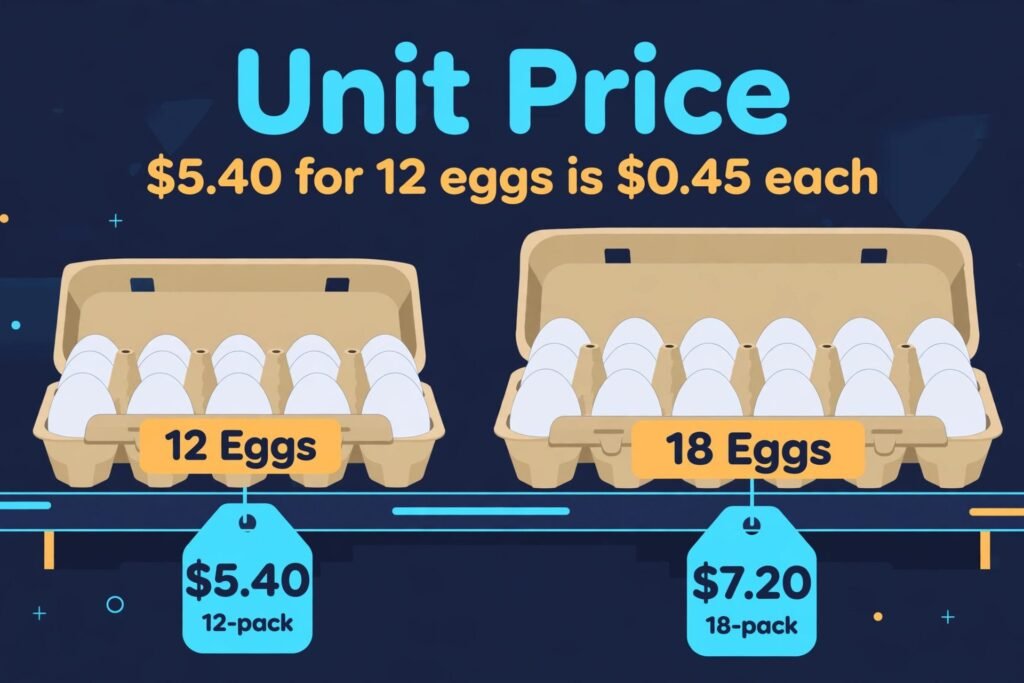
The 12-pack of eggs costs $5.40 and the 18-pack costs $7.20. Most shoppers grab the $5.40 pack because the number is smaller, and most shoppers are wrong. The 18-pack costs $0.40 per egg while the 12-pack costs $0.45, so the dearer pack is the cheaper buy. Check the small number on the shelf label before you trust the big one.
Think of unit price as the cost of one unit: one egg, one ounce, one litre, or 100 grams. One number makes any two packs compare fairly: the total price divided by the quantity. Divide the price by the quantity.
What unit price is
Shops print the unit price on the shelf label, usually in small print under the total price. NIST, the US National Institute of Standards and Technology, defines unit pricing as the cost per unit of measure, such as the cost per millilitre or per ounce, and its guide (SP 1181) sets out how those labels should look. One division turns any pack into a fair comparison, and the rest of this guide is practice.
Unit price is one kind of unit rate, and the difference matters. A unit rate covers anything per one unit, like speed in miles per hour or output in mugs per hour. Unit price is only the money case. The unit rate guide teaches the general idea, while this guide stays with money and shopping, where the numbers come from real packs.
The formula, as a proportion
One division gives the unit price: unit price = total price / quantity. For notebooks, 6 notebooks cost $7.20, so the unit price is $7.20 / 6 = $1.20 per notebook. Set it up as a proportion and the same answer appears: $7.20 / 6 notebooks = x / 1 notebook, so x = $1.20. Divide the price by the quantity.
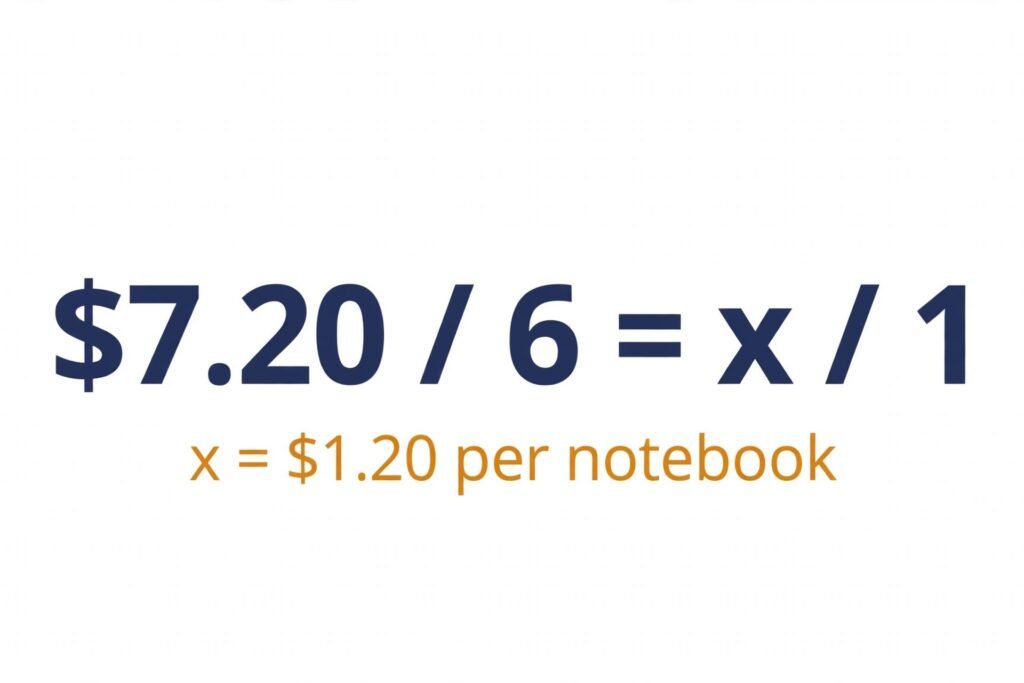
Try it: 4 notebooks cost $5.60. The unit price is $5.60 / 4 = $1.40 per notebook.
Comparing two packs, step by step
Back to the eggs. The 12-pack costs $5.40, so $5.40 / 12 = $0.45 per egg. For the 18-pack, $7.20 / 18 = $0.40 per egg. The 18-pack wins by $0.05 per egg, even though its total price is higher. Try the same numbers on the Proportion Calculator and the answers should match.
Rice works the same way. A 2 kg bag costs $6.00, so $6.00 / 2 = $3.00 per kg. The 5 kg bag costs $13.50, so $13.50 / 5 = $2.70 per kg. That wins by $0.30 per kg, which is $1.50 saved on every 5 kg you buy. Divide the price by the quantity.
The table is the whole method in four rows.
| Pack | Total price | Quantity | Unit price | Verdict |
|---|---|---|---|---|
| Eggs, 12-pack | $5.40 | 12 eggs | $0.45 each | Dearer per egg |
| Eggs, 18-pack | $7.20 | 18 eggs | $0.40 each | Cheaper per egg |
| Rice, 2 kg bag | $6.00 | 2 kg | $3.00 per kg | Dearer per kg |
| Rice, 5 kg bag | $13.50 | 5 kg | $2.70 per kg | Cheaper per kg |
Read down the unit-price column only, never the total-price column, when you compare packs.
Try it: 10 apples cost $6.00 and 15 apples cost $8.25. The unit prices are $0.60 and $0.55, so the 15-pack wins.
When the units do not match
Packs do not always use the same unit, and comparing them directly gives the wrong winner. A 1.5 litre bottle of juice costs $4.50, so $4.50 / 1.5 = $3.00 per litre. The 750 ml bottle costs $2.55. Convert first: 750 ml = 0.75 litres. Then $2.55 / 0.75 = $3.40 per litre. The bigger bottle wins, and comparing $4.50 with $2.55 directly would have picked the dearer juice.
Cheese pulls the same trick with weight. One cheese costs $3.20 per pound and another costs $0.25 per ounce. Convert first: 1 pound = 16 ounces, so $3.20 / 16 = $0.20 per ounce. The per-pound cheese is cheaper per ounce, even though $3.20 looks bigger than $0.25. Divide the price by the quantity.
Try it: 500 g of oats costs $2.50 and a 1 kg bag costs $4.60. Convert first: 1 kg = 1,000 g, so the big bag is $4.60 / 10 = $0.46 per 100 g, against $0.50 per 100 g for the small pack. The 1 kg bag wins.
Price per 100 grams
Some foods sell in grams, and the shelf label often quotes the price per 100 grams. A 400 g block of cheese costs $7.20. Per 100 g, that is $7.20 / 4 = $1.80. A 250 g block costs $5.00. Per 100 g, that is $5.00 / 2.5 = $2.00. The 400 g block wins by $0.20 per 100 g. Shops use 100 grams as the unit instead of 1 gram, because $0.018 per gram is a number nobody can picture.
Try it: 200 g of nuts costs $3.60 and 350 g costs $5.95. Per 100 g, that is $1.80 against $1.70, so the 350 g bag wins.
How much can you buy?
Unit price also answers the question backwards: how much can I buy with this money? The notebooks cost $1.20 each, and you have $12.00. Divide the money by the unit price: $12.00 / $1.20 = 10 notebooks. The proportion runs the other way too: $1.20 / 1 notebook = $12.00 / x notebooks, so x = 10. One division answers both questions, price over quantity or money over unit price. The Proportion Calculator solves the same proportion in one step.
A search query that reached this site asked which rate describes a unit price, with 2 lemons for $1.00. The unit price is $1.00 / 2 = $0.50 per lemon. As a proportion: $1.00 / 2 lemons = x / 1 lemon, so x = $0.50. That is the unit price, the cost of one lemon.
Try it: 8 apples cost $4.00. At $0.50 each, how many apples does $6.50 buy? Divide $6.50 by $0.50 to get 13 apples.
When the cheapest per unit is the wrong buy
The lowest unit price is not always the best buy. A 3 kg box of washing powder costs $9.00, which is $3.00 per kg. The 10 kg box costs $25.00, which is $2.50 per kg. It is cheaper per kg, but if the household uses 1 kg a month and the powder goes stale in 6 months, 4 kg would be wasted, so the small box is the better buy. Unit price answers cheapest per unit, not cheapest for you. Money proportions like this one are worked step by step in the proportion word problems guide.
The mistake: buying the biggest pack because the unit price is lowest, then throwing half of it away. I have watched shoppers do this with spices that went stale before they used a quarter of the jar. The unit price was a bargain and the purchase was a waste. Check the use-by date and your real usage before the unit price decides for you.
Try it: a 5 kg bag at $2.70 per kg beats a 2 kg bag at $3.00 per kg, but only if you cook through 5 kg before it goes stale.
Two quick practice problems
First, 24 oz of oats costs $4.80, so $4.80 / 24 = $0.20 per oz. A 16 oz bag costs $3.52, so $3.52 / 16 = $0.22 per oz. The 24 oz bag wins. Second, a 12 oz bottle costs $3.00 and a 20 oz bottle costs $4.60. Per ounce, that is $0.25 against $0.23, so the 20 oz bottle wins.
Key takeaways
- Unit price is the cost of one unit, found by dividing the total price by the quantity.
- Divide the price by the quantity. That one division compares any two packs fairly.
- Convert to one unit first, or the comparison picks the wrong winner.
- The lowest unit price is the cheapest per unit, not always the cheapest buy for you.
Now pick two packs from your own kitchen, work out both unit prices, and write the winner on the shopping list. Try the same numbers on the Proportion Calculator to check your division. That one habit saves real money every week.
Unit price questions, answered
What is unit price? Unit price is what one unit of something costs: one egg, one ounce, one litre, or 100 grams. It is the total price divided by the quantity, so packs of different sizes can be compared fairly.
How do you find the unit price? Divide the total price by the quantity, in one unit. For 12 eggs at $5.40, the unit price is $5.40 / 12 = $0.45 per egg. As a proportion, price / quantity = unit price / 1.
How do you compare unit prices when the units do not match? Convert to one unit first, then divide. 750 ml is 0.75 litres, and 1 pound is 16 ounces. Comparing prices in different units gives the wrong winner.
Is the lowest unit price always the best buy? No. It is the cheapest per unit, but if you cannot use it all before it goes off, the wasted part costs you more. Buy the pack you will actually finish.
How is unit price different from unit rate? Unit price is one kind of unit rate: the money kind. A unit rate can be anything per one unit, such as miles per hour or mugs per hour. Unit price is always money per one unit.
How do you work out the unit price when the price is for more than one item? Divide the total price by how many items there are. If 2 lemons cost $1.00, one lemon costs $1.00 / 2 = $0.50. The price for one item is the unit price.