
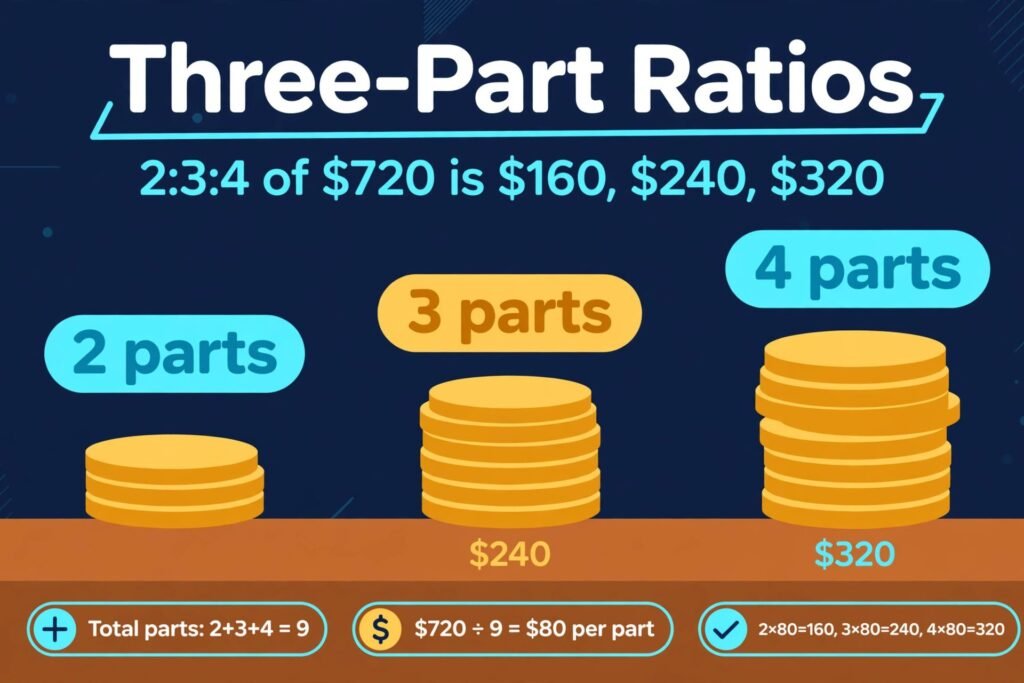
Three friends win $720 in a raffle, and they agreed beforehand to split it 2:3:4. Your share depends on which number is yours, and guessing wrong costs real money. I have watched students divide by 3 here, or hand the biggest share to the wrong person. The fix is one short method you can use on any three-part split.
A three-part ratio splits one whole into three shares, and the three numbers tell you how many parts each share gets. In 2:3:4, the shares get 2, 3 and 4 parts, which is 9 parts in total. The method never changes. Add the parts, divide, then multiply.
What a three-part ratio actually says
Read 2:3:4 as a recipe, not as three separate numbers. It says that for every 2 units the first share gets, the second gets 3 and the third gets 4. Nothing in the ratio tells you the size of one part, so the same ratio could split $90 or $9,000. The total you are splitting decides the size of one part. If that difference still feels fuzzy, the ratio vs proportion guide sorts it out.
One more thing matters before the examples. A three-part ratio compares the parts with each other, not with the whole, so the first share in 2:3:4 is 2 parts out of 9, or 2/9 of the total. I checked the method against OpenStax Prealgebra 2e, section 6.5, and the Math is Fun proportions page.
Splitting an amount in three parts
Take the raffle money, $720 split in 2:3:4. First add the parts: 2 + 3 + 4 = 9. Divide the total by that number to find one part: $720 / 9 = $80. Multiply each part of the ratio by one part: 2 x $80 = $160, 3 x $80 = $240 and 4 x $80 = $320. Add the parts, divide, then multiply. My check: $160 + $240 + $320 = $720, so the shares add back to the total exactly.
Try it: split $900 in 2:3:4. One part is $100, so the shares are $200, $300 and $400.
Paint gives the same method a different shape. A mix of 3:2:1 needs 12 litres in total. Total parts = 3 + 2 + 1 = 6, so one part is 12 / 6 = 2 litres. The shares are 3 x 2 = 6 litres of the first colour, 2 x 2 = 4 litres of the second and 1 x 2 = 2 litres of the third. Adding them back gives 6 + 4 + 2 = 12.
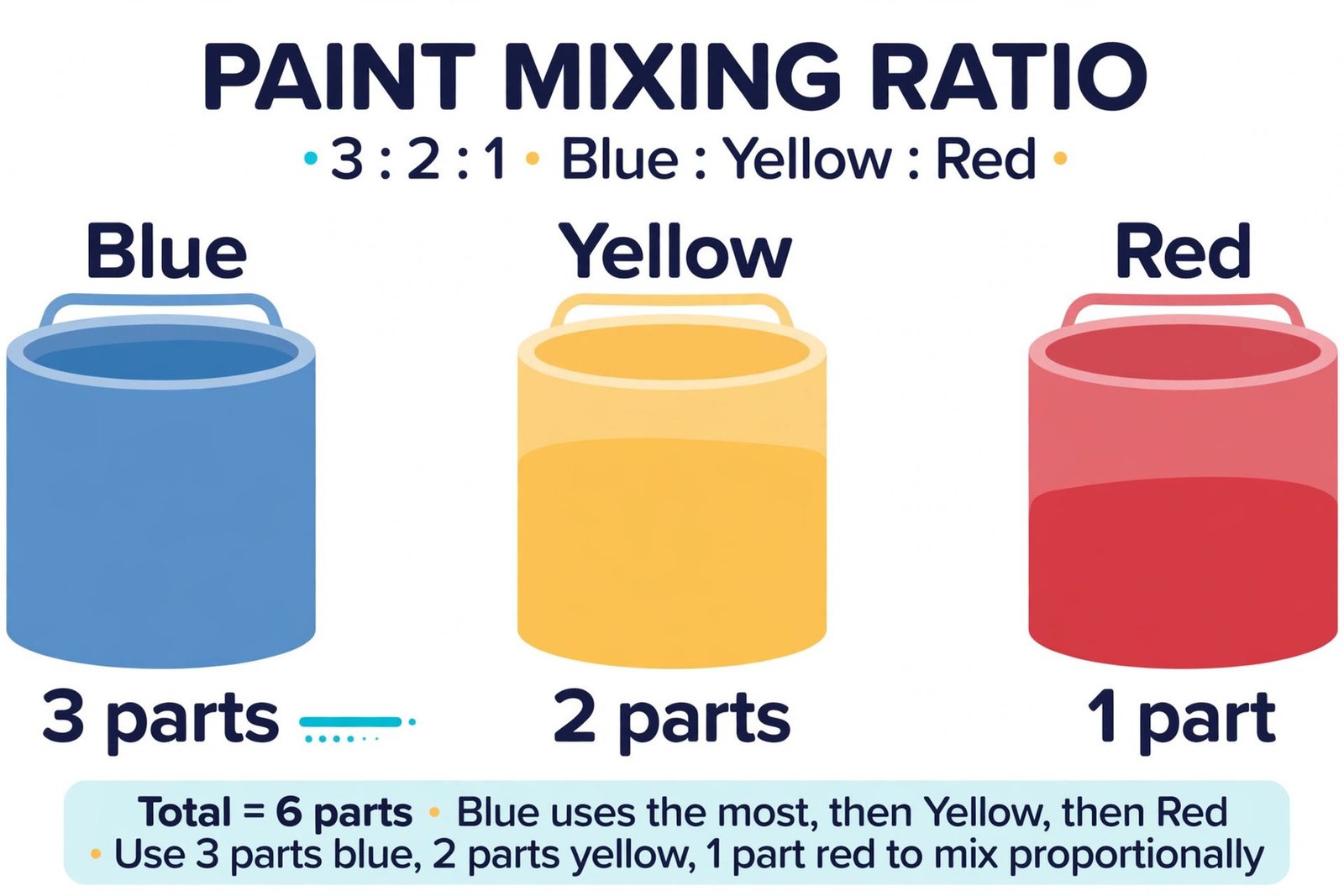
Try it: mix 18 litres in 3:2:1. One part is 3 litres, so you need 9 litres, 6 litres and 3 litres. Try the same numbers on the Proportion Calculator by solving for x in 3/6 = x/18, and the calculator should give 9.
The same split as fractions
There is a second way to work the same split, and seeing both ways agree is what makes the method stick. In 2:3:4, the shares are 2/9, 3/9 and 4/9 of the total, because the parts add to 9. Work them out: 2/9 of $720 is $160, 3/9 is $240 and 4/9 is $320. Those are the same three answers as before. One part is the total divided by 9, and a share is its fraction of the total. Add the parts, divide, then multiply.
The table shows the same split worked two ways.
| Share | One-part method | Fraction method | Answer |
|---|---|---|---|
| First share, 2 parts | $80 a part | 2/9 of $720 | $160 |
| Second share, 3 parts | $80 a part | 3/9 of $720 | $240 |
| Third share, 4 parts | $80 a part | 4/9 of $720 | $320 |
Both methods must give the same three numbers, or one of them is wrong. When they disagree, add the parts again.
Try it: write the shares of $540 in 1:2:3 as fractions of the total, then work out each share. The fractions are 1/6, 2/6 and 3/6, so the shares are $90, $180 and $270.
Simplifying three-part ratios
A three-part ratio simplifies the same way a two-part ratio does: divide all three numbers by their greatest common divisor, the largest number that divides all three. Take 12:18:30. The greatest common divisor of 12, 18 and 30 is 6, so 12 / 6 = 2, 18 / 6 = 3 and 30 / 6 = 5, which gives the simplified ratio 2:3:5. Another one: 15:25:35 has a greatest common divisor of 5, so it simplifies to 3:5:7. The simplifying ratios guide works through the two-part cases step by step.
Most guides skip this part: not every ratio simplifies. The ratio 4:6:9 has a greatest common divisor of 1, so it stays 4:6:9. If no number bigger than 1 divides all three parts, the ratio is already in its simplest form.
Try it: simplify 21:28:35. The greatest common divisor is 7, so the ratio simplifies to 3:4:5.
Joining two ratios into one
Sometimes you get two ratios and need one three-part ratio. Apples to pears is 2:3, and pears to oranges is 3:5. Pears is the quantity both ratios share, and it is 3 in both, so the three-part ratio is 2:3:5. With 100 pieces of fruit in that ratio, the total parts are 10 and one part is 10, so you get 20 apples, 30 pears and 50 oranges. Check: 20 + 30 + 50 = 100. When the shared term differs, scale one ratio until it matches, then read the three parts off in order.
Try it: join cats to dogs 4:5 with dogs to rabbits 5:2. Dogs is the shared term at 5 in both, so the three-part ratio is 4:5:2.
Working backwards from the shares
The method also runs backwards. Three partners receive $450, $600 and $750, and you want the ratio they were paid in. Divide all three shares by their greatest common divisor, which is 150: 450 / 150 = 3, 600 / 150 = 4 and 750 / 150 = 5. The ratio is 3:4:5. Check it forwards: 3 + 4 + 5 = 12 parts, and $1,800 / 12 = $150 a part. Add the parts, divide, then multiply. That check closes the loop.
Try it: three tips of $120, $180 and $240 were split in what ratio? All three divide by 60, giving 2:3:4.
The part-to-whole trap
The mistake: in the ratio 1:2:3, the first share is one half of the total. It feels right because 1 is half of 2, the next number in the ratio, but it is wrong. Six parts make the whole here, so the first share takes 1/6 of the total, the second 2/6 and the third 3/6. With $600, the shares are $100, $200 and $300, and $100 + $200 + $300 = $600. The comparison is always part to part, never part to whole.
Try it: in 2:3:5, what fraction of the total is the middle share? The parts add to 10, so the middle share is 3/10 of the total.
Two quick practice problems
Split $960 in 3:5:4. Total parts = 3 + 5 + 4 = 12, one part = $960 / 12 = $80, so the shares are $240, $400 and $320. Check: $240 + $400 + $320 = $960. Then simplify 18:24:30. The greatest common divisor is 6, so the ratio simplifies to 3:4:5.
Key takeaways
- A three-part ratio splits one whole into three shares, and one part gets its size from the total.
- Add the parts, divide, then multiply. That short method works for money, paint, fruit and any other three-part split.
- Simplify by dividing all three numbers by their greatest common divisor, and accept that some ratios, like 4:6:9, are already in simplest form.
- Two ratios join into one through the quantity they share, and shares turn back into a ratio by dividing by their greatest common divisor.
Now split a real amount three ways: a bill or a prize. Work out the shares on paper, then check them on the Proportion Calculator and make sure they add back to the total. That one check is what turns a method you read into a method you trust.
Three-part ratio questions, answered
How do you split an amount in a three-part ratio? Add the three parts together, divide the total by that number to find one part, then multiply each part of the ratio by one part. For $720 in 2:3:4, the parts add to 9, one part is $80, and the shares are $160, $240 and $320.
How do you simplify a three-part ratio? Divide all three numbers by their greatest common divisor. 12:18:30 divides by 6 to give 2:3:5. If the three numbers share no divisor bigger than 1, the ratio is already in its simplest form.
How do you join two ratios into one three-part ratio? Find the quantity the two ratios share and make it the same number in both. Apples to pears 2:3 and pears to oranges 3:5 share pears at 3, so the combined ratio is 2:3:5.
Is the first part of 1:2:3 one half of the total? No. The total has 1 + 2 + 3 = 6 parts, so the first share is 1/6 of the total, the second is 2/6 and the third is 3/6. A ratio compares parts to each other, not to the whole.
How do you find the ratio from the shares? Divide all three shares by their greatest common divisor. Shares of $450, $600 and $750 all divide by 150, giving the ratio 3:4:5.