
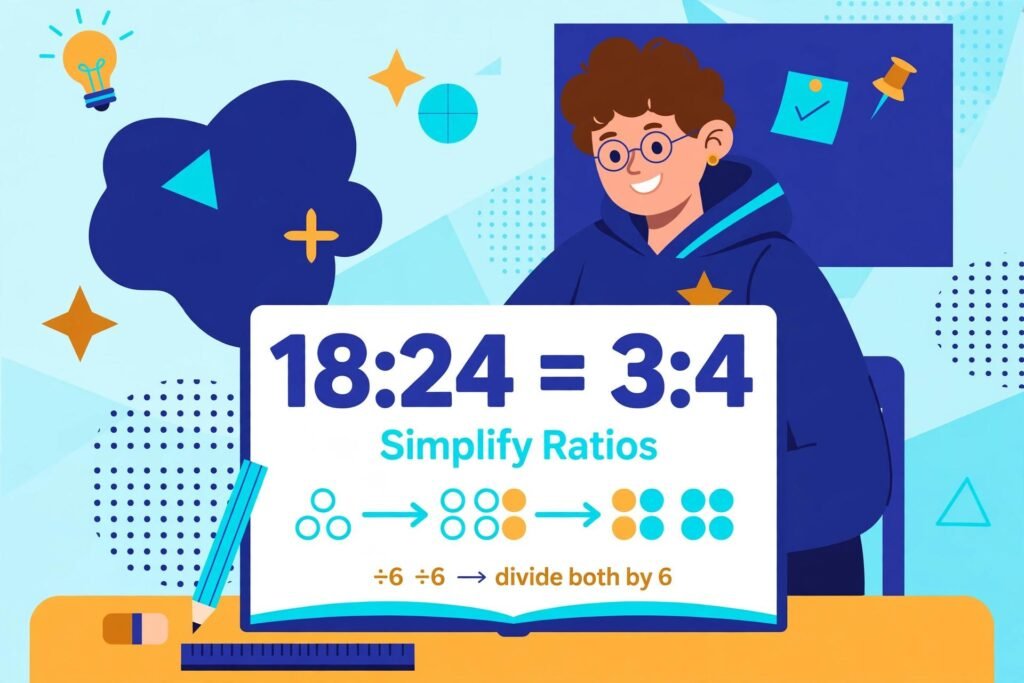
Is 9:12 the simplest form of 18:24? Divide both parts by 2 and you get 9:12. It looks done. It is not. Can 9 and 12 both divide by 3? They can. The answer is simpler than the start, but it is not simplest.
That is the whole trap on this page. Simplifying is not one division. It is dividing until nothing is left to divide out. I always get the ratio ready before I divide anything. Divide every part, every time. That one rule is the whole page.
What does simplest form actually mean?
A ratio in simplest form still compares the same two things in the same order. It just uses smaller numbers. The ratio 18:24 and the ratio 3:4 describe the same relationship, because both parts of the first ratio are six times the matching parts of the second. Nothing about the comparison changes when you divide both sides by the same number. That last point is the whole idea. Dividing only one side would change the comparison, and so would adding or subtracting the same number from both sides. Simplest form is reached when the parts are whole numbers and no number larger than 1 divides every part. At that point, there is nothing left to divide out, and you stop.
Think of it like a recipe that serves too many people. If a sauce uses 18 spoonfuls of one ingredient for every 24 spoonfuls of another, a smaller batch with 3 spoonfuls for every 4 keeps the taste exactly the same. The numbers are easier to work with, but the flavor balance is unchanged.
Get the ratio ready before you divide
Most mistakes happen before any dividing starts. A ratio can only be simplified once every part is a whole number in the same unit. If one part is in minutes and the other is in hours, or one part is a decimal and the other is a whole number, fix that mismatch first.
Same unit first. Simplify the ratio of 30 minutes to 1 hour. Convert the hour first, because 1 hour equals 60 minutes. The ratio becomes 30:60. The greatest common factor of 30 and 60 is 30, so divide both parts by 30 to get 1:2. Writing 30:1 without converting would answer a different question entirely, and that is the most common unit mistake in homework.
Your turn. 45 minutes to 2 hours. Convert first: 2 hours is 120 minutes, so the ratio is 45:120. Divide both parts by 15 to get 3:8.
Clear decimals and fractions first. To simplify 0.6:0.9, multiply both parts by 10, which clears the decimal places without changing the comparison. That gives 6:9. The greatest common factor of 6 and 9 is 3, so the simplified ratio is 2:3. You can check it by dividing back: 0.6 divided by 0.3 is 2, and 0.9 divided by 0.3 is 3. Fractions work the same way. To simplify 3/4 : 1/2, multiply both parts by 4, the denominator that clears both fractions. That gives 3:2, and 3 and 2 share no factor larger than 1, so you are done. The rule is always the same: multiply every part by the same number to reach whole numbers, then divide every part by the same factor to reach simplest form.
Try one. Simplify 0.8:1.2. Multiply both parts by 10 to get 8:12, then divide both parts by 4 to get 2:3. Check: 0.8 divided by 0.4 is 2, and 1.2 divided by 0.4 is 3.
Try one more. Simplify 2/3 : 1/6. Multiply both parts by 6 to clear the fractions. That gives 4:1, and 4 and 1 share no factor larger than 1, so you are done.
The two-step method, worked slowly
Once the parts are whole numbers in the same unit, the method has just two steps. First, find the greatest common factor of all the parts. Second, divide every part by that number. Then confirm that the new parts share no factor larger than 1. Worked example: simplify 18:24. The factors of 18 are 1, 2, 3, 6, 9, and 18. The factors of 24 are 1, 2, 3, 4, 6, 8, 12, and 24. The largest factor on both lists is 6, so 6 is the greatest common factor. Divide each part by 6: 18 divided by 6 is 3, and 24 divided by 6 is 4. The simplified ratio is 3:4. Multiply back to check: 3 times 6 is 18, and 4 times 6 is 24, so the original ratio is recovered exactly. Try those same numbers on the Proportion Calculator in Simplify mode and see whether you get 3:4. If your answer matches, you have used the method correctly. If it does not, check whether you divided both parts, and whether the number you divided by really divides both parts evenly.
Now you try. Simplify 27:36. The greatest common factor of 27 and 36 is 9, so 27:36 simplifies to 3:4. Check: 3 times 9 is 27, and 4 times 9 is 36. Divide every part, every time.
When the biggest factor hides
Listing factors works well for small numbers, but it gets slow when the numbers grow. You do not have to find the greatest common factor in one jump. Dividing in stages reaches the same answer, and it is often faster on a test because you only need a factor you can see. Worked example: simplify 84:126. Both numbers are even, so divide by 6 first: 84 divided by 6 is 14, and 126 divided by 6 is 21. That gives 14:21. Both of those numbers divide by 7, so divide again: 14 divided by 7 is 2, and 21 divided by 7 is 3. The simplified ratio is 2:3. You can confirm the shortcut was correct because 2 times 42 is 84 and 3 times 42 is 126, so the greatest common factor was 42 all along, even though you never had to spot it at the start. The only rule for staged dividing is that every stage must divide every part. Dividing one part by 6 and the other by 7 would break the comparison. Keep going until no number larger than 1 divides all the parts, and then stop. That stopping point is the test that tells you the ratio is fully simplified.
One more. Simplify 56:84 in stages. Divide both parts by 4: 56 divided by 4 is 14, and 84 divided by 4 is 21. That leaves 14:21. Both divide by 7, so 56:84 simplifies to 2:3. Check: 2 times 28 is 56 and 3 times 28 is 84, so the greatest common factor was 28.
Ratios with three parts
A three-part ratio follows the same method, with one extra caution: the divisor must divide all three parts at once. A number shared by only two parts is not enough, because dividing the third part by it would not give a whole number, or it would change the comparison. Worked example: simplify 6:9:15. The greatest common factor of 6, 9, and 15 is 3. Divide each part by 3: 6 divided by 3 is 2, 9 divided by 3 is 3, and 15 divided by 3 is 5. The simplified ratio is 2:3:5. Multiply back to check: 2 times 3 is 6, 3 times 3 is 9, and 5 times 3 is 15. Order matters here just as it does with two parts: 2:3:5 is not the same as 3:2:5, because the parts belong to different things. For a quick sense of why order matters, remember the difference between a ratio and a proportion: a ratio compares parts in a stated order, while a proportion states that two ratios are equal. Simplifying keeps the order; it never swaps the parts around.
Try it. Simplify 8:12:20. The greatest common factor of 8, 12, and 20 is 4, so 8:12:20 simplifies to 2:3:5. Check: 2 times 4 is 8, 3 times 4 is 12, and 5 times 4 is 20. Divide every part, every time.
Which way is quickest?
There are three practical routes to simplest form, and they all end at the same place, because they all divide every part by factors that the parts share. Divide by the greatest common factor in one step when the numbers are small enough that you can spot the largest shared factor. Divide in stages when the numbers are large and the largest shared factor is not obvious. List the factors when you want to be certain, or when the numbers are small and the lists are short. Choose by the size of the numbers, not by habit. Here is a trick I say out loud, every time. “Same number, every part, or the comparison breaks.” Say it before you divide, and you will never divide only one side.
Mistakes that quietly change the answer
Simplifying the units away too early is the first trap. The ratio 30 minutes to 1 hour is not 30:1, because the hour has not been turned into minutes yet. Convert first, and the answer 1:2 follows naturally. A second trap is dividing only one part, which produces a ratio that no longer matches the original amounts. A third trap is stopping early: 18:24 divided by 2 gives 9:12, which is simpler than the start but not yet simplest, because 9 and 12 still share 3. Always run the final check that no number larger than 1 divides every part. Flipping the order is a subtler trap. If a class has 18 girls and 24 boys, the ratio of girls to boys is 18:24, which simplifies to 3:4. The ratio of boys to girls is 24:18, which simplifies to 4:3. Both simplifications are correct, but they answer different questions, so write the parts in the order the question states them and keep that order through every step.
One more check links this post to the next skill in the chain. Once a ratio is simplified, you can use it to check whether two ratios form a proportion, because two ratios that simplify to the same form are equal. That check is a separate job with its own steps, and the simplified form is simply the cleanest starting point for it.
Practice, with answers to confirm
Try these two before you read the answers. First, simplify 45:60. Second, simplify 2.4:3.6. For the first, the greatest common factor of 45 and 60 is 15, so dividing both parts by 15 gives 3:4. For the second, multiply both parts by 10 to clear the decimals, which gives 24:36, and dividing both parts by 12 gives 2:3. If you got both, the method is working. If the second one tripped you up, go back to the decimals section and clear the decimal places before you look for a factor. For a money example in US units, suppose a pack deal costs $12 for 8 pens and another costs $18 for 12 pens. Simplify 12:8 by dividing both parts by 4 to get 3:2, and simplify 18:12 by dividing both parts by 6 to get 3:2 as well. The two deals match in price per pen, which is exactly the kind of comparison a simplified ratio is meant to make easy.
Questions students ask next
What does it mean for a ratio to be in simplest form? It means the parts are whole numbers that share no divisor larger than 1, while still describing the same comparison in the same order as the original ratio.
Can I simplify a ratio when the parts use different units? Not until you convert them. Change every part to the same unit first, for example turning 1 hour into 60 minutes, and only then look for a common factor.
What if the greatest common factor is 1? Then the ratio is already as simple as it can get. The ratio 7:11 is one such case, because 7 and 11 share no whole-number divisor above 1, so dividing further would only introduce fractions and change the form.
Do I have to find the greatest common factor in one step? No. Dividing by any factor shared by every part, then repeating until nothing larger than 1 is shared, reaches the same final ratio as a single division by the greatest common factor.
Try it on the calculator
The check is built into the method. After dividing 84 and 126 by 42, the parts are 2 and 3, and 2 and 3 share no factor larger than 1, so 2:3 is the smallest form. When the parts still share a factor, divide again, and when they share nothing larger than 1, the ratio is finished.