
A class has 12 boys and 16 girls. What is the ratio of boys to girls? Write 12/28 and the answer is marked wrong. Both numbers were in the problem. The wrong one was used.
That is the whole confusion on this page. A ratio and a proportion look alike, and one wrong number turns a right idea into a wrong answer. I always ask one question before I touch a calculator. Am I looking at one ratio or two? Count the ratios. That one question is the whole page.
One class, two questions
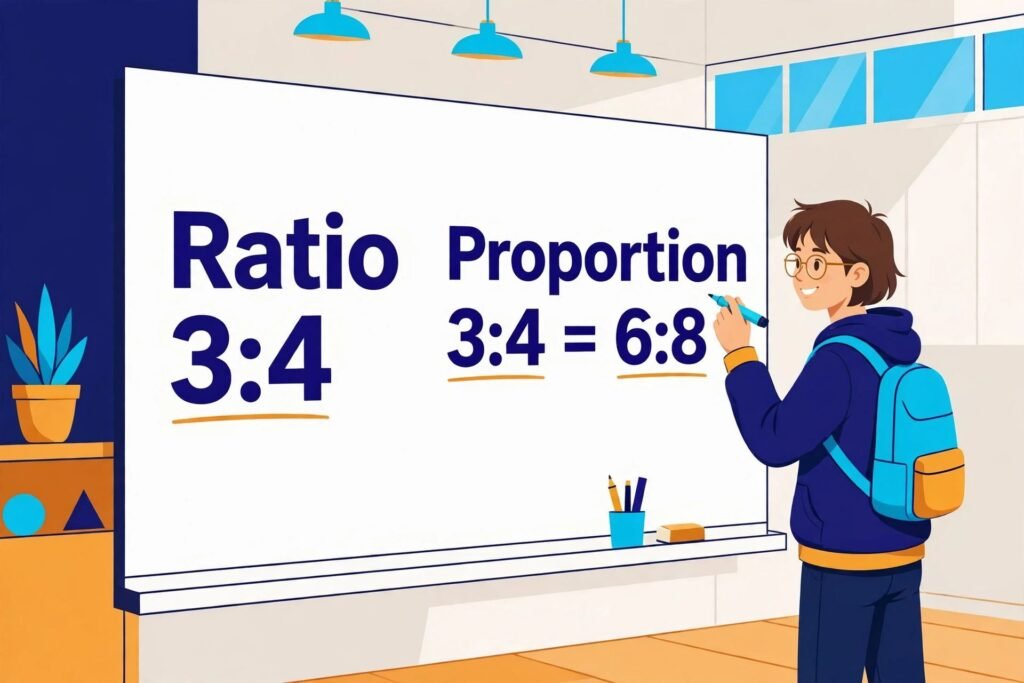
Picture a class with 12 boys and 16 girls. Those two numbers can answer two different questions. First, compare the boys with the girls. That comparison is a ratio: 12:16. Divide both parts by their greatest common factor, 4, and it simplifies to 3:4. Read it as “3 to 4.” For every 3 boys, there are 4 girls. Nothing is set equal to anything else. It is one comparison, standing alone.
Second, compare the boys with everyone in the class. There are 12 + 16 = 28 students in all. The boys make up 12 out of 28, which simplifies to 3:7 after dividing by 4. This is a part-to-whole comparison. The second number is the total, not the other part. Count the ratios. The ratio 3:4 compares one part with another part. The ratio 3:7 compares one part with the whole class. Mixing those two up is the most common source of wrong answers on this topic, because both ratios are correct for their own question and wrong for the other one. Before you simplify or solve, stop and name the question: part against part, or part against whole?
Your turn. A class has 15 boys and 20 girls. Boys to girls is 15:20, which is 3:4 after dividing by 5. Boys out of the whole class is 15 out of 35, which is 3:7 after dividing by 5. Same pattern, different question.
What does a ratio actually say?
A ratio tells you how two quantities stand in relation to each other. It does not tell you how many of each quantity you actually have. A ratio of 3:4 could describe 3 boys and 4 girls, or 6 boys and 8 girls, or 30 boys and 40 girls. The counts change. The relationship does not. You can write the same ratio in three forms: the colon form 3:4, the fraction form 3/4, and the word form “3 to 4.” In school problems, all three mean the same comparison, as long as the order stays the same. The order is the meaning. A ratio of 3:2 is not the same as a ratio of 2:3, just as “3 boys to 2 girls” is not the same class as “2 boys to 3 girls.”
To simplify a ratio, divide both parts by the same number, usually the greatest common factor. Take 10 apples and 15 oranges. The ratio is 10:15. Divide both parts by 5 and you get 2:3. Scaling works the same way in reverse. A recipe with flour and sugar in the ratio 2:1 keeps that relationship when you double it: 4:2 simplifies back to 2:1. If you doubled only the flour, you would have a different recipe, and a different ratio. Ratios are not limited to two parts. A paint mix of 3:2:1 is still one ratio, with three parts. It is not a proportion, because no second ratio has been set equal to it. Count the ratios. One comparison is one ratio, no matter how many parts it has.
Try one. 8 apples and 12 oranges. The ratio is 8:12. Divide both parts by 4 and you get 2:3.
When does it become a proportion?
A proportion is born the moment you place an equals sign between two ratios. The statement 3/4 = 6/8 claims that two different-looking comparisons describe the same relationship. Both reduce to the same simplest form, so the claim is true. Cross-multiplication gives you a fast way to test that claim without simplifying first. For 3/4 = 6/8, multiply diagonally: 3 times 8 is 24, and 4 times 6 is 24. The two cross products match, so the ratios form a proportion. If the cross products differ, the ratios do not form a proportion, no matter how similar they look.
Here is that check with a second pair. Do the ratios 4:6 and 10:15 form a proportion? Write them as fractions, 4/6 and 10/15, and cross-multiply: 4 times 15 is 60, and 6 times 10 is 60. The products are equal, so 4:6 = 10:15 is a true proportion. You could also see it by simplifying: 4:6 reduces to 2:3, and 10:15 reduces to 2:3 as well. A proportion can also find a missing value. If you know three of the four numbers, cross-multiplication turns the proportion into a simple equation. That is the step students use most often in word problems.
Now you try. Do 5/10 and 8/16 form a proportion? Cross-multiply: 5 times 16 is 80, and 10 times 8 is 80. The products match, so yes. Both simplify to 1/2.
The pair that fools everyone
Most textbook pages show only proportions that turn out to be true. That habit hides the skill students need most: recognizing a pair that looks proportional but is not. Do 3/4 and 6/9 form a proportion? Cross-multiply and show both products. First, 3 times 9 is 27. Second, 4 times 6 is 24. The products are 27 and 24, and 27 does not equal 24. The ratios do not form a proportion. Simplifying confirms it: 6:9 reduces to 2:3, while 3:4 is already in simplest form. They describe different relationships.
Here is the trap. Both ratios grew in the same direction. 3 grew to 6, but 4 grew to 9, and doubling one side while growing the other by a different factor breaks the equality. Do not trust a pair just because both ratios grew. Try those same numbers on the Proportion Calculator in Check mode and compare its answer with the two cross products above, 27 and 24. Seeing FALSE beside your own arithmetic makes the rule stick: equal cross products mean a proportion, unequal cross products mean no proportion.
Two meanings of one word
Here is a genuine source of confusion that many guides skip. In everyday English, people often use “proportion” to mean a share of a whole. You might read that “a large proportion of the class passed the test.” In that sentence, proportion means a part-to-whole fraction, such as 3 out of 10. No equals sign appears, and no second ratio is involved. In school proportion problems, the word has a stricter meaning. A proportion is an equation of two equal ratios, such as 3/4 = 6/8. This guide uses the school meaning whenever it says “proportion,” because that is the meaning your homework, tests, and calculator modes use.
Keep the two uses apart with a simple test. If you can point to an equals sign between two ratios, you have a proportion in the school sense. If you only have one share of a whole, such as 3 purple boxes out of 10 boxes, you have a part-to-whole fraction, 3/10. You can turn that share into a proportion equation only by setting it equal to a second ratio, for example 3/10 = 6/20. Until that second ratio appears, the share alone is not a proportion equation.
Three traps that make smart students slip
One, reading the ratio backward. Order carries the whole meaning of a ratio. If a problem says the ratio of red marbles to blue marbles is 3:2, then the first number always belongs to red and the second always belongs to blue. Swapping them gives 2:3, a different class, a different mixture, and a different answer. When you set up a proportion, keep the same order on both sides: red over blue on the left, red over blue on the right. Here is a trick I say out loud, every time. “Red over blue equals red over blue.” Say both ratios the same way, and you will never flip them.
Two, treating a ratio fraction like a share of the whole. A ratio written as a fraction can be greater than 1, and that is perfectly fine. The ratio 3:2 written as 3/2 equals 1.5. That number describes a comparison, not a share. The share of the whole is different: with 3 parts and 2 parts, there are 5 parts in total, so the first part is 3/5 of the whole. Students who answer 3/2 when the question asks for the share of the whole have used the right numbers in the wrong comparison. Ask first whether the denominator should be the other part or the total.
Three, simplifying decimals and three-part ratios the wrong way. The ratio 1.5:2.5 looks awkward, so clear the decimals by multiplying both parts by 2. That gives 3:5, which is already in simplest form. As a check, 1.5 divided by 2.5 is 0.6, and 3 divided by 5 is 0.6. The value did not change; only the form did. Three-part ratios need the opposite reminder: do not split them into a proportion. A paint mix of 3:2:1 is one ratio with three parts. It becomes part of a proportion only when you set it equal to another three-part ratio, such as 3:2:1 = 6:4:2. Check that second statement by simplifying: 6:4:2 divides by 2 to give 3:2:1, so the equality holds.
Which button do I press?
Students often know the numbers but not the next step. Match the question to the job, and the method follows. If you have one ratio and want its simplest form, simplify it. If you have two ratios and want to know whether they are equal, check them. If you have three numbers in a proportion and one missing value, solve for it. Try that matching with a money problem. Suppose 5 pounds of apples cost $7.50. How much do 8 pounds cost at the same price per pound? Set up the proportion with pounds over dollars on both sides: 5/7.50 = 8/x, where x is the unknown cost. Cross-multiply: 5 times x equals 7.50 times 8, so 5x = 60. Divide both sides by 5, and x = 12. Eight pounds cost $12. The unit price check agrees: $7.50 divided by 5 is $1.50 per pound, and 8 times $1.50 is $12. Run the same setup through the Proportion Calculator in Solve mode with 5, 7.50, and 8, and confirm that it returns 12 before you move on. That confirmation is worth more than speed. If the calculator returns a different number, the setup is the first place to look, usually the order of the numbers on one side.
Try it. 4 pounds of apples cost $6. How much for 10 pounds? The unit price is $1.50 per pound, so 10 times 1.50 is $15. Check: 4/6 = 10/x, so 4x = 60, x = 15. More pounds, more money.
Once you can tell a ratio from a proportion, the next question is what kind of relationship the proportion describes. Some proportions grow together, while others move in opposite directions. The guide Direct vs Inverse Proportion Explained works through that difference with its own examples, so read it when a problem asks what happens to one quantity while another quantity changes.
Three questions before you calculate
Use these three questions in order, and write your answer to each one before you calculate. The habit takes seconds, and it prevents most setup errors. How many ratios do I have? One ratio means a comparison to simplify or read. Two ratios, or one ratio and a missing value, mean a proportion to check or solve. What is being compared with what? Name the order out loud, such as “pounds to dollars,” and keep that order on both sides of the equals sign. Does my answer keep the relationship? Simplify the result, cross-multiply as a check, or compare the unit price. If the check fails, fix the setup before you trust the answer.
That routine also protects you against the most tempting shortcut: assuming two ratios are proportional because the numbers both increased. Growth alone proves nothing. Only equal cross products, or equal simplified forms, prove that two ratios form a proportion. Count the ratios. Then check them.
Questions students ask next
What is the difference between a ratio and a proportion? A ratio compares two quantities, such as 3:4. A proportion states that two ratios are equal, such as 3/4 = 6/8.
Can one ratio be a proportion by itself? No. A single ratio is only a comparison. It becomes part of a proportion when it is set equal to a second ratio.
How do you check if two ratios form a proportion? Cross-multiply. If the two cross products are equal, the ratios form a proportion; if they differ, they do not. For example, 3/4 and 6/9 do not form a proportion because 27 does not equal 24.
Is the ratio 3:2 the same as the fraction 3/2? Written as a comparison, yes: 3:2 can be written as 3/2. But the part-to-whole fraction is different: 3 parts out of 5 total is 3/5. Keep the order in mind, because 3:2 is not 2:3.
Try the difference yourself. For 3/4 and 6/8, both cross products are 24, so the pairs match and form a proportion. For 3/4 and 6/9, the cross products are 27 and 24, so the pairs do not match. A ratio compares two numbers, and a proportion states that two ratios are equal, and the cross products are what tell the two cases apart.
Pingback: Proportion Word Problems: Recipes, Maps and Money