
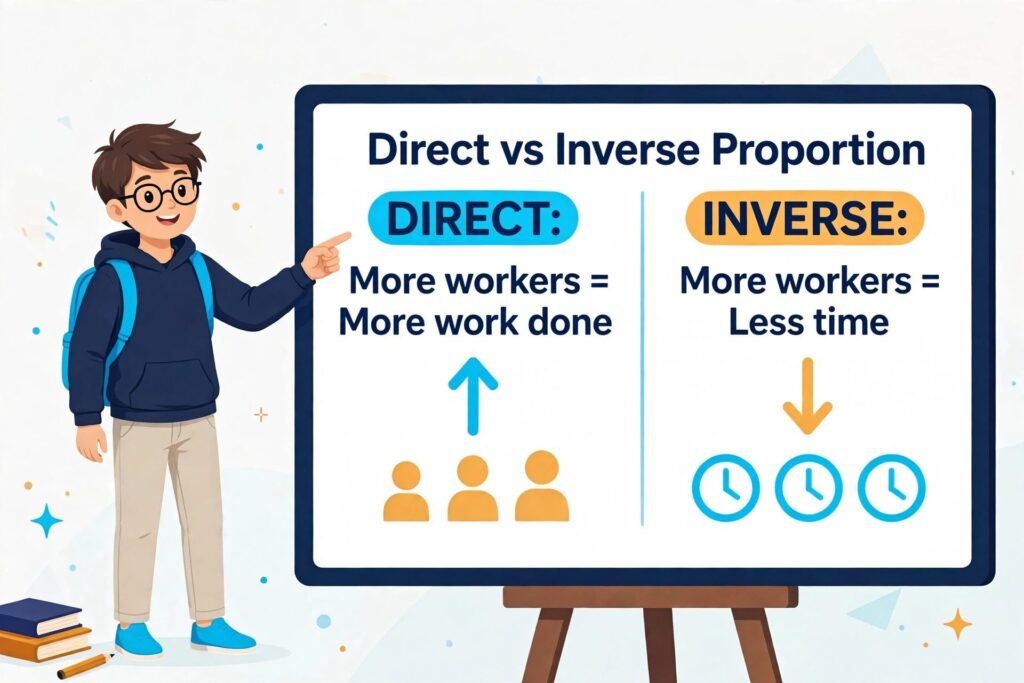
Four workers take 6 days to paint a fence. How long for 8 workers? Set it up the usual way, 4/6 = 8/x, cross-multiply, and x is 12 days. More workers, more days. That cannot be right. More workers should mean less time, not more.
That is the whole trap of this page. Direct and inverse proportion look the same on the surface, two numbers and a missing one, and the setup decides everything. I always ask one question before I touch a calculator. What stays the same? If the ratio stays the same, it is direct. If the product stays the same, it is inverse. Ask what stays the same. That one question is the whole page.
What is direct proportion?
Direct proportion means two quantities change in the same direction and by the same factor. Double one and the other doubles. Cut one in half and the other is cut in half too. The ratio between them does not change. Ask what stays the same. Here, the ratio stays the same.
Buying notebooks at a fixed price is the clearest case. One notebook costs $4, two cost $8, and five cost $20. More notebooks, more money. The formula is y = kx. Here x and y are the two quantities, and k is the constant of proportionality, how much y changes for each unit of x. In the notebook example k is $4 per notebook, because the total cost is always 4 times the number of notebooks. You can also write it as a ratio: y divided by x equals k. Divide the second quantity by the first in each pair. If you get the same answer every time, the relationship is directly proportional.
| Notebooks | Total cost | Cost divided by notebooks |
|---|---|---|
| 1 | $4 | $4 |
| 2 | $8 | $4 |
| 3 | $12 | $4 |
| 5 | $20 | $4 |
Every row gives the same result, $4. That is the signature of direct proportion: a constant ratio. On a graph it makes a straight line through the origin, the point (0, 0). Zero notebooks cost $0, and zero hours of driving at a steady speed cover zero miles. Direct proportion shows up in many school problems: the distance traveled at a steady speed, the cost of identical items, the paint needed for a wall, the servings in a recipe that is scaled up. When the question says “at the same rate,” it is usually pointing you toward direct proportion.
What is inverse proportion?
Inverse proportion, sometimes called indirect proportion, works the other way around. When one quantity increases, the other decreases by the same factor. The two quantities move in opposite directions, but their product stays constant. Ask what stays the same. Here, the product stays the same.
Think about workers finishing a job. If 4 workers take 6 days to paint a fence, 8 workers working at the same pace should take about 3 days. More workers, less time, because the total amount of work has not changed. The formula is x times y equals k. Or, written another way: y equals k divided by x. Here k is again a constant, but this time it is the product of the two quantities, not their ratio. Multiply each pair of values together. If every pair gives the same product, the relationship is inversely proportional.
| Workers | Days | Workers times days |
|---|---|---|
| 2 | 12 | 24 |
| 4 | 6 | 24 |
| 6 | 4 | 24 |
| 8 | 3 | 24 |
Every row multiplies to 24 worker-days. That constant product is the total work. Doubling the workers halves the time. Tripling the workers cuts the time to one-third. The pattern is exact only when the rate stays the same, which is why homework problems usually add a phrase such as “working at the same rate.” Speed and travel time give another clear example. For a fixed distance, driving faster means arriving sooner. If you drive 60 miles per hour for 3 hours, you cover 180 miles. At 90 miles per hour, the same 180 miles take only 2 hours. On a graph, inverse proportion does not make a straight line. It makes a curve that gets closer and closer to the axes without touching them. You do not need the graph for most homework, but it is a useful picture: as one value grows very large, the other gets very small.
Side by side
| Direct proportion | Inverse proportion | |
|---|---|---|
| Direction of change | Both quantities increase or decrease together | One increases while the other decreases |
| What stays constant | The ratio: y divided by x equals k | The product: x times y equals k |
| Formula | y = kx | y = k divided by x |
| Doubling one value | The other value doubles | The other value halves |
| Graph shape | Straight line through (0, 0) | Curve that approaches the axes |
| Everyday example | Cost of identical notebooks | Workers needed to finish a job in less time |
The most important row is the second one. Ask what stays the same. If the ratio stays the same, use direct proportion. If the product stays the same, use inverse proportion. That one question prevents most mistakes, because it forces you to test the numbers instead of guessing from the story alone.
How do you tell them apart?
Use this short method whenever a word problem does not tell you which type it is. First, spot the two quantities and the fixed condition. Name the two quantities, such as workers and days, or speed and time. Then find what is held fixed: the total work, the total distance, the price per item, or the speed. Second, test what happens when one quantity doubles. If the second should also double, the relationship is direct. If the second should halve, the relationship is inverse. If neither happens in a clean way, the relationship may not be a proportion at all. Third, check with numbers. For direct proportion, divide the paired values and look for a constant ratio. For inverse proportion, multiply the paired values and look for a constant product.
Try the doubling test on a simple shopping question. If 3 pounds of apples cost $6, doubling the apples to 6 pounds should double the cost to $12. That is direct. Now try it on a travel question. If a trip takes 4 hours at 50 miles per hour, doubling the speed to 100 miles per hour should halve the time to 2 hours for the same distance. That is inverse. The story changes, but the test stays the same. For a quick check while you work, you can use the free proportion calculator to confirm a direct proportion answer before you write it down. Use it as a check, not as a replacement for showing your steps, because your teacher will want to see the method.
Worked examples
Example 1: Direct proportion with cost
Three notebooks cost $12. How much do 7 notebooks cost at the same price? First, find the unit price. Divide $12 by 3 notebooks to get $4 per notebook. Then multiply the unit price by the new quantity: $4 times 7 is $28. Then check with a proportion. Set up 3/12 = 7/x. Cross-multiply: 3x = 84, so x = 28. The answer is $28. Does it make sense? 7 is more than double 3, so the cost should be more than double $12, and $28 is. Ask what stays the same. The ratio, $4 per notebook, stayed the same.
Try it. 4 notebooks cost $16. How much for 9 notebooks? The unit price is $4, so 9 times 4 is $36. Check: 4/16 = 9/x, so 4x = 144, x = 36. More notebooks, more money.
Example 2: Direct proportion with distance and time
A car travels 120 miles in 2 hours at a steady speed. How far will it travel in 5 hours at the same speed? First, find the speed. Divide 120 miles by 2 hours to get 60 miles per hour. Then multiply the speed by the new time: 60 times 5 is 300 miles. Then check with a proportion: 120/2 = x/5. Cross-multiply: 2x = 600, so x = 300. The car travels 300 miles. Does it make sense? 5 hours is two and a half times 2 hours, and 300 miles is two and a half times 120 miles. The ratio stayed constant, which is exactly what direct proportion requires.
Try it. A car travels 90 miles in 3 hours. How far in 4 hours at the same speed? The speed is 30 miles per hour, so 4 times 30 is 120 miles. Check: 90/3 = x/4, so 3x = 360, x = 120.
Example 3: Inverse proportion with workers and time
Four workers can paint a fence in 6 days, working at the same rate. How long will it take 8 workers to paint the same fence? First, find the constant product, the total work. Multiply 4 workers times 6 days to get 24 worker-days. Then divide the total work by the new number of workers: 24 divided by 8 is 3 days. Then check the logic. Doubling the workers from 4 to 8 should halve the time from 6 days to 3 days. It does, so the answer fits the inverse pattern. Ask what stays the same. The total work, 24 worker-days, stayed the same.
Here is the trap from the top of this page. Do not cross-multiply this problem in the same way as a direct proportion. If you set up 4/6 = 8/x, you would get 12 days, which is longer with more workers. That cannot be right. For inverse proportion, keep the product equal: 4 times 6 equals 8 times x, so x = 3.
Try it. 6 workers take 8 days to finish a job. How long for 12 workers? The total work is 6 times 8, which is 48 worker-days. Divide by 12: 48 divided by 12 is 4 days. Doubling the workers halved the time, from 8 days to 4. More workers, less time.
Example 4: Inverse proportion with speed and time
A bus travels at 60 miles per hour and takes 3 hours to reach a town. How long will the same trip take at 90 miles per hour? First, find the distance, which is the constant product. Multiply 60 times 3 to get 180 miles. Then divide the distance by the new speed: 180 divided by 90 is 2 hours. Then check the logic. The speed went up, so the time must go down. Two hours is less than 3 hours, and the product is still 90 times 2, which is 180. The answer is 2 hours. Notice that the distance never changed. Whenever a problem fixes the total distance, total work, or total amount in some way, that fixed total is often the constant product in an inverse proportion.
Try it. A car travels at 40 miles per hour and takes 5 hours. How long at 50 miles per hour? The distance is 40 times 5, which is 200 miles. Divide by 50: 200 divided by 50 is 4 hours. Check: 50 times 4 is 200.
After you finish an example by hand, you can check a direct proportion result with the proportion calculator on the homepage. For inverse problems, use the Inverse mode on the same calculator, which checks the product for you, and still write out the product step shown above in your own work.
What goes wrong most often?
Most errors come from rushing the setup, not from hard arithmetic. One, assuming every increase is direct. Not every relationship in which one number goes up is a direct proportion. More workers finishing a job faster is the classic counterexample. Always run the doubling test before you choose a method.
Two, cross-multiplying an inverse problem as if it were direct. Cross-multiplication works for equal ratios in direct proportion. In an inverse problem, the correct equality is between products, not ratios. If you cross-multiply without flipping one ratio, you will often get an answer that moves in the wrong direction.
Three, mixing units. Keep the units consistent in each pair. Do not compare miles in one pair with feet in another, or hours with minutes, unless you convert first. A unit mistake can make a correct method give a wrong answer.
Four, forgetting the “same rate” condition. Direct and inverse proportion problems assume the rate, price, or pace stays the same. If workers get tired, a car hits traffic, or a store changes its price, the simple proportion no longer applies. In homework, that condition is usually stated, so read the question twice and underline it.
Five, skipping the reasonableness check. A one-line check catches most setup errors. If more workers give you more days, or a higher speed gives you more time for the same trip, stop and rework the problem. The answer should make sense in the story, not just in the arithmetic.
When it is not a proportion at all
Not every pair of quantities that change together is a proportion. A proportion needs a constant ratio or a constant product. If neither stays constant, the method in this guide does not apply. Ask what stays the same. If nothing stays the same, it is not a proportion.
Try a fraction case first. One-half pound of apples costs $1.50. How much do 2 1/2 pounds cost at the same unit price? Divide $1.50 by 1/2 to get $3.00 per pound, then multiply 2.5 times $3.00 to get $7.50. Check the ratio: $1.50 divided by 0.5 is $3.00 and $7.50 divided by 2.5 is $3.00, so the ratio stays constant and the answer is $7.50.
Now try a starting-charge case. A taxi charges a $3 base fare plus $2 per mile. One mile costs $5, two miles cost $7, and three miles cost $9. Each extra mile always adds $2, but the ratios are not constant: $5 divided by 1 is $5, $7 divided by 2 is $3.50, and $9 divided by 3 is $3. The products are not constant either. This is not a proportion, because the $3 base fare means zero miles would still show a $3 charge on the same pattern, so the line does not pass through (0, 0).
A child’s height is another non-proportion trap. A child who is 42 inches tall at age 5 and 55 inches tall at age 10 has grown, but doubling the age does not double the height to 84 inches. The ratios 42 divided by 5 is 8.4 and 55 divided by 10 is 5.5 are different, so age and height are not directly proportional. Always test the ratio or the product before you choose a method.
In everyday life
These ideas are not only for tests. Grocery shopping is full of direct proportion: the total price rises in step with the weight or the number of items, as long as the unit price is fixed. A recipe is the same. Doubling a recipe doubles each ingredient. Inverse proportion appears whenever a fixed total is shared or completed faster. Splitting a $120 bill among more people lowers each person’s share. Filling a tank with a faster hose takes less time. Maps and scale drawings also rely on proportion, usually the direct kind. If 1 inch on a map stands for 10 miles, 3 inches stand for 30 miles. Money problems mix both kinds: earning at a fixed hourly wage is direct, while finishing a fixed job with more helpers is inverse. Learning to spot which kind you are looking at is the real skill, and it gets faster with practice.
Try these yourself
Try these three quick questions on paper, then check your answers with the steps above. If 5 pens cost $15, how much do 9 pens cost at the same price? Direct: $3 per pen, so $27. If 3 machines take 8 hours to complete a job, how long will 6 machines take at the same rate? Inverse: 3 times 8 is 24 machine-hours, so 24 divided by 6 is 4 hours. A cyclist rides 45 miles in 3 hours at a steady pace. How far will the cyclist ride in 7 hours? Direct: 15 miles per hour, so 105 miles. If any answer feels wrong, go back to the doubling test and the constant check. Finding the mistake in your own setup is often more useful than getting the right answer the first time.
The short version
Direct proportion keeps the ratio constant: both quantities move together by the same factor. Inverse proportion keeps the product constant: one quantity rises while the other falls by the same factor. Decide which pattern fits by doubling one value, testing the ratio or the product, and checking that the answer makes sense in the story. Once that decision is clear, the arithmetic is usually simple, and the method works for cost, distance, work, recipes, and many other everyday problems. If you want to double-check a direct proportion, try the proportion calculator and compare its result with your own steps.
Questions students ask next
What is the difference between direct and inverse proportion? Direct proportion means both quantities increase or decrease together by the same factor, so their ratio stays constant. Inverse proportion means one quantity increases while the other decreases by the same factor, so their product stays constant.
What is an example of direct proportion? Buying identical notebooks is a direct proportion example. If one notebook costs $4, two cost $8 and five cost $20, because the total cost rises at the same rate as the number of notebooks.
What is an example of inverse proportion? Workers finishing a fixed job is an inverse proportion example. If 4 workers take 6 days, 8 workers take 3 days at the same rate, because more workers mean less time for the same total work.
How do you know if a problem is direct or inverse proportion? Double one quantity and ask what should happen to the other. If the other should double, the problem is direct. If the other should halve, the problem is inverse. Then confirm it by checking for a constant ratio or a constant product.
What is the formula for direct and inverse proportion? The direct proportion formula is y = kx, where k is the constant ratio. The inverse proportion formula is x times y equals k, or y equals k divided by x, where k is the constant product.
Pingback: Ratio vs Proportion Explained With Examples and Checks