
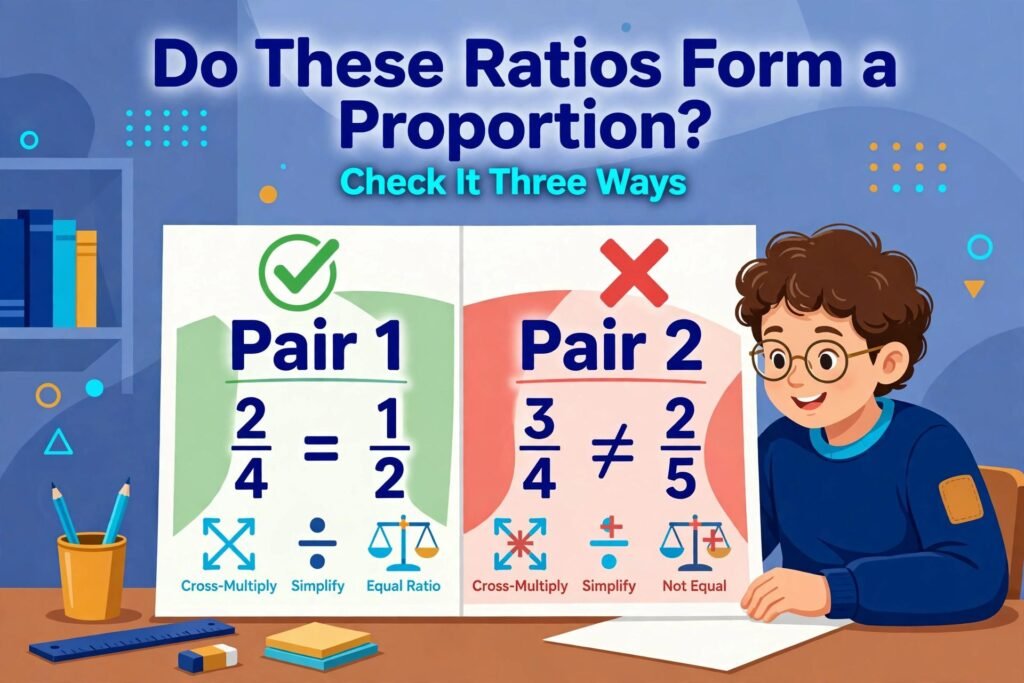
7/9 is 0.778. 15/19 is 0.789. Round both to 0.8 and they look like a proportion. They are not. The cross products are 133 and 135. Close is not a proportion.
That is the whole lesson on this page. A proportion is exact. There is no close-enough rule and no small rounding tolerance that turns unequal ratios into a proportion. I always cross-multiply first. It never lies. Exact, not close.
What does it mean for two ratios to form a proportion?
Two ratios form a proportion when they describe the same relationship between two quantities. A ratio compares two quantities, for example 5 parts to 8 parts. Two ratios form a proportion when the two ratios are equal as fractions. In symbols, a/b = c/d is a proportion when the fraction a/b has the same value as the fraction c/d. They do not need the same numbers, only the same relative size. That is why 5/8 and 15/24 can form a proportion even though 15 and 24 are larger numbers: each part has been scaled by the same factor. Understanding the difference between a single ratio and a statement that two ratios are equal helps here. If you need a refresher, see the guide to ratio vs proportion before you work through the checks below.
Check 1: compare the cross products
Cross-multiplication is the most direct check. For a/b = c/d, multiply the numerator of the first ratio by the denominator of the second ratio, and multiply the denominator of the first ratio by the numerator of the second ratio. The two results are the cross products. If the cross products are equal, the ratios form a proportion. If they are not equal, the ratios do not form a proportion, even if the difference is small. Multiply a by d to get the first cross product. Multiply b by c to get the second cross product. Equal means a proportion; unequal means no proportion.
Apply this to 5/8 and 15/24. The first cross product is 5 times 24 = 120. The second cross product is 8 times 15 = 120. Because 120 = 120, the cross products are equal, so 5/8 and 15/24 form a proportion. You can confirm the same result with the Proportion Calculator on the home page, which checks the cross products for you. Here is a trick I say out loud, every time. “Five times twenty-four equals eight times fifteen.” Say both products out loud, and the check is done.
Try it. Do 3/7 and 9/21 form a proportion? Cross-multiply: 3 times 21 is 63, and 7 times 9 is 63. The products match, so yes. Exact, not close.
Check 2: simplify both ratios
For the same pair, 5/8 is already in its simplest form because 5 and 8 share no common factor greater than 1. For 15/24, divide both parts by 3: 15 ÷ 3 = 5 and 24 ÷ 3 = 8, so 15/24 simplifies to 5/8. Both ratios simplify to 5/8, which confirms the cross-product result: 5/8 and 15/24 form a proportion. Simplifying also makes the scaling clear, since 5/8 multiplied by 3/3 gives 15/24.
Your turn. Do 6/10 and 9/15 form a proportion? Simplify both. 6/10 divides by 2 to give 3/5, and 9/15 divides by 3 to give 3/5. Both simplify to 3/5, so yes, they form a proportion. Exact, not close.
Check 3: compare the decimal values
Dividing the numerator by the denominator turns each ratio into a decimal. Two ratios form a proportion when their decimal values are exactly equal. This check is quick on a calculator, but it needs care: compare enough decimal places, and do not round the decimals before you compare them. Rounding early can make two different ratios look equal. For 5/8, 5 divided by 8 is 0.625. For 15/24, 15 divided by 24 is 0.625. The decimals are exactly equal, so the ratios form a proportion. The free proportion calculator gives the same answer and shows the working, which is helpful when the decimals do not terminate neatly.
Try one. Do 4/5 and 12/15 form a proportion? Divide: 4 divided by 5 is 0.8, and 12 divided by 15 is 0.8. The decimals are exactly equal, so yes. Exact, not close.
When close is not enough
All three checks must point the same way. If any reliable check says the ratios are unequal, the ratios do not form a proportion. This matters most when the decimals look almost the same at a glance. Consider 7/9 and 15/19. The cross products are 7 times 19 = 133 and 9 times 15 = 135. Because 133 is not equal to 135, the ratios do not form a proportion. The decimals tell the same story when you keep enough places: 7 divided by 9 is 0.778 and 15 divided by 19 is 0.789, rounded to three decimal places. The values are close, but they are not equal.
Here is the trap from the top of this page. Calling them a proportion because they look close would be wrong, and rounding both decimals to 0.8 would hide the difference completely. Use the exact cross products whenever a pair looks close. Decimals are a helpful check only when you compare their exact values or enough decimal places to separate them. When the cross products disagree, the cross products settle the question. Exact, not close.
Watch out for flipped order
Order matters. A ratio compares a first quantity with a second quantity, and swapping the two sides changes the ratio. The pair 2:3 and 3:2 looks similar, but the order is reversed, so the comparison is not the same. Check 2:3 against 3:2 with cross products. The first cross product is 2 times 2 = 4, and the second is 3 times 3 = 9. Because 4 is not equal to 9, 2:3 and 3:2 do not form a proportion. By contrast, 2:3 and 8:12 keep the same order: 2 times 12 = 24 and 3 times 8 = 24, so 2:3 and 8:12 do form a proportion. Always line up the corresponding parts before you multiply, and keep the same order in both ratios.
Now you try. Do 3:4 and 4:3 form a proportion? Cross-multiply: 3 times 3 is 9, and 4 times 4 is 16. The products are 9 and 16, so no, they do not form a proportion. The order is flipped, and the check catches it.
What if a denominator is zero?
A ratio with 0 as the denominator cannot be checked, because division by zero is undefined. For example, 3/0 has no value, so there is no proportion to check. In that case the check stops: do not treat the cross products as equal, and do not assign the ratio a decimal value. The proportion calculator reports an error for a zero denominator instead of giving a misleading answer, and you should treat any result that depends on 3/0 the same way.
Decimals and money
The same checks work with decimals. For 1.2/1.8 and 2/3, the cross products are 1.2 times 3 = 3.6 and 1.8 times 2 = 3.6. Because 3.6 = 3.6, the ratios form a proportion. Simplifying gives the same answer: 1.2/1.8 simplifies to 2/3 when both parts are divided by 0.6. Unit prices work the same way. Compare $4.00 for 5 notebooks with $8.00 for 10 notebooks. The cross products are 4.00 times 10 = 40 and 5 times 8.00 = 40. Because 40 = 40, the two prices describe the same unit price, so the ratios form a proportion. If the cross products had differed, the unit prices would differ too, even if the totals looked similar.
One more. Compare $6.00 for 4 pens with $9.00 for 6 pens. The cross products are 6.00 times 6 = 36 and 4 times 9.00 = 36. Because 36 = 36, the unit price is the same ($1.50 per pen), so the ratios form a proportion. Exact, not close.
Try it yourself
Before you decide, run through these reminders. They cover the mistakes that cause most wrong answers. Cross-multiply first, and require the cross products to be exactly equal. Simplify both ratios and check that they reduce to the same simplest ratio. Compare decimals without rounding early, and keep the order of the parts the same in both ratios. Now try 9/12 and 12/16. The cross products are 9 times 16 = 144 and 12 times 12 = 144. Because 144 = 144, the ratios form a proportion. Simplifying confirms it: 9/12 simplifies to 3/4, and 12/16 also simplifies to 3/4. The decimals agree as well, since both equal 0.75.
Questions students ask next
How do you check if two ratios form a proportion? Cross-multiply: if a/b = c/d, check whether a times d equals b times c. Equal cross products mean the ratios form a proportion; unequal cross products mean they do not.
Can you check a proportion by simplifying instead? Yes. Simplify both ratios to their simplest form. If both simplify to the same ratio, they form a proportion. For example, 15/24 simplifies to 5/8, so 5/8 and 15/24 form a proportion.
What if the cross products are close but not equal? Then the ratios do not form a proportion. A small difference still counts: 7/9 and 15/19 give 133 and 135, so they are not a proportion, even though the decimals look close.
What if one ratio has a zero underneath? It cannot be checked. A ratio with 0 as the denominator, such as 3/0, is undefined, so there is no proportion to check and the calculator reports an error.
Checking two ratios is a matter of being exact: equal cross products, the same simplest form, and exactly equal decimals all point to a proportion. When any of those checks fails, the answer is no, however close the numbers look. Exact, not close.