
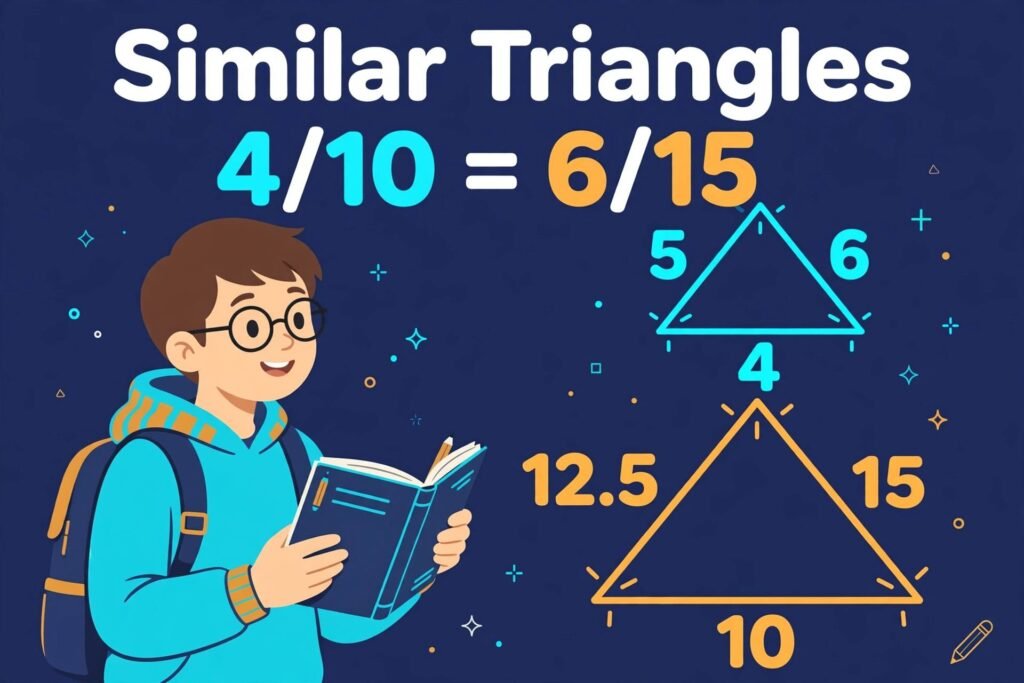
Two triangles on a worksheet. One is turned sideways, the other upside down. Match the longest side with the longest side, the shortest with the shortest, and write the proportion. Solve it carefully. Every number is right. The answer is wrong. The problem said triangle ABC is similar to triangle DEF, and the letters, not the look of the triangles, decide which side goes with which. The wrong sides were paired, and no amount of careful multiplication can fix a setup that started wrong.
That is the whole trap on this page. With similar triangles, the matching comes first and the numbers come second. I always write the correspondence down before any numbers go into a fraction. Correspondence first. That one habit is the whole page.
Start with the correspondence, not the numbers
Two triangles are similar when they have the same shape, and a proportion finds the missing side: match the corresponding sides, write them as equal fractions, and solve. If triangle PQR matches triangle STU, then PQ/ST = QR/TU = PR/SU, and any one missing length comes out of that single line. The step most explanations rush past is the one that decides whether the whole problem works: deciding which side matches which. Two triangles are similar when their matching angles are equal and their matching sides are in the same ratio. The matching is read off the similarity statement, in order. When a problem says triangle ABC is similar to triangle DEF, written ABC ~ DEF, it means side AB matches DE, side BC matches EF, and side CA matches FD. The letters line up, and the sides follow the letters. That order matters because a triangle on a test is often turned around or flipped. A side that looks like the longest one in the small triangle may sit on the left in the large triangle and on the right in the small one, and matching by appearance alone pairs the wrong sides. Write the correspondence first, in words or in a short line, and only then write the proportion. Those ten seconds save the kind of mistake no amount of careful multiplication can fix, because the arithmetic will happily solve a wrongly set-up proportion and give a confident wrong answer.
Here is the habit to build: before any numbers go into a fraction, say which triangle each number belongs to. Put the small triangle’s sides on the top of both fractions, or the large triangle’s sides on the top of both fractions, and keep that choice the same all the way through. Mixed positions, with the small triangle on top in one fraction and on the bottom in the other, are the most common source of a flipped answer. Correspondence first. Here is a trick I say out loud, every time. “AB goes with DE, BC goes with EF, CA goes with FD.” Say it before you write the proportion, and you will never match sides by appearance again.
Check that the triangles are similar before you solve
Most worked examples jump straight to solving for a missing side. That skips a question that comes first: are these two triangles similar at all? If they are not, there is no proportion to solve, and any answer you produce is meaningless. The check is simple. Compare all three pairs of matching sides. If all three ratios are equal, the triangles are similar. If even one ratio is different, they are not.
Worked example, a pair that passes: one triangle has sides 5, 12, and 13, and the other has sides 10, 24, and 26, with the sides listed in matching order. The three ratios are 5/10 = 0.5, 12/24 = 0.5, and 13/26 = 0.5. All three are equal, so the triangles are similar, and the small triangle is half the size of the large one: the scale factor from small to large is 2. The numbers 5, 12, 13 are a familiar right-triangle set, and doubling each one keeps the shape exactly, which is why every ratio lands on 0.5.
Try it. One triangle has sides 3, 4, and 5, and the other has sides 6, 8, and 10. The ratios are 3/6 = 0.5, 4/8 = 0.5, and 5/10 = 0.5, so the triangles are similar, with scale factor 2.
Worked example, a pair that fails: one triangle has sides 4, 6, and 9, and the other has sides 6, 9, and 12, again in matching order. The first two ratios match: 4/6 = 2/3, and 6/9 = 2/3. The third does not: 9/12 = 3/4, and 3/4 is not equal to 2/3. Two matching ratios are not enough. Because the third pair breaks the pattern, these triangles are not similar, and setting up a proportion between them would be a mistake. On a test, the false pair is often built exactly this way, with the first two ratios agreeing so that a quick glance says “similar” and only the third ratio tells the truth.
Try one. One triangle has sides 2, 3, and 4, and the other has sides 4, 6, and 9. The first two ratios match: 2/4 = 0.5 and 3/6 = 0.5. The third does not: 4/9 is 0.444…, which is not 0.5, so these triangles are not similar.
That check is the same idea as checking whether two ratios form a proportion, applied to three pairs instead of one. It is worth doing even when the problem states that the triangles are similar, because a problem that gives you the side lengths may be testing whether you notice the mismatch. And if the problem does state the similarity, the check still confirms you have matched the sides in the right order: if the ratios come out unequal, the matching is wrong, not the triangles.
Find a missing side with a proportion
Once the triangles are confirmed similar and the correspondence is written down, the rest is a proportion like any other. Take the matching sides, write them as equal fractions, and solve for the unknown. Worked example: triangle PQR is similar to triangle STU. Side PQ is 4, and its match ST is 10. Side QR is 6, and its match TU is unknown, call it x. The proportion is 4/10 = 6/x, with the first triangle’s sides on top and the second triangle’s sides on the bottom in both fractions. Cross multiply: 4 times x equals 10 times 6, so 4x = 60. Divide both sides by 4, and x = 15. So TU is 15.
There is a second way to see the same answer, and it is a good check. The scale factor from the first triangle to the second is 10 divided by 4, which is 2.5. Every side of the second triangle is 2.5 times its match in the first, so TU is 6 times 2.5, which is 15. The two routes agree. Notice that the scale factor here is 2.5, not a whole number. Similar triangles do not have to scale by 2 or 3; a decimal scale factor works exactly the same way, and a test will often use one precisely because students expect a whole number. Try those same numbers on the Proportion Calculator in Solve mode: enter 4/10 = 6/x and see whether you get 15. If your answer matches, your setup was right. If it does not, look at the correspondence first, before you doubt the multiplication. The solving step itself is cross multiplication; here it is just the tool that finishes the job once the proportion is set up correctly.
Your turn. Triangle PQR is similar to triangle STU. PQ is 3, ST is 9, QR is 5, TU is x. The proportion is 3/9 = 5/x, so 3x = 45 and x = 15. Check: 9 divided by 3 is 3, and 5 times 3 is 15. Correspondence first.
Measure something tall without climbing it
The most useful thing similar triangles do outside a textbook is indirect measurement: finding the height of something too tall to measure directly, using shadows. At the same time of day, the sun hits everything at the same angle, so a person and a flagpole, with their shadows, form two similar triangles. The ratio of height to shadow is the same for both. Worked example: a 5-foot student casts a 2-foot shadow, and a flagpole nearby casts a 14-foot shadow at the same moment. The proportion keeps height over shadow on both sides: 5/2 = h/14, where h is the flagpole’s height. Cross multiply: 2 times h equals 5 times 14, so 2h = 70. Divide both sides by 2, and h = 35 feet. The flagpole is 35 feet tall.
Picture the two triangles side by side. The 5-foot student and the 2-foot shadow form the small triangle. The flagpole and its 14-foot shadow form the large triangle. Both triangles have the same shape, so 5/2 = 35/14. Before moving on, run the sense check that most short explanations leave out. A flagpole should be much taller than a 5-foot student, and 35 feet is. If the ratios had been swapped, with shadow over height on one side, the answer would have come out as a flagpole shorter than the student, which is absurd on its face. That is the value of the check: a wrong setup often produces an answer that is plainly impossible, but only if you stop to ask whether the number makes sense. The same habit works for trees and buildings: the taller object casts the longer shadow, and the answer must respect that. You can confirm the shadow numbers on the Proportion Calculator too, in Solve mode with 5/2 = h/14. The calculator gives 35, matching the hand calculation.
Now you try. A 6-foot student casts a 4-foot shadow, and a tree casts a 20-foot shadow at the same moment. The proportion is 6/4 = h/20, so 4h = 120 and h = 30 feet. The tree is taller than the student, as it should be.
The line inside the triangle that makes a smaller copy
There is one more place similar triangles appear that many posts never mention. Draw a line inside a triangle, parallel to one of its sides, so that it cuts the other two sides. The small triangle at the top is similar to the whole triangle, because the parallel line makes the matching angles equal. That gives a proportion between the pieces of the cut sides, and it solves problems that do not look like similar-triangle problems at first glance. Worked example: inside a triangle, a line parallel to one side cuts the other two sides at points D and E. On one side, AD is 5 and DB is 10. On the other side, AE is 6 and EC is unknown, call it x. Because the line is parallel, the segments are in proportion: AD/DB = AE/EC, so 5/10 = 6/x. Cross multiply: 5 times x equals 10 times 6, so 5x = 60. Divide both sides by 5, and x = 12. So EC is 12.
The key condition is the word parallel. If the line inside the triangle is not parallel to the base, the small triangle is not similar to the whole one, and the proportion does not hold. A problem will usually state the parallel condition plainly, or mark it on the diagram with matching arrow marks on the two parallel lines. Look for that mark before setting anything up. Correspondence first.
Try one more. A line parallel to one side cuts the other two sides: AD is 3, DB is 6, AE is 4, EC is x. The proportion is 3/6 = 4/x, so 3x = 24 and x = 8. So EC is 8.
Sides, perimeter, and area do not all scale the same way
This is the part students get wrong most often on tests, so it is worth reading slowly. When a figure is enlarged, its side lengths and its perimeter grow by the scale factor, but its area grows by the square of the scale factor, and its angles do not change at all. With a scale factor of 3 to 5 from the small triangle to the large one, a side of 3 becomes 5, and a small perimeter of 24 becomes 24 times 5/3, which is 40. A small area of 18 becomes 18 times (5/3) squared, which is 18 times 25/9, which is 50. So the area ratio is 18 to 50, which simplifies to 9 to 25, and 9:25 is the square of 3:5, not 3:5 itself. The angles stay exactly as they are, because enlarging a shape never changes its corners: a 40-degree angle stays 40 degrees.
Why the area behaves this way is easy to see once you picture it. Area is length times length, so when every length is multiplied by 5/3, the area is multiplied by 5/3 twice, once for each direction. Perimeter is a sum of lengths, so it is multiplied only once. If a question asks for an area and you catch yourself multiplying by the scale factor once, stop: that gives the perimeter answer.
One more. A small triangle has area 10 and perimeter 14, and the scale factor to the large triangle is 1 to 2. The large perimeter is 14 times 2, which is 28. The large area is 10 times 2 squared, which is 40. The perimeter scales by 2, the area by 4.
Mistakes that turn a right idea into a wrong answer
Four mistakes account for most of the lost marks on similar-triangle problems. First, matching sides by size or appearance instead of by the similarity statement, which fails whenever a triangle is rotated or flipped. Second, solving for a missing side without checking that the triangles are similar, which produces an answer to a problem that does not exist. Third, putting one triangle on top in one fraction and on the bottom in the other, which flips the proportion and gives the reciprocal of the right answer. Fourth, scaling an area by the scale factor instead of its square, which is the trap in the section above. Each of these is a setup mistake, not an arithmetic mistake, and each one is caught by the habits in this post: write the correspondence, check all three ratios, keep the triangle positions consistent, and square the scale factor for area.
Here is the one that catches even careful students. A small triangle has area 18, and the scale factor to the large triangle is 3 to 5. The wrong move is to multiply the area by 5/3 once: 18 times 5/3 is 30. That is the perimeter answer, not the area answer. The right move is to square the scale factor first: (5/3) squared is 25/9, and 18 times 25/9 is 50. The wrong answer, 30, looks plausible, which is exactly why the check matters. If your area answer is smaller than the scale factor would suggest for a length, ask yourself whether you squared the factor.
One more habit helps on every problem of this type: estimate before you calculate. If the large triangle is about twice the small one, the missing side should be about twice its match. If your answer comes out ten times larger, or smaller than the side it matches when it should be larger, the setup is wrong. Estimation takes five seconds and catches errors that a careful re-multiplication never will, because re-multiplying a wrong setup gives the same wrong answer.
Try these yourself
Two short problems to practise the method. Cover the answers, work each one through, and then check. Two triangles are similar. One pair of matching sides is 9 and 12, and another pair is 6 and x. Find x. A 4-foot post casts a 6-foot shadow. At the same time, a tree casts a 27-foot shadow. How tall is the tree? Answers: (1) The proportion is 9/12 = 6/x. Cross multiply: 9x = 72, so x = 8. The scale factor is 12/9, which is 4/3, and 6 times 4/3 is 8, confirming the answer. (2) The proportion is 4/6 = h/27, with height over shadow on both sides. Cross multiply: 6h = 108, so h = 18 feet. The tree is 18 feet tall, which passes the sense check: it is taller than the 4-foot post, as it should be. If either answer did not match, try the same numbers on the Proportion Calculator and compare step by step. The calculator shows the same working, and seeing where your steps part from its steps is usually enough to find the setup slip.
Questions students ask next
What does it mean for two triangles to be similar? Their corresponding angles are equal and their corresponding sides are in the same ratio. They have the same shape but not necessarily the same size.
How do I know which sides correspond? Read the similarity statement in order: in ABC ~ DEF, side AB matches DE, BC matches EF, and CA matches FD. Do not match sides by size alone when a triangle is turned around.
How do I find a missing side in similar triangles? Write the matching sides as a proportion, with the same triangle’s side in the same position on both sides, then cross-multiply and solve. For example, 4/10 = 6/x gives x = 15.
Are similar triangles the same as congruent triangles? They are not the same. Congruent triangles are the same size as well as the same shape, so their scale factor is 1. Similar triangles can be any size, so their scale factor can be any number, such as 2.5.
Does the area scale the same way as the side lengths? It does not. If the side lengths scale by 3:5, the perimeter also scales by 3:5, but the area scales by 9:25, which is the square of 3:5.
Similar triangles show up everywhere once you know what to look for: in shadows, in maps, in scale models, and in any problem where one shape is a larger or smaller copy of another. The method stays the same each time: write the correspondence, check the ratios, set up the proportion, and solve. Try your next homework problem on the Proportion Calculator and see whether the answer agrees with your own working.