

One number tells you the price of 1 ticket, 10 tickets, or 100 tickets, and it never changes. That number is the constant of proportionality. Learn it once, and every other value in the relationship follows from it.
What the constant actually is
In a proportional relationship, one quantity is always the same fixed number times the other. Call the first quantity x and the second y, and the relationship is y = kx, where k is that fixed number. Divide both sides by x and you get the way to find it: k = y / x. Every pair of values gives the same k, and that sameness is the whole test of whether a relationship is proportional at all.
When x is 1, y equals k, so k is also the unit rate, taught on its own in the unit rate guide. Variation with k, including the inverse kind, lives in the direct and inverse variation guide. Here the job is narrower: find k and use it.
Finding k in a table
Concert tickets give the cleanest table I know. Three tickets cost $66, so k = 66 / 3 = $22 per ticket. From that one number: 1 ticket costs $22, 2 cost $44, 3 cost $66, and 5 cost $110. Check any row, and the ratio is the same: 44 / 2 = 22, and 110 / 5 = 22. Divide y by x, and k stays the same.
Once k is known, each new value is one multiplication, and the equation form is y = 22x, where x is tickets and y is dollars. Run the same division through the Proportion Calculator and the answer should match.
Try it: a taxi charges $14 for 2 miles. The constant is 14 / 2 = $7 per mile, so 5 miles cost 5 x 7 = $35.
Finding k on a graph
On a graph, a proportional relationship is a straight line through the origin, and k is how steep that line is. Suppose the line shows the cost of apples, and it passes through (2, 10): 2 pounds cost $10. Divide the y-coordinate by the x-coordinate, and k = 10 / 2 = $5 per pound. Predict from there: 7 pounds cost 7 x 5 = $35. A second point on the same line, (6, 30), agrees: 30 / 6 = 5. Divide y by x, and k stays the same.
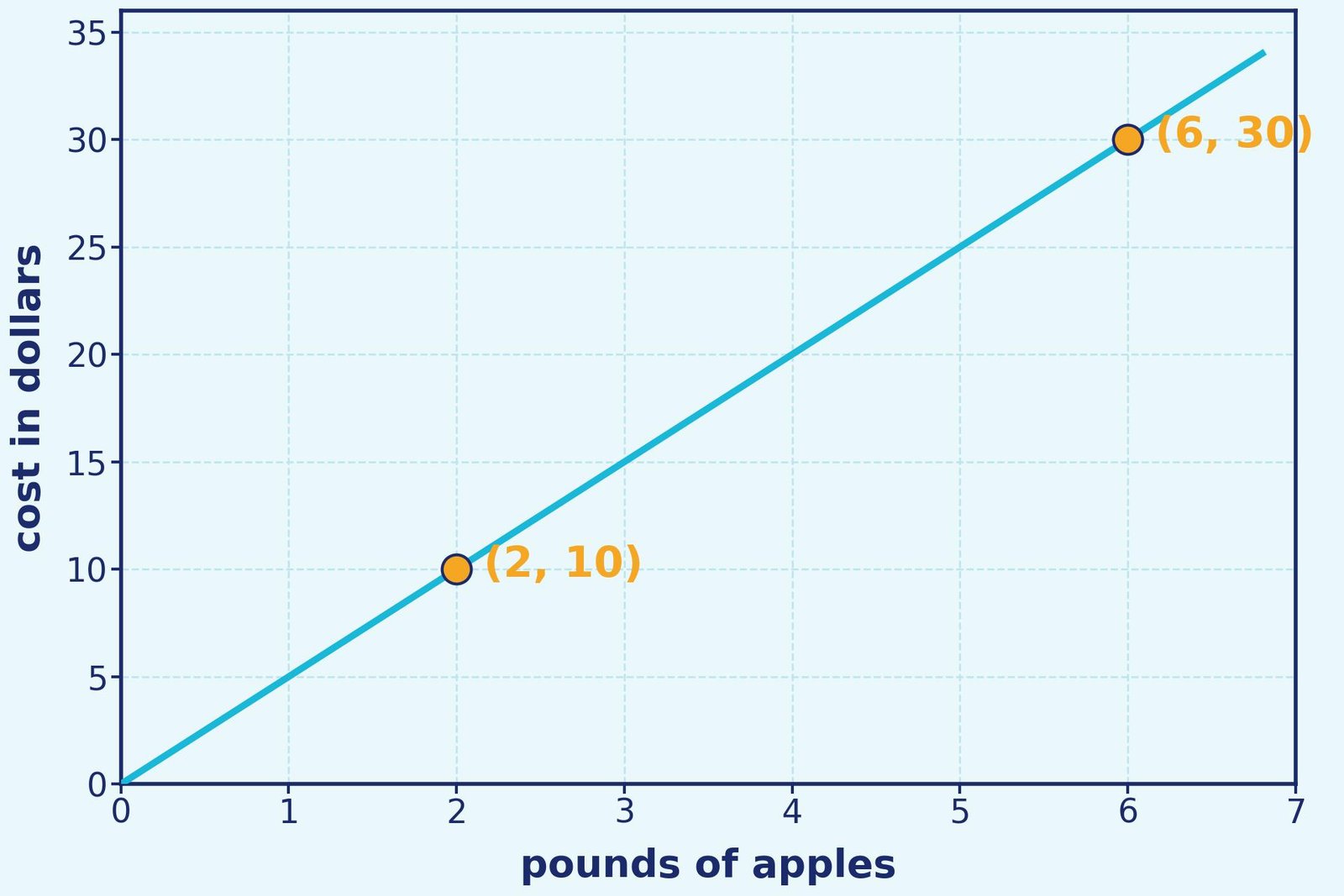
The mistake: a student looks at the origin, the point (0, 0), and tries k = 0 / 0, then calls k zero. That is wrong twice over. You cannot divide by zero, and k = 0 would mean every y is 0, which the graph contradicts. Use any other point, such as (2, 10), which gives k = 5. The origin only confirms the line is proportional, it never gives you k.
Try it: a line through the origin passes through (3, 18). The constant is 18 / 3 = 6, so at x = 8, y = 8 x 6 = 48.
Finding k in an equation
Take y = 1.5x, where x is cups of rice and y is cups of water. The number multiplying x is 1.5, so k = 1.5 cups of water per cup of rice. For 4 cups of rice, y = 1.5 x 4 = 6 cups of water, and 6 / 4 = 1.5 checks it. Divide y by x, and k stays the same.
Try it: y = 2.5x gives k = 2.5. At x = 10, y = 2.5 x 10 = 25.
Finding k from words alone
Sometimes no table or graph is given, only a sentence. A plumber charges the same rate per hour, and 4 hours cost $260. The words “the same rate” are the clue: k = 260 / 4 = $65 per hour. Build the table from there: 1 hour costs $65, 2 hours cost $130, and 7 hours cost $455. Check it: 455 / 7 = 65.
The move is always the same: find one pair of matching numbers, divide y by x, and the constant falls out. More problems stated in words are worked in the proportion word problems guide, with the answer checked after each one.
Try it: an electrician charges $360 for 6 hours. The constant is 360 / 6 = $60 per hour, so 9 hours cost 9 x 60 = $540.
When there is no constant at all
Not every table has a k, and the test that catches it is the same division. A gym charges a $30 joining fee plus $20 per month: 1 month costs $50, 2 months cost $70, and 3 months cost $90. Divide y by x in each row, and the answers are 50, 35 and 30. They are not equal, so there is no constant of proportionality here. The $30 joining fee is the reason: it is not a monthly amount, so it bends the ratio on every row.
One unequal ratio is enough to end the search. Do not average the ratios, do not pick the middle one, and do not force a k where none exists. A relationship either keeps one ratio everywhere, or it has no constant of proportionality.
Try it: a phone plan charges a $15 activation fee plus $25 a month. One month costs $40 and two months cost $65, so the ratios are 40 and 32.5, which are not equal, so there is no constant.
Using k both ways
Back to the concert tickets, where k = $22 per ticket. One k answers two kinds of question. Forward, multiply by k to find y: 5 tickets cost 5 x 22 = $110. Backwards, divide by k to find x: $154 buys 154 / 22 = 7 tickets. Divide y by x, and k stays the same.
The table puts all four ways side by side.
| Where you see it | What you divide | k | What k means |
|---|---|---|---|
| Table: tickets | 66 / 3 | 22 | $22 per ticket |
| Graph: apples | 10 / 2 | 5 | $5 per pound |
| Equation: rice | 1.5, from y = 1.5x | 1.5 | 1.5 cups of water per cup of rice |
| Words: plumber | 260 / 4 | 65 | $65 per hour |
Whichever way you meet the relationship, the number you find is the same k. That is the point of the constant.
Try it: with k = 5 dollars per pound, 9 pounds of apples cost 9 x 5 = $45, and $60 buys 60 / 5 = 12 pounds.
Two quick practice problems
First, a table shows 2 hours at $52 and 5 hours at $130. The constant is 52 / 2 = $26 per hour, and the second row agrees, since 130 / 5 = 26. So 8 hours cost $208. Second, a graph point (3, 27) gives k = 27 / 3 = 9, so y = 9x, and at x = 6, y = 54.
Key takeaways
- The constant of proportionality, k, is the fixed number one quantity is multiplied by to get the other, found as k = y / x.
- Tables, graphs, equations and words all hide the same k.
- If the ratios differ from row to row, there is no constant, and no averaging will create one.
- One k predicts both ways: multiply by k to find y, and divide by k to find x.
Pick one proportional relationship from your own day, a bus fare, a recipe, or an hourly wage, and find its k three ways: from a table, from a graph, and from words. If all three give the same number, you have found the constant. Check your divisions on the Proportion Calculator.
Constant of proportionality questions, answered
What is the constant of proportionality? The constant of proportionality is the fixed number that one quantity is multiplied by to get the other in a proportional relationship, written k in y = kx. For 3 tickets at 66 dollars, k = 66 / 3 = 22 dollars per ticket, and that number never changes while the relationship holds.
How do you find the constant of proportionality from a table? Divide y by x in any row. If every row gives the same number, that number is k. For 2 hours and 52 dollars, k = 52 / 2 = 26 dollars per hour. Check a second row to be sure the ratio really stays fixed.
How do you find the constant of proportionality from a graph? Pick any point on the straight line through the origin, except (0, 0), and divide its y-coordinate by its x-coordinate. A point (2, 10) gives k = 10 / 2 = 5. Every point on the same line gives the same k, which is how you know the line is proportional.
Is the constant of proportionality the same as the unit rate? In a proportional relationship, yes. The constant k is the value of y when x is 1, which is the unit rate. A unit rate can exist without a proportional relationship, but k only exists when the ratio stays fixed.
How do you know a table is not proportional? Divide y by x in each row. If the quotients are different, there is no constant of proportionality. A gym charging a 30 dollar joining fee plus 20 dollars a month gives 50, 35 and 30, so the table is not proportional.
How do you use k to find a missing value? Multiply by k to find y, or divide by k to find x. With k = 22 dollars per ticket, 5 tickets cost 5 x 22 = 110 dollars, and 154 dollars buys 154 / 22 = 7 tickets. The same k answers both questions.