
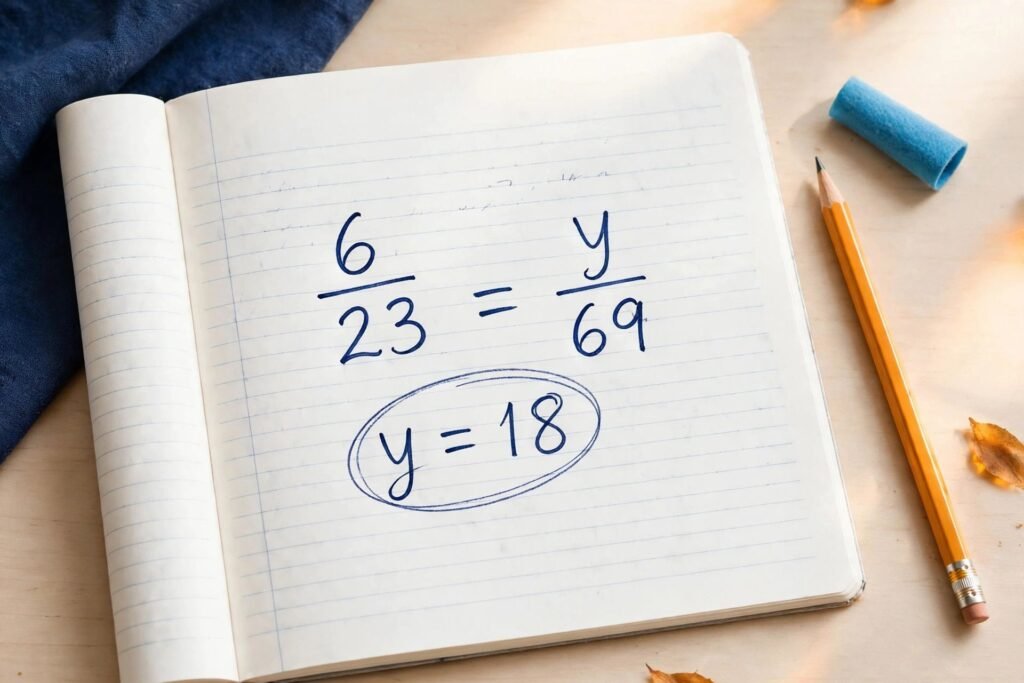
“Solve the proportion. If necessary, round to the nearest hundredth.” That line sits at the top of more homework sheets than any other in this topic. Every version of the question is the same job: one number is missing, and the proportion tells you how to find it.
What does it mean to solve for x?
A proportion says two ratios are equal. When one of the four numbers is missing, we write x in its place, and solving for x means finding the one number that makes both sides equal again. I think of x as a blank in a sentence, and the other three numbers are the clues. The check is built in: put your answer back where x was, and the two ratios must match. Isolate x, then check it.
The three steps that work every time
First, cross multiply. Multiply the numerator of one side by the denominator of the other side, and set the two products equal. Second, isolate x. Divide both sides by the number in front of x, and undo any addition or subtraction first if x sits inside brackets. Third, check. Put the answer back in place of x and cross multiply again, and both products must be equal. The cross multiplication step is taught in the cross multiplication guide, and the general method is in the step by step guide.
Where can x sit?
The letter x can sit in any of the four spots, and the spot changes the arithmetic, not the method.
| Where x sits | Example | After cross multiplying | Divide by | x |
|---|---|---|---|---|
| Top left | x / 12 = 3 / 4 | 4x = 36 | 4 | 9 |
| Top right | 3 / 4 = x / 12 | 4x = 36 | 4 | 9 |
| Bottom left | 3 / x = 9 / 12 | 9x = 36 | 9 | 4 |
| Bottom right | 3 / 4 = 9 / x | 3x = 36 | 3 | 12 |
The top two rows give the same answer, because flipping the whole proportion over does not change it. In every row the last step is a division, never a second multiplication. Isolate x, then check it.
Example 1: x on top
Solve the proportion 6 / 23 = y / 69, a real homework question, with y on top on the right. Cross multiply first: 23y = 6 × 69, so 23y = 414. Now divide both sides by 23: y = 414 / 23 = 18. Check it: 18 / 69 simplifies to 6 / 23, so both ratios match. Isolate x, then check it.
Try It: Solve 15 / 35 = g / 7. Cross multiply to get 35g = 105, then divide by 35. The answer is g = 3.
Example 2: x on the bottom
When x sits underneath, the cross multiplication still puts x on one side multiplied by a number, exactly as before. Take 3 / a = 1 / 6. Cross multiply: a = 3 × 6 = 18, and 3 / 18 is 1 / 6. The unknown was underneath, and the method never changed.
Try It: Solve 4 / 9 = 13 / q, and round to the nearest hundredth. Cross multiply to get 4q = 117, then divide by 4. The answer is q = 29.25.
The mistake that gives a giant answer
The mistake: a student solves 6 / 23 = y / 69, cross multiplies to get 23y = 414, and then multiplies again: y = 414 × 23 = 9,522. That number feels right, because every step used multiplication. Put 9,522 back in: 9,522 / 69 is about 138, and 138 is nowhere near 6 / 23. Cross multiplication gives you an equation, and you undo the multiplication by dividing. So 414 / 23 = 18, not 414 × 23. If your answer is far bigger than every number in the question, stop and ask whether you multiplied when you should have divided.
Example 3: x inside brackets
Sometimes x is not alone. It sits inside brackets with another number, and you have to free it before you can divide. Solve 6 / 14 = 7 / (x – 3), and round to the nearest hundredth. Cross multiply: 6(x – 3) = 7 × 14 = 98. Distribute the 6: 6x – 18 = 98. Add 18 to both sides: 6x = 116. Divide by 6: x = 116 / 6 = 19.33. Check it: 7 / 16.33 is about 0.4286, the same as 6 / 14.
Try It: Solve (3 – y) / 4 = 1 / 9, and round to the nearest hundredth. Cross multiply to get 9(3 – y) = 4, so 27 – 9y = 4, and 9y = 23. The answer is y = 2.56.
Example 4: x on both sides
The hardest version has x on both sides, and it needs one extra move: collect all the x terms on one side before you divide. Solve (j – 5) / 2 = (j + 8) / 7. Cross multiply: 7(j – 5) = 2(j + 8). Distribute: 7j – 35 = 2j + 16. Move the j terms together and the plain numbers together: 7j – 2j = 16 + 35, so 5j = 51, and j = 10.2. Check it: 5.2 / 2 is 2.6, and 18.2 / 7 is also 2.6. Isolate x, then check it.
Try It: Solve (x + 2) / 3 = (x + 5) / 6. Cross multiply to get 6(x + 2) = 3(x + 5), so 6x + 12 = 3x + 15, and 3x = 3. The answer is x = 1.
What about decimals and rounding?
Some proportions give answers that need rounding to the nearest hundredth. Take 1 / 0.19 = 12 / n: n = 0.19 × 12 = 2.28, which lands exactly on two decimal places. When the division does not end, keep one extra digit, then round. Solve 5 / 7 = x / 11. Cross multiply: 7x = 55, so x = 55 / 7 = 7.857. The third decimal is 7, which is 5 or more, so the second decimal rounds up: x = 7.86. Never round in the middle of the working, because an early rounding error grows with every step that follows.
A money problem, start to finish
Four concert tickets cost $26. How much do 7 tickets cost at the same price? Let x be the cost of 7 tickets. Set up the proportion with tickets on top and dollars underneath: 4 / 26 = 7 / x. Cross multiply: 4x = 7 × 26 = 182. Divide by 4: x = 45.50. Check it: $26 / 4 is $6.50 per ticket, and 7 × $6.50 is $45.50. Try the same numbers on the Proportion Calculator and you will see the same $45.50.
Try It: A map uses 3 inches for 45 miles. How far is a route that measures 8 inches on the map? Set it up as 3 / 45 = 8 / x. The answer is 120 miles.
Practice problems
- 2 / 5 = x / 15
- 7 / 8 = 21 / x
- 5 / 6 = x / 42
- 9 / 4 = x / 20
Answers: 6, 24, 35, 45.
Key takeaways
- Cross multiply first, then isolate x, then check by putting the answer back.
- The position of x changes what you divide by, not the method.
- If x sits inside brackets, distribute first.
- Round only at the end, and keep one extra digit while you divide.
- An answer far bigger than the numbers in the question means you multiplied instead of dividing.
Pick one problem from your own homework and solve it twice: once by hand, and once on the Proportion Calculator. The same three steps are explained from the other side in OpenStax Prealgebra 6.5, and Math is Fun Proportions shows the same job with pictures.
Solve for x questions, answered
Do I always have to cross multiply to solve for x?
No. If the numbers divide neatly, you can scale instead. For 6 / 23 = y / 69, 69 is 3 times 23, so y is 3 times 6, which is 18. Cross multiplication works every time, so use it when the scaling is not obvious.
What if x is on both sides of the proportion?
Cross multiply, distribute on both sides, then collect the x terms on one side and the plain numbers on the other. For (j – 5) / 2 = (j + 8) / 7, that gives 5j = 51, so j = 10.2. Check both sides after.
What if x comes out negative?
It can happen, and it is usually a sign to re-read the question. For 9 / 5 = 3 / (x + 7), the working gives x = -5.33. A homework problem expecting a length or a price would not ask for it, so check the setup first.
How do I round to the nearest hundredth?
Divide one digit past the hundredths place, then look at the third decimal. If it is 5 or more, round the second decimal up; if it is 4 or less, leave it. So 7.857 becomes 7.86, and 18.666 becomes 18.67. Round only at the end.
How do I check my answer?
Put the answer back where x was and cross multiply again. For 6 / 23 = 18 / 69, both products are 414, so the answer is right. If the products differ, the mistake sits in the cross multiplication or the division, so rework those two steps.
What is the difference between solving for x and checking if two ratios form a proportion?
Solving finds a missing number, while checking tests whether two complete ratios are equal. The check is a yes or no question, and it is taught in the guide to checking two ratios. Solving for x always ends with a number.