
0.333 is one third. I see it written that way all the time, in homework, in comments, on worksheets. It is wrong. The decimal 0.333 stops after three places, and it equals 333/1000, not 1/3. One third is 0.333…, with the threes going on forever, and those three little dots change everything. This guide shows you how to turn any decimal into a fraction, in simplest form, without guessing, and how to tell the decimals that stop from the ones that never do.
A decimal and a fraction are two ways of writing the same number. The decimal 0.75 and the fraction 3/4 are the same amount, just dressed differently. Converting is the work of changing the outfit: you write the decimal as a fraction, then you tidy it into its simplest form. Count the places, then simplify. That is the whole method, and the examples below show it working on the decimals you actually meet.
How do you turn a decimal into a fraction?
I use three steps, and they never change.
- Count the places. The number of digits after the decimal point tells me the denominator: one place means tenths, two means hundredths, three means thousandths.
- Write the fraction. The digits become the numerator, and the matching power of ten becomes the denominator.
- Simplify. Divide the top and bottom by their greatest common factor until nothing divides both. My equivalent fractions guide shows how the same value can wear many fraction outfits.
Example 1: a decimal with two places
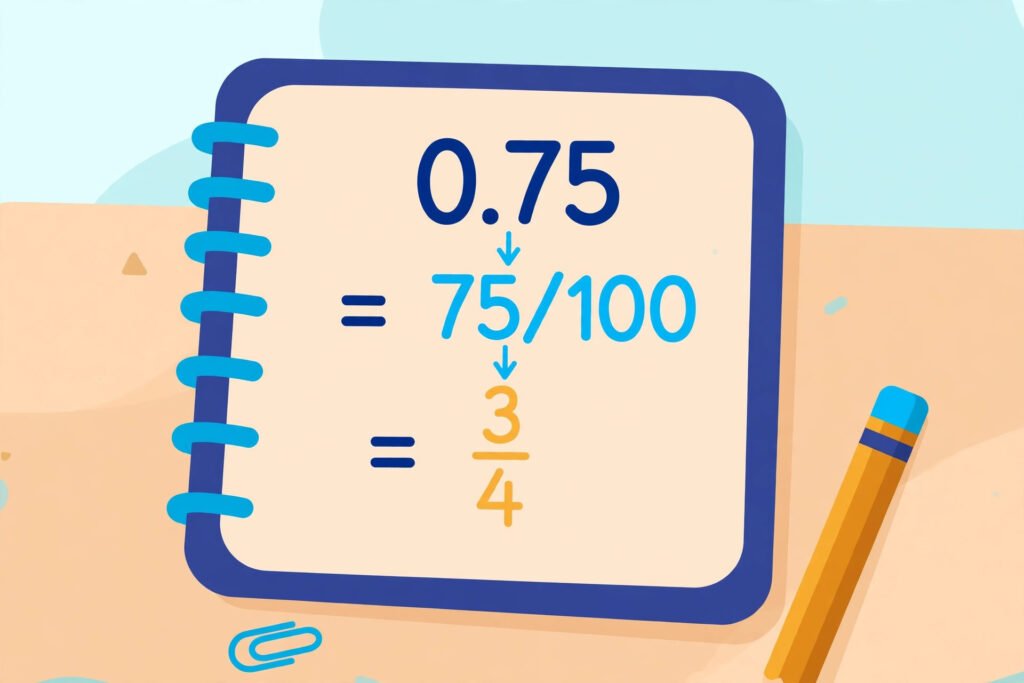
Take 0.75. It has two places after the point, so it starts as 75 hundredths, or 75/100. Now I simplify. The greatest common factor of 75 and 100 is 25, so I divide both by 25: 75 divided by 25 is 3, and 100 divided by 25 is 4. The answer is 3/4. Count the places, then simplify.
The check is easy: 3 divided by 4 is 0.75, so I am back where I started. You can run the same check on the Proportion Calculator by comparing 75/100 with 3/4.
Try it: turn 0.35 into a fraction. Two places, so it starts as 35/100, and dividing by 5 gives 7/20.
Example 2: a decimal with three places
Three places means thousandths. 0.125 starts as 125/1000. The greatest common factor of 125 and 1000 is 125, so I divide both by 125: 125 divided by 125 is 1, and 1000 divided by 125 is 8. The answer is 1/8. This is the one I meet most in measuring, because an eighth of an inch is 0.125 inches, and a ruler marked in eighths is really a fractions chart in disguise.
Try it: turn 0.625 into a fraction. Three places, 625/1000, and dividing by 125 gives 5/8.
Example 3: a decimal bigger than 1
A decimal bigger than 1 becomes a mixed number, and I handle it in two parts. Take 2.4. The whole part is 2, and the decimal part is 0.4. One place means tenths, so 0.4 is 4/10, which simplifies to 2/5. I put the parts back together: 2 2/5. If I want it as a single fraction, I multiply the whole number by the denominator and add the numerator: 2 times 5 is 10, plus 2 is 12, so the answer is 12/5. Count the places, then simplify, and keep the whole part out of the way until the end.
Try it: turn 1.25 into a fraction. You should get 1 1/4, or 5/4 as a single fraction.
What about a decimal that never ends?
Here is where the counting method stops working, because a repeating decimal has no last place. Take 0.333…. I cannot write it over a power of ten, so I use a short piece of algebra instead, and it is the same cross-multiply-and-divide thinking you use to solve for x. I call the number x: x = 0.333…. Then I multiply by 10, which shifts the point one place: 10x = 3.333…. Now I subtract the first equation from the second, and the endless tails cancel: 10x minus x is 9x, and 3.333… minus 0.333… is exactly 3. So 9x = 3, and x = 3/9, which simplifies to 1/3. The dots were doing real work all along.
The same trick works when only part of the decimal repeats. Take 0.1666…. The 6 repeats, but the 1 does not. I call it x: x = 0.1666…. I multiply by 100 to move the point past the repeating digit: 100x = 16.666…. Then I multiply by 10: 10x = 1.666…. I subtract the second from the first, and the tails cancel again: 100x minus 10x is 90x, and 16.666… minus 1.666… is exactly 15. So 90x = 15, and x = 15/90, which simplifies to 1/6. If the algebra here feels new, my solve for x in a proportion guide works through the same moves step by step.
Try it: turn 0.777… into a fraction. Call it x, multiply by 10, subtract, and you should get 7/9.
The mistake I see most: dropping the dots
The mistake from the opening is worth one more look, because it is so easy to make. A student writes 0.333 = 1/3 and moves on, and the working looks tidy. It is still wrong, and there is a one-line test that proves it. If 0.333 really were 1/3, then 3 times 0.333 would be exactly 1. It is 0.999, not 1. The missing 0.001 is the whole story. A decimal that stops is a different number from the repeating decimal it resembles, and the dots are the only thing telling you which one you have.
Going the other way: fraction to decimal
Sometimes you need the reverse trip. To turn a fraction into a decimal, I divide the top number by the bottom number. Take 5/8. Five divided by 8 is 0.625, and that is the answer. Some fractions never finish dividing: 1 divided by 6 is 0.1666…, and the 6 repeats forever, which is why 1/6 and 0.1666… are the same number. When a remainder repeats during the division, the digits repeat from there, and I write the repeating part with dots.
Try it: turn 3/8 into a decimal. Three divided by 8 is 0.375.
The decimals I look up most
These eleven come up so often that I keep them as a lookup chart. Every row follows the same method: count the places, write the fraction, simplify.
| Decimal | Fraction | Decimal | Fraction |
|---|---|---|---|
| 0.5 | 1/2 | 0.125 | 1/8 |
| 0.25 | 1/4 | 0.375 | 3/8 |
| 0.75 | 3/4 | 0.625 | 5/8 |
| 0.2 | 1/5 | 0.875 | 7/8 |
| 0.4 | 2/5 | 0.6 | 3/5 |
| 0.8 | 4/5 | 0.1 | 1/10 |
If a decimal is not on this chart, the method still works. Count the places, write the fraction, simplify, and check by dividing back.
How do I check my conversion on the calculator?
The Proportion Calculator checks a conversion for me. A decimal like 0.75 is really the fraction 75/100, so I type 75/100 on one side and 3/4 on the other, and the calculator compares the cross products: 75 times 4 is 300, and 100 times 3 is 300. Equal products mean the conversion is right. Try it with 0.625 and 5/8: 625 times 8 is 5000, and 1000 times 5 is 5000. The same check catches a wrong simplification in seconds, and it works for any conversion on this page.
Practice: four quick conversions
- Turn 0.6 into a fraction. Answer: 3/5.
- Turn 0.45 into a fraction. Answer: 9/20.
- Turn 3.75 into a fraction. Answer: 3 3/4, or 15/4 as a single fraction.
- Turn 0.444… into a fraction. Answer: 4/9.
Frequently asked questions
How do you turn a decimal into a fraction?
Count the places after the decimal point, write the digits over 10, 100, or 1000 to match, then simplify by dividing the top and bottom by their greatest common factor. For 0.75, two places give 75/100, and dividing by 25 gives 3/4.
What is 0.75 as a fraction?
0.75 is 3/4. It has two decimal places, so it starts as 75/100, and 75 and 100 share the greatest common factor 25. Divide both by 25 and you get 3/4. Check it yourself: 3 divided by 4 is 0.75.
How do you convert a repeating decimal to a fraction?
Call the decimal x, multiply by a power of 10 to shift the repeating part, then subtract so the repeating tails cancel. For 0.333…, 10x minus x is 3, so 9x = 3 and x = 1/3. For 0.1666…, the same trick gives 1/6.
How do you turn a fraction into a decimal?
Divide the numerator by the denominator. For 5/8, 5 divided by 8 is 0.625. If a remainder repeats during the division, the digits repeat from there: 1 divided by 6 is 0.1666…, so 1/6 equals 0.1666… with the 6 repeating.
Can every decimal be written as a fraction?
No. Terminating decimals and repeating decimals can always be written as fractions. A decimal that never ends and never repeats, like pi, cannot be written as an exact fraction. You can only round it, for example pi is about 22/7, which is close but not exact.
How do I check my decimal to fraction conversion?
Divide the fraction back into a decimal and compare it with the number you started from. If 0.75 becomes 3/4, then 3 divided by 4 must be 0.75. You can also check with the Proportion Calculator by comparing the cross products of 75/100 and 3/4.
Key takeaways
Count the places, then simplify. Terminating decimals go over a power of ten. Repeating decimals need the multiply-and-subtract trick, because counting has no last place. Going back is just division, and a quick check by dividing back catches almost every slip. Try your own decimal on the Proportion Calculator and watch the check pass.
Sources: OpenStax Prealgebra 2e, section 6.5, Solve Proportions and their Applications; Math is Fun, Proportions.