
Your tape measure says 5/16 of an inch. The chart on the wall lists decimals, and your homework asks for 0.3125. You stare at the fraction and wonder how one turns into the other.
I have been there, and the answer is shorter than it looks. A fraction bar is a division sign. Divide the top by the bottom.
That one move turns any fraction into a decimal. The rest of this guide shows you how to do the division by hand, when the decimal stops and when it repeats, how to round it, and how to check it. Try the same numbers on the Proportion Calculator as you read.
What a Fraction to Decimal Conversion Really Means
A fraction like 5/8 is really a division problem wearing a different outfit. The top number, the numerator, is the number being divided. The bottom number, the denominator, is the number doing the dividing. So 5/8 means 5 divided by 8.
Here is a sense check before I divide. A proper fraction is smaller than 1, so its decimal must start with 0 point something. If your answer for 5/8 comes out bigger than 1, something went wrong.
How to Convert a Fraction to a Decimal in 4 Steps
The method never changes, whatever the fraction is.
- Write the fraction as a division, numerator divided by denominator.
- Set up the long division. Put a decimal point after the whole number part of the answer, then bring down a zero each time the remainder is not zero.
- Keep dividing until the remainder reaches zero, or until you spot a remainder you have already seen.
- Check the answer by turning the decimal back into a fraction.
Let me show the whole thing on one fraction, with every remainder written out.
Worked Example: 5/8 as a Decimal
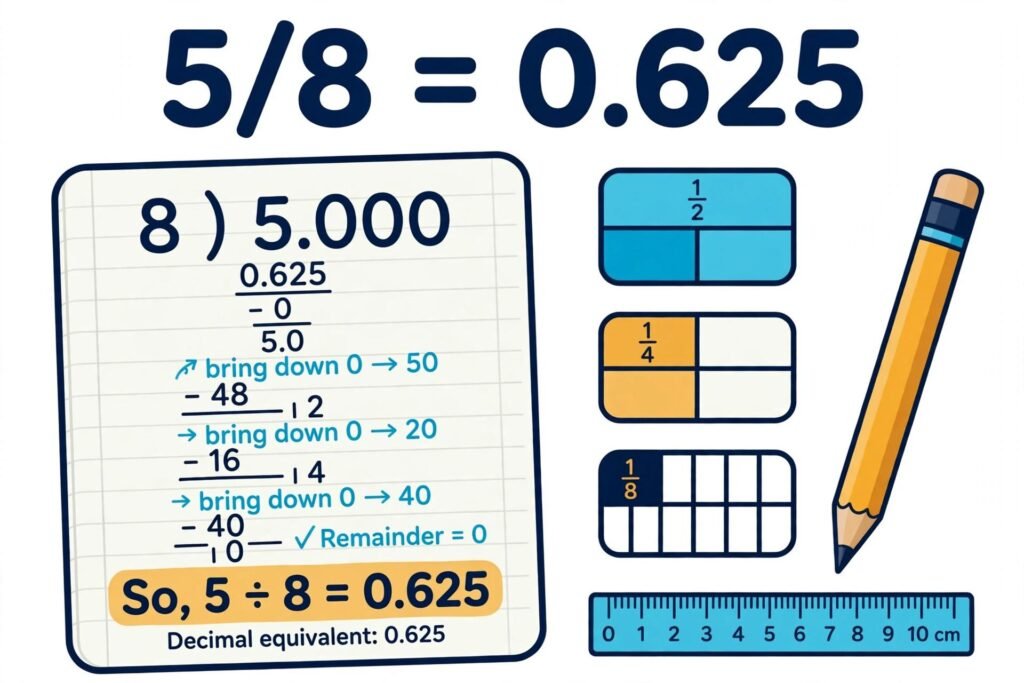
We want 5/8 as a decimal. Divide the top by the bottom.
Start with 5 divided by 8. Eight does not go into 5, so the answer starts with 0, and I put a decimal point after it. Bring down a zero, which makes 50. Eight goes into 50 six times, because 6 times 8 is 48, leaving a remainder of 2.
Bring down another zero, which makes 20. Eight goes into 20 two times, leaving a remainder of 4. Bring down one more zero, which makes 40. Eight goes into 40 exactly five times, and the remainder is 0, so the division stops. The digits I found, in order, are 6, 2, and 5. So 5/8 equals 0.625.
Try it: turn 7/8 into a decimal. Eight goes into 70 eight times with 6 left over, into 60 seven times with 4 left over, and into 40 five times with nothing left. The answer is 0.875. Check it on the Proportion Calculator and see the same digits appear.
The Mistake I See Most Often
Here is the wrong answer first. A student looks at 3/4 and writes 0.34. It feels right, because the digits 3 and 4 are right there in the fraction, and 0.34 looks like a decimal built from them. But a fraction is not two digits glued together. It is a division. Three divided by 4 is 0.75, not 0.34. Three quarters of a dollar is 75 cents, and nobody would call 34 cents three quarters of a dollar.
Before I write any decimal, I ask what the fraction is worth in plain words. Three quarters is more than a half, so the decimal has to be bigger than 0.5, and 0.34 fails that test before I even divide.
When Does the Decimal Stop, and When Does It Repeat?
Some fractions divide out neatly, like 5/8 did. Others never finish. The fraction 2/3 is the classic case: 3 goes into 20 six times with 2 left over, then into 20 again, and again, forever. The decimal is 0.666 and it never ends. We call that a repeating decimal.
You can tell which kind you have before you divide. First, reduce the fraction to its lowest terms. The Simplify Calculator guide shows how, if the fraction needs reducing. Then study the denominator. When 2 and 5 are its only prime factors, the decimal comes to a stop. The denominator 8 is 2 times 2 times 2, so 5/8 stops. The denominator 10 is 2 times 5, so 7/10 stops at 0.7.
If the denominator has any other prime factor, the decimal repeats. The denominator 12 is 2 times 2 times 3, and that 3 means trouble. For 5/12, the division gives 0.4166, and the remainder 8 comes back again and again, so the digit 6 repeats forever.
Try it: turn 1/6 into a decimal. Six goes into 10 one time with 4 left over, into 40 six times with 4 left over again, and the 4 keeps coming back. The answer is 0.1666 and the 6 repeats.
How to Round a Repeating Decimal
Homework rarely wants a decimal that goes on forever. It usually asks you to round to the nearest hundredth, which means two digits after the decimal point. The rule is to work out one digit more than you need, then look at that extra digit.
Take 2/3, which is 0.666 and keeps going. The third digit is 6, so the second digit rounds up and the answer is 0.67. For 5/6, the decimal is 0.8333 and the third digit is 3, so the second digit stays put and the answer is 0.83.
Try it: round 7/9 to the nearest hundredth. Seven divided by 9 is 0.777 and the 7 repeats, so the third digit rounds the second one up. The answer is 0.78.
What About Mixed Numbers?
A mixed number converts in two calm steps. Keep the whole number where it is, in front of the decimal point, and convert only the fraction part. For 2 3/4, the whole part is 2 and the fraction part 3/4 is 0.75, so the answer is 2.75. The Mixed Fraction Calculator guide shows the same idea from the other direction, if you ever need to go back from a decimal to a mixed number.
Try it: turn 1 1/2 into a decimal. The whole part is 1, and 1/2 is 0.5, so the answer is 1.5.
The Shortcut: Make the Denominator 10, 100, or 1,000
Long division always works, but sometimes there is a faster road. If you can turn the denominator into 10, 100, or 1,000 by multiplying the top and bottom by the same number, the decimal reads itself off. Take 7/20. Twenty times 5 is 100, so multiply the top and bottom by 5. Seven times 5 is 35, and 20 times 5 is 100, so 7/20 equals 35/100, which is 0.35.
Try it: turn 9/25 into a decimal. Twenty-five times 4 is 100, so 9/25 equals 36/100, which is 0.36.
This shortcut only works when the denominator divides a power of ten. Denominators like 20, 25, 40, and 50 qualify. Denominators like 3, 6, 7, and 9 do not, and for those you go back to long division. Divide the top by the bottom.
How to Check Your Answer
Every conversion here can be checked by going backwards. Turn the decimal back into a fraction and see whether you land on the one you started with. The Decimal to Fraction Calculator guide walks through that trip in full. For 0.625, write the digits over 1,000 to get 625/1000, then divide the top and bottom by 125 to get 5/8, exactly where I started.
An aspect ratio is a fraction in disguise, too: 16 divided by 9 is about 1.78, and the Aspect Ratio Calculator guide uses the same division to find a missing width or height.
Common Conversions to Know by Heart
These six come up so often in homework and in real measuring that they are worth knowing at a glance. Every row was worked out by the same division method above.
| Fraction | Decimal | Percent |
|---|---|---|
| 1/2 | 0.5 | 50% |
| 1/4 | 0.25 | 25% |
| 3/4 | 0.75 | 75% |
| 1/8 | 0.125 | 12.5% |
| 5/8 | 0.625 | 62.5% |
| 7/8 | 0.875 | 87.5% |
Practice Problems
Try these three before you read the answers. Each one uses a different part of the method.
- Turn 9/16 into a decimal.
- Turn 4/11 into a decimal, then round it to the nearest hundredth.
- Turn 3 1/8 into a decimal.
Answers: 1) 9/16 equals 0.5625, because 16 goes into 90 five times, into 100 six times, into 40 two times, and into 80 five times, with a remainder of zero at the end. 2) 4/11 equals 0.3636 and keeps repeating, so to the nearest hundredth it is 0.36. 3) 3 1/8 equals 3.125, because 1/8 is 0.125 and the whole part is 3.
Frequently Asked Questions
How do you convert a fraction to a decimal?
Divide the numerator by the denominator. Write the fraction as a division, then do long division, bringing down a zero each time the remainder is not zero. For 5/8, 8 goes into 50 six times, into 20 two times, and into 40 five times, so 5/8 equals 0.625. A remainder of zero means the decimal stops.
What is 5/8 as a decimal?
5/8 as a decimal is 0.625. Divide 5 by 8 with long division: 8 goes into 50 six times with 2 left over, into 20 two times with 4 left over, and into 40 exactly five times. The remainder reaches zero, so the decimal stops at 0.625, which is the same as 62.5 percent.
How do you know if a decimal repeats or stops?
First reduce the fraction to lowest terms. Then look at the denominator. If its only prime factors are 2 and 5, the decimal stops. The denominator 8 has only 2s, so 5/8 stops at 0.625. The denominator 12 has a 3 as well, so 5/12 repeats as 0.4166 and never ends.
How do you convert a mixed number to a decimal?
Keep the whole number in front of the decimal point and convert only the fraction part. For 2 3/4, the whole part is 2 and the fraction 3/4 equals 0.75, so the answer is 2.75. If the fraction part repeats, convert it the same way and round it only at the very end.
How do you round a repeating decimal to the nearest hundredth?
Work out at least three decimal places, then look at the third one. For 2/3, the decimal is 0.666 and the third digit is 6, so the second digit rounds up and the answer is 0.67. If the third digit is 4 or less, leave the second digit alone. For 5/6, 0.833 rounds to 0.83.
Key Takeaways
A fraction is a division waiting to happen. A remainder of zero ends the division, while a repeated remainder means the digits repeat. Mixed numbers keep their whole part, and a denominator that can become 10, 100, or 1,000 gives a shortcut. Round only after working out one extra digit, then turn the decimal back into a fraction to prove the answer.
Now open the Proportion Calculator and try your own homework fraction. Type the top number and the bottom number, watch the decimal appear, and check it against the long division you just learned.