
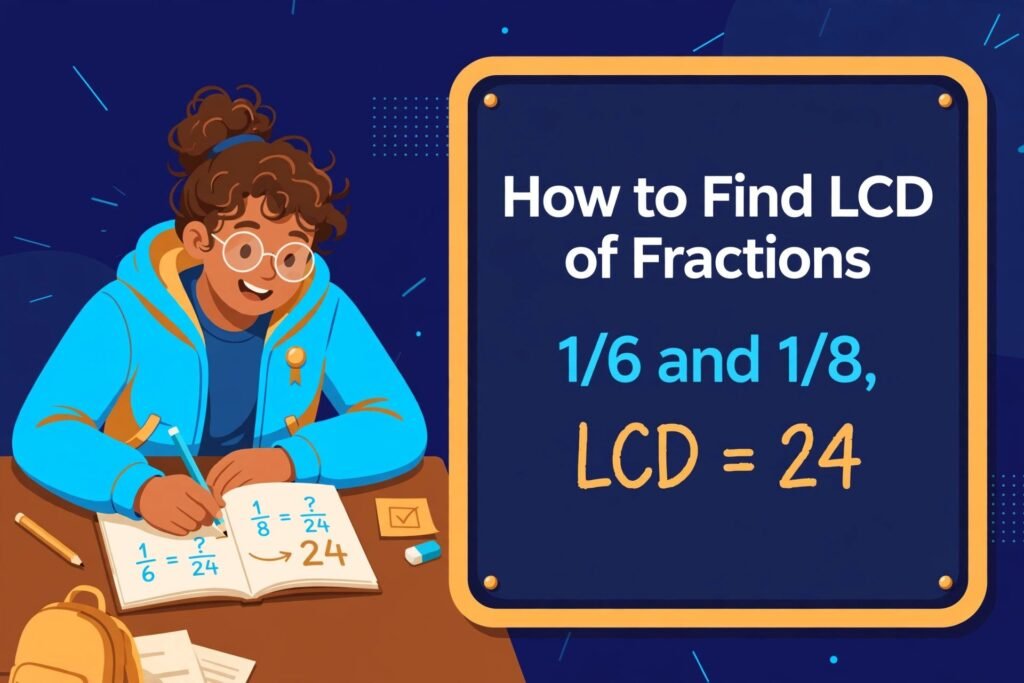
You need to add 1/6 and 1/8. The denominators do not match, so what number do both fractions share? That shared number has a name, and once you find it, the adding turns easy.
The least common denominator, or LCD, is the smallest number both denominators divide into evenly. For 1/6 and 1/8, that number is 24. Once you have it, you rewrite both fractions over 24, and then the adding is easy.
My verdict is simple. When the denominators are small, list the multiples and take the first match. When they are bigger, use prime factorization or the GCF shortcut. I keep all four methods in my pocket, and I pick the fastest one for the numbers in front of me.
What is the LCD, really?
Think of the LCD as a common meeting place for the denominators. Two fractions can only join when they share a bottom number, and the LCD is the smallest bottom number that works for both. It is the least common multiple of the denominators, the same idea you already know from whole numbers, now doing a job under fractions.
Before you trust any LCD, run one quick sense check. Every denominator must divide it evenly, with nothing left over. When one denominator fails that test, the number is not the LCD yet, and you need to keep looking.
Which method should you use?
Four methods reach the same answer, and the best one depends on your numbers. Small denominators suit a quick list. Bigger ones suit factoring. Three fractions suit the ladder. Pick the method first, and the arithmetic stays short.
| Method | Best when | Watch out for |
|---|---|---|
| List the multiples | Denominators are small, under 12 | Slow for big numbers |
| Prime factorization | Denominators are bigger, or you want certainty | Takes a minute to factor |
| GCF shortcut | Exactly two denominators | Needs the GCF first |
| Ladder method | Three or more denominators | Keep dividing until all are 1 |
When you are unsure, start with the list of multiples. It is the easiest method to check, and it shows you what the LCD means before the other methods speed it up.
Method 1: list the multiples
Listing multiples is the most direct method there is. You count by each denominator until the lists meet, and the first number they share is the LCD. It needs no factoring and no formulas, only patient counting.
I will find the LCD of 1/6 and 1/8. I count by 6: 6, 12, 18, 24. I count by 8: 8, 16, 24. The first number on both lists is 24, so the LCD is 24. I can rewrite both fractions over 24 now: 1/6 becomes 4/24, because 6 times 4 is 24 and 1 times 4 is 4, and 1/8 becomes 3/24, because 8 times 3 is 24 and 1 times 3 is 3.
Find the smallest number they all divide into.
Try it: find the LCD of 1/4 and 1/6. Count by 4 to get 4, 8, 12, and count by 6 to get 6, 12. The first shared number is 12, so the LCD is 12.
Method 2: prime factorization
Prime factorization works when the denominators are too big to list comfortably. You break each denominator into prime factors, then you take every prime at its highest power, and you multiply those together. The product is the LCD.
I will find the LCD of 5/9 and 7/12. I factor 9 into 3 times 3. I factor 12 into 2 times 2 times 3. I take each prime at its highest power: 2 appears twice, so I take 2 times 2, and 3 appears twice, so I take 3 times 3. I multiply them: 2 times 2 times 3 times 3 is 36, so the LCD is 36.
Find the smallest number they all divide into.
Try it: find the LCD of 8 and 12. Factor 8 into 2 times 2 times 2, and factor 12 into 2 times 2 times 3. Take 2 at its highest power, which is 2 times 2 times 2, and take 3 once. The product is 24, so the LCD is 24.
Method 3: the GCF shortcut
The GCF shortcut turns two numbers into one quick division. It says the LCD of two numbers equals their product divided by their greatest common factor. You only need the GCF, and the formula does the rest.
I will find the LCD of 3/10 and 7/15. The denominators are 10 and 15, and their greatest common factor is 5. I multiply the denominators: 10 times 15 is 150. I divide by the GCF: 150 divided by 5 is 30, so the LCD is 30. I can rewrite both fractions over 30 now: 3/10 becomes 9/30, because 10 times 3 is 30 and 3 times 3 is 9, and 7/15 becomes 14/30, because 15 times 2 is 30 and 7 times 2 is 14.
Try it: find the LCD of 9 and 12 with the shortcut. Their product is 108, and their greatest common factor is 3. Divide 108 by 3 to get 36, so the LCD is 36. This shortcut only works for two numbers at a time, so for three denominators, use it twice or switch to the ladder.
Method 4: the ladder method
The ladder method handles three or more denominators at once, which the shortcut cannot do. You write the denominators in a row, divide them all by a shared prime, write the results below, and repeat until every number is 1. Then you multiply the primes down the side, and the product is the LCD.
I will find the LCD of 1/6, 7/10, and 2/15. I start with 6, 10, and 15. I divide all three by 2: 6 becomes 3, 10 becomes 5, and 15 stays 15, because 2 does not divide it. I divide by 3: 3 becomes 1, 5 stays 5, and 15 becomes 5. I divide by 5: 1 stays 1, 5 becomes 1, and 5 becomes 1. The primes down the side are 2, 3, and 5, so I multiply them: 2 times 3 times 5 is 30, and the LCD is 30.
Find the smallest number they all divide into.
Try it: find the LCD of 4, 6, and 10 with the ladder. Divide by 2 to get 2, 3, 5. Divide by 2 again to get 1, 3, 5. Divide by 3 to get 1, 1, 5. Divide by 5 to get 1, 1, 1. The primes are 2, 2, 3, and 5, so the LCD is 60.
How do you use the LCD to add and subtract?
The LCD earns its keep when you add or subtract. You find it, rewrite each fraction over it, and then the tops do the work while the bottom stays put. My mixed fraction guide uses the same move inside its add and subtract jobs, and it is the right next read when whole numbers join the fractions.
I will add 1/6 and 7/10. Their LCD is 30, from the ladder above. I rewrite 1/6 as 5/30, because 6 times 5 is 30 and 1 times 5 is 5. I rewrite 7/10 as 21/30, because 10 times 3 is 30 and 7 times 3 is 21. Now I add the tops: 5 plus 21 is 26, so the sum is 26/30. Both numbers share 2, so I simplify to 13/15.
I will subtract 7/10 minus 1/6 with the same LCD, 30. I rewrite 7/10 as 21/30 and 1/6 as 5/30. I subtract the tops: 21 minus 5 is 16, so the answer is 16/30. Both numbers share 2, so I simplify to 8/15.
Comparing works the same way. I will compare 5/9 and 7/12, whose LCD is 36 from the factoring method. I rewrite 5/9 as 20/36, because 9 times 4 is 36 and 5 times 4 is 20. I rewrite 7/12 as 21/36, because 12 times 3 is 36 and 7 times 3 is 21. The top 21 beats 20, so 7/12 is the bigger fraction.
What mistake catches almost everyone?
The most common mistake is adding the tops and the bottoms separately, which skips the LCD entirely. It feels fast, because it copies what multiplication does, but it breaks the meaning of a fraction. Watch it fail: 1/5 + 1/7 done the wrong way gives 2/12, which simplifies to 1/6. That cannot be right, because 1/5 alone is already bigger than 1/6, and adding a positive number cannot shrink the total. The right way uses the LCD, 35: 1/5 becomes 7/35 and 1/7 becomes 5/35, so the answer is 12/35. The wrong answer is smaller than one of the parts. The right answer is bigger than both.
How do you check the LCD before you trust it?
I check every LCD with two quick tests before I use it. First, I divide the LCD by each denominator and I must get a whole number every time, with nothing left over. Second, I check that no smaller number passes the same test, because a bigger common denominator still works but makes the arithmetic heavier. When both tests pass, I use the LCD with confidence.
There is one more check I use after rewriting. I test the rewritten fraction with the proportion formula: 5/9 equals 20/36 only when 5 times 36 equals 9 times 20, and both give 180. When the cross products match, the rewrite is right, and the LCD did its job.
- Pick a method from the table above.
- Find the LCD and test it against every denominator.
- Rewrite each fraction over the LCD.
- Add, subtract, or compare, then simplify the answer. Type the same fractions into the Proportion Calculator and read its steps to confirm.
Find the smallest number they all divide into.
Practice problems
Try these four on paper first, then check each one on the calculator. The answers sit right after the list, so cover them while you work.
- Find the LCD of 1/5 and 3/10.
- Add 2/9 and 5/12.
- Subtract 7/8 minus 3/10.
- Compare 4/7 and 5/9. Which is bigger?
Answers: (a) 10. (b) 23/36. (c) 23/40. (d) 4/7 is bigger, because 36/63 beats 35/63.
Key takeaways
The LCD is the smallest number all the denominators divide into, and it is the LCM of those denominators. Small numbers suit a list of multiples, bigger ones suit prime factorization, two numbers suit the GCF shortcut, and three or more suit the ladder. Rewrite each fraction over the LCD, then add, subtract, or compare the tops. Check the LCD against every denominator before you use it, and trust the answer only when the check passes.
Frequently asked questions
What is the LCD of two fractions?
The LCD of two fractions is the smallest number both denominators divide into evenly, with nothing left over. It is the least common multiple of the two denominators. Once you find it, you rewrite both fractions over that number, and then you can add, subtract, or compare them.
Is the LCD the same as the LCM?
Yes, for fractions the LCD is the LCM of the denominators, the same number with a different name. The LCM works on whole numbers, and the LCD is what you call it when those numbers sit under fractions. Finding one always finds the other, so you only learn the method once.
What if one denominator already divides the other?
Then the bigger denominator is the LCD, and you are done in one step. For 1/6 and 1/12, the LCD is 12, because 6 divides 12 evenly. Only the fraction with the smaller denominator needs rewriting, so the work stays short.
Can I just multiply the denominators together?
You can, because the product of the denominators is always a common denominator, but it is often not the least one. Using it means bigger numbers and an extra simplifying step at the end. The LCD keeps the numbers small, so find it when the denominators are not tiny.
How do I use the LCD to add fractions?
Find the LCD first, then rewrite each fraction over it by multiplying the top and bottom by the same number. Add the new tops and keep the LCD as the bottom. Simplify the answer if the top and bottom share a factor, and check that the sum is bigger than each part.
What is the LCD of three fractions?
The LCD of three fractions is the smallest number all three denominators divide into, found the same way as for two. List multiples, factor into primes, or use the ladder method with all three numbers at once. Then rewrite each fraction over that number before you add, subtract, or compare them.