
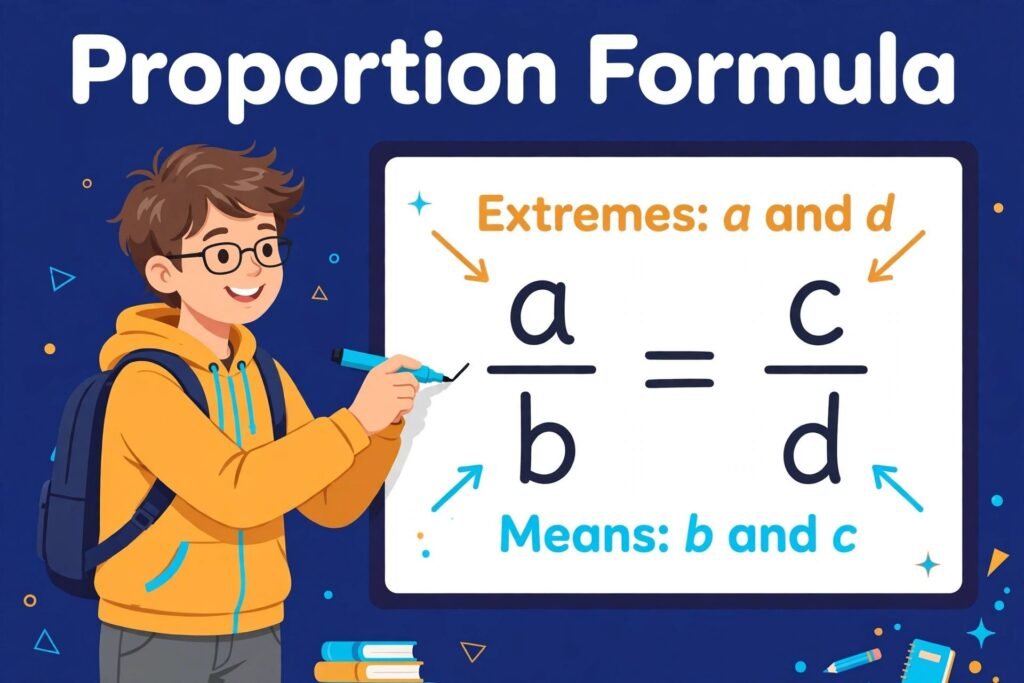
Proportion Formula: a/b = c/d, Means and Extremes
I once set up a proportion with miles over hours on the left and hours over miles on the right, then stared at an answer that said a car travels 4 miles in 60 hours. My arithmetic was fine, but the formula was upside down on one side, and the numbers paid the price. That one crooked setup taught me the lesson: the proportion formula only works when both sides tell the same story in the same order.
This guide fixes that mistake at the root. You will learn the formula itself, a over b equals c over d, its four terms, why the cross products must match, how to rewrite it in equivalent forms, and how to set it up from a word problem without mixing the units. I made these errors myself, so I will show you the wrong turn first.
What Went Wrong in That Setup?
Look at my bad setup again. On the left I wrote miles over hours, and on the right I wrote hours over miles. The two sides were not the same kind of ratio, so the equals sign lied. A proportion is two equal ratios, so the top of each side must carry the same unit and the bottom of each side must carry the same unit.
Here is the corrected version: a car travels 120 miles in 2 hours, and I want the time for 240 miles at the same speed. Miles go on top both times and hours go on the bottom both times: 120 / 2 = 240 / x. Now both sides read miles per hour. That unit check catches more errors than any other habit in this guide.
What Are the Four Terms of a Proportion?
Every proportion has four numbers, each with a name worth learning. In a over b equals c over d, the letters a, b, c, and d are the terms. The outside terms, a and d, are called the extremes, because they sit at the far ends. Inside, b and c are called the means, because they sit in the middle.
Take a real example and label it with me. In 2 / 3 = 8 / 12, the extremes are 2 and 12, the numbers on the outside edges, and the means are 3 and 8, the numbers hugging the equals sign. Extremes live at the extremes, means live in the middle.
Why do the names matter at all? Because the whole checking trick of this guide runs on them. The product of the means equals the product of the extremes in every true proportion, and that single sentence turns a guess into a test. If a fraction still puzzles you, my fraction to decimal guide shows how a ratio and a decimal match.
Why Do the Cross Products Have to Match?
Cross products are the multiplications you get by reaching across the equals sign. Multiply the means together and the extremes together, then compare. In a true proportion the two products are always equal, and that is the means-extremes property in action. A proportion is two equal ratios.
Let me show it with the example from the last section. In 2 / 3 = 8 / 12, the means are 3 and 8, and their product is 3 x 8 = 24. The extremes are 2 and 12, and their product is 2 x 12 = 24. Both products land on 24, so the proportion is true. I check every proportion this way, or I run it through the Proportion Calculator.
Try It: Check whether 3 / 5 = 9 / 15 is a proportion. Multiply the means, 5 x 9 = 45, and the extremes, 3 x 15 = 45. The products match, so the two ratios form a proportion.
Common mistake: A classmate of mine once multiplied straight across instead of crossways. In 2 / 3 = 8 / 12 he worked out 2 x 8 = 16 and 3 x 12 = 36, then announced the proportion was false. The wrong pairing gave a wrong verdict. Cross products reach across the equals sign, means with means and extremes with extremes, and only those pairings tell the truth. My guide to cross multiplication explained walks through the same check step by step.
Which Equivalent Form Should I Use?
One proportion can wear several outfits. Equivalent forms rewrite the same proportion without changing its value, and each form suits a different job. The three forms you will meet most are the reciprocal, the swap of the means, and adding one to each side. Pick the form that puts the number you need within reach.
Start from 5 / 7 = 15 / 21. Flip both sides for the reciprocal: 7 / 5 = 21 / 15, with cross products 7 x 15 = 105 and 5 x 21 = 105. Swap the means instead: 5 / 15 = 7 / 21, with cross products 5 x 21 = 105 and 15 x 7 = 105. Add one to each side: (5 + 7) / 7 = (15 + 21) / 21, or 12 / 7 = 36 / 21, with cross products 12 x 21 = 252 and 7 x 36 = 252.
So which form do you actually use? Reach for the reciprocal when the unknown sits in a denominator and flipping puts it on top. Try the swap of the means when the known numbers sit on opposite sides and you want them together. Use the addition form when a problem gives you a sum, like a total length split into two parts. A proportion is two equal ratios.
| Form | What changes | Use it when |
|---|---|---|
| Reciprocal | Both sides flip | Unknown sits in a denominator |
| Swap the means | Inside terms trade places | Known numbers should sit together |
| Add one | One added to each side | Problem gives you a sum |
Try It: Rewrite 4 / 9 = 12 / 27 by swapping the means. You should get 4 / 12 = 9 / 27, and the check holds: 4 x 27 = 108 and 12 x 9 = 108.
How Do I Set Up the Formula From a Word Problem?
Word problems hand you a story, not a formula, so first pull out two ratios with matching units. Notebooks cost money here, so notebooks go on top and dollars go on the bottom, on both sides. My guide to how to calculate for ratio covers the same habit.
Here is the problem. 9 notebooks cost $13.50, and I want the cost of 14 notebooks. Write 9 / 13.50 = 14 / x, notebooks on top and dollars below on each side. Cross multiply and you get 9x = 189, so x = 21, which means 14 notebooks cost $21.00. Check it: $13.50 / 9 = $1.50 each, and 14 x $1.50 = $21.00. A proportion is two equal ratios.
Try It: 6 notebooks cost $9.00. What do 10 notebooks cost at the same price? Set up 6 / 9 = 10 / x and solve. You should get $15.00, checked at $1.50 each times 10.
Is This Pair a Proportion or Not?
Not every pair of ratios earns the equals sign, and the cross product check is the judge. Take 7 / 9 = 14 / 18. The means give 9 x 14 = 126 and the extremes give 7 x 18 = 126, so the products match and the pair is a true proportion. Now take 4 / 7 = 9 / 15. The means give 7 x 9 = 63 and the extremes give 4 x 15 = 60, so the products differ and the pair is not a proportion. Equal products mean yes, and unequal products mean no.
Try It: Is 5 / 8 = 15 / 24 a proportion? Multiply the means, 8 x 15 = 120, and the extremes, 5 x 24 = 120. The products match, so yes, it is true.
What If One Term Is Missing?
Sometimes one of the four terms is a letter. The formula still works the same way: cross multiply, then divide. In x / 9 = 10 / 15, cross multiplying gives 15x = 90, so x = 6, and the check holds, 6 / 9 = 10 / 15, which the Proportion Calculator also confirms. My guide to solve for x in a proportion works through every position the missing term can sit in.
Try It: Find y in 5 / y = 20 / 28. Cross multiply to get 20y = 140, so y = 7, and 5 / 7 = 20 / 28 checks out.
When Should I Use This Formula, and When Should I Not?
Use the proportion formula when two ratios should be equal and three of the four terms are known. Skip it when the quantities do not grow together in a fixed ratio, and skip it for percent problems, which use their own formula. A relationship like y = kx instead of two equal ratios belongs to variation, not to this page.
Can You Solve These Three?
- Name the means and extremes in 6 / 11 = 18 / 33. Answer: means 11 and 18, extremes 6 and 33; 11 x 18 = 198 equals 6 x 33 = 198, so it is a true proportion.
- 4 packs cost $11.00. What do 7 packs cost? Answer: 4 / 11 = 7 / x gives 4x = 77, so x = $19.25, checked at $2.75 a pack times 7.
- Rewrite 8 / 10 = 24 / 30 in reciprocal form. Answer: 10 / 8 = 30 / 24, and 10 x 24 = 240 equals 8 x 30 = 240.
Key Takeaways
The proportion formula, a over b equals c over d, says two ratios are equal. Name the outside terms the extremes and the inside terms the means, then check that the product of the means equals the product of the extremes. Match the units before you write anything, and check every answer with a cross product.
Frequently Asked Questions
What is the proportion formula? The proportion formula is a over b equals c over d, two ratios set equal to each other. The letters stand for four numbers, called terms. It says the first ratio has the same value as the second ratio, so you can use it to check a pair of ratios or to find a missing term.
What are the means and extremes in a proportion? In a over b equals c over d, the extremes are the outside terms, a and d, and the means are the inside terms, b and c. The product of the means equals the product of the extremes when the proportion is true. That single fact is the check you use on every proportion you meet.
How do I check if two ratios form a proportion? Multiply the means and multiply the extremes, then compare the two products. In 2 over 3 equals 8 over 12, the means give 3 times 8, which is 24, and the extremes give 2 times 12, which is also 24. Equal products mean a true proportion, and unequal products mean the ratios do not form one.
What are the equivalent forms of a proportion? Equivalent forms rewrite the same proportion without changing its value. From 5 over 7 equals 15 over 21 you can flip both sides to get 7 over 5 equals 21 over 15, or swap the means to get 5 over 15 equals 7 over 21. Both forms keep the cross products equal at 105.
How do I set up a proportion formula from a word problem? Match the units first, top with top and bottom with bottom, then write the two ratios. For 9 notebooks costing 13 dollars 50, write 9 over 13.50 equals 14 over x for 14 notebooks. Cross multiply to get 9x equals 189, so x is 21 dollars, and check it at 1 dollar 50 per notebook.