
“30% of 240 students ride the bus. How many ride the bus?” Set it up fast: x over 30 equals 240 over 100. Cross-multiply, and x is 800. Eight hundred students ride the bus. Out of 240 students. That cannot be right. You cannot have more riders than students.
That is the whole trap of a percent proportion. The solving is cross multiplication, and the arithmetic is easy. The setup is where the question is won or lost. I always ask one question before I touch a calculator. Which number is the full amount? Label first, then multiply. That is the whole post.
One setup for every percent question
A percent proportion is the equation part over whole equals percent over 100. It turns any percent question into a proportion you can solve: put the part over the whole on one side, the percent over 100 on the other, and cross multiply to find the missing number. That single setup is the whole point of this post. Whether a question asks for the part, the whole, or the percent, the equation stays the same, and only the unknown moves. Learn to label the three numbers correctly and every percent problem becomes the same familiar job: set it up, cross multiply, and check the answer against a quick estimate. Label first, then multiply.
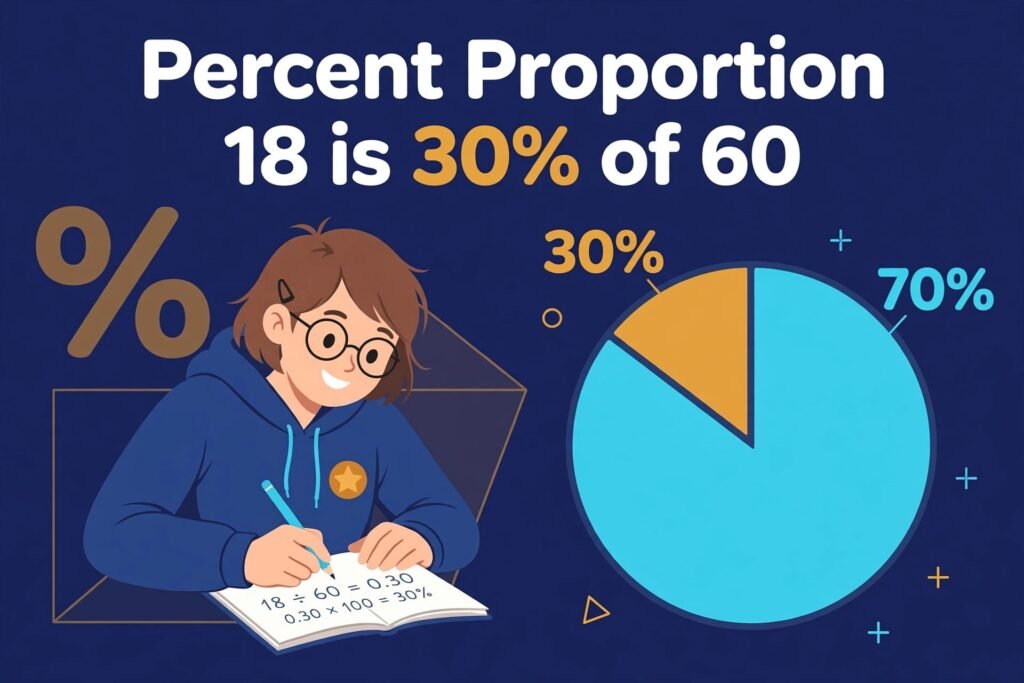
Percent means out of one hundred, so a percent is already a fraction with 100 underneath it. Thirty percent is 30 out of 100, which is the same as 30/100. A percent proportion simply sets that fraction equal to another fraction, the part out of the whole. If 18 students out of 60 ride the bus, the fraction 18/60 describes exactly the same share as 30/100, and writing 18/60 = 30/100 is the percent proportion for that situation. Three numbers appear in every percent problem: the part, the whole, and the percent. The whole is the full amount you are taking a share of. The part is the piece of it you are interested in. The percent is the number with the % sign. Most textbook questions give you a clue: the number after the word “is” is the part, and the number after the word “of” is the whole. In “18 is 30% of 60,” the part is 18 and the whole is 60, and the setup writes itself. Once the proportion is written, the solving is cross multiplication, the same move explained in Cross Multiplication Explained. The work that matters here is the setup, because a correctly labeled proportion almost solves itself, while a swapped label gives a confident wrong answer.
Three questions, one equation
Every percent question is one of three kinds, and the only thing that changes is which slot holds the x. The table below shows all three at a glance, so you can match the question in front of you to its row before you write anything down.
| Question type | What you know | Where the x goes | Setup |
|---|---|---|---|
| Find the part | The percent and the whole | x over the whole | x/240 = 30/100 |
| Find the whole | The part and the percent | x under the part | 18/x = 30/100 |
| Find the percent | The part and the whole | x over 100 | 27/90 = x/100 |
Notice that the setup never changes: part over whole on the left, percent over 100 on the right. What changes is only where the x sits. That is why labeling comes first and multiplying comes second. Once the numbers are in the right slots, the arithmetic is the same in all three cases.
How many ride the bus?
A school has 240 students, and 30% of them ride the bus to school. How many students ride the bus? Here the whole is 240 students and the percent is 30, so the part is the unknown. Set it up as x/240 = 30/100 and cross multiply: 100x = 240 times 30, which is 7,200, so x = 72. Seventy-two students ride the bus. Before trusting that answer, estimate it. Ten percent of 240 is 24, so 30% is three lots of 24, which is 72. The estimate agrees exactly, which is what you want to see. Try the same numbers on the Proportion Calculator, setting up 30/100 = x/240, and check that you get 72 too. If your answer differs, look at the labels first: the whole, 240, belongs underneath the x. Label first, then multiply.
Try it. A school has 300 students, and 40% of them ride the bus. How many ride the bus? The whole is 300 and the percent is 40, so x/300 = 40/100. Cross multiply: 100x = 12,000, so x = 120. Estimate: 10% of 300 is 30, so 40% is four lots of 30, which is 120.
18 is 30% of what number?
Now the unknown moves underneath. The question is: 18 is 30% of what number? The part is 18, the percent is 30, and the whole is missing, so the setup is 18/x = 30/100. Cross multiply: 30x = 18 times 100, which is 1,800, so x = 60. The whole number is 60, and the check is quick: 30% of 60 is 18, which is where we started. This is the case students find hardest, because the x sits in a denominator and the answer comes out bigger than the part. That is exactly right, though: the whole is always bigger than the part when the percent is below 100, so an answer smaller than 18 would have been a warning sign. Whenever your answer for a whole comes out smaller than the part, stop and check the setup.
Try it. 25 is 20% of what number? The part is 25 and the percent is 20, so 25/x = 20/100. Cross multiply: 20x = 2,500, so x = 125. Check: 20% of 125 is 25.
What percent did Maya score?
A quiz has 90 points in total, and Maya scores 27. What percent did she score? The part is 27, the whole is 90, and the percent is unknown, so x goes over 100: 27/90 = x/100. Cross multiply: 90x = 27 times 100, which is 2,700, so x = 30. Maya scored 30%. The check runs the other way: 30% of 90 is 27, which matches her score. When the percent is the unknown, the answer you get is the percent number itself, so remember to write the % sign with it. An answer of 30 without the sign is not wrong in the arithmetic, but it does not answer the question, and on a test it can cost the mark. Also note that a percent over 100 is possible: if the part is bigger than the whole, the percent comes out above 100, and that can still be correct, for example, scoring 108 points on a 90-point quiz with bonus questions is 120%.
Try it. A test has 80 points, and Omar scores 64. What percent did he score? 64/80 = x/100. Cross multiply: 80x = 6,400, so x = 80. Check: 80% of 80 is 64.
What if the sentence has no “is” and no “of”?
Textbook questions usually hand you the words “is” and “of,” but real-life questions do not. A price tag never says “the discount is 25% of the price.” It says “25% off.” That is the gap most explanations leave open: they teach the word clue and stop, so the method falls apart the moment the wording changes. The fix is to label by meaning instead of by words. Ask which number is the full amount. That is the whole. Ask which number is the piece you want. That is the part. Ask which number carries the % sign. That is the percent. Here is a trick I say out loud, every time. “Part over whole equals percent over 100.” Say the setup the same way every time, and the labels fall into place.
A jacket costs $84 and is on sale at 25% off. What is the sale price? The full amount is $84, so the whole is 84. The percent off is 25. The discount is the unknown part, so set it up as x/84 = 25/100. Cross multiply: 100x = 84 times 25, which is 2,100, so x = 21. The discount is $21, and the sale price is $84 minus $21, which is $63. A quick estimate backs it up: 25% is a quarter, and a quarter of $84 is $21, so the discount looks right before you trust it. There is also a shorter route to the same answer. Paying 25% less means paying 100% minus 25%, which is 75% of the original price, and 75% of $84 is $63. Both routes land on $63, and the second one skips the subtraction. Try the discount version on the Proportion Calculator with 25/100 = x/84 and confirm you get 21 before you subtract. Label first, then multiply.
Try it. A shirt costs $60 and is on sale at 20% off. What is the sale price? The discount is the unknown part: x/60 = 20/100. Cross multiply: 100x = 1,200, so x = 12. The discount is $12, and the sale price is $60 minus $12, which is $48. Shorter route: pay 80%, and 80% of $60 is $48.
Tips and sales: one more step
A tip is a percent increase, and a sale is a percent decrease, and the percent proportion handles both. The only difference is what you do after the proportion gives you its answer. For a tip, the proportion finds the tip, and then you add it to the bill. For a sale, the proportion finds the discount, and then you subtract it from the price. A dinner bill comes to $46, and you want to leave a 20% tip. The whole is the bill, $46, the percent is 20, and the tip is the unknown part: x/46 = 20/100. Cross multiply: 100x = 46 times 20, which is 920, so x = 9.20. The tip is $9.20, and the total you pay is $46 plus $9.20, which is $55.20. The estimate agrees: 10% of $46 is $4.60, so 20% is twice that, $9.20.
Percent increase works the same way, except the whole is the original value, never the new one. A lunch combo rises from $12 to $15. The increase is $15 minus $12, which is $3, and the question is what percent $3 is of the original $12: 3/12 = x/100. Cross multiply: 12x = 300, so x = 25. The price rose by 25%. Putting the new price, $15, underneath instead would have given a smaller, wrong percent, which is the trap to watch for. Word problems that mix percents with money, recipes, and maps follow the same pattern: set up the proportion first, then decide whether the answer needs adding or subtracting. The proportion word problems post works through money, recipes, and maps the same way, if you want more practice with the setup before the arithmetic.
Try it. A dinner bill comes to $80, and you want to leave a 15% tip. How much is the tip, and what is the total? The tip is the unknown part: x/80 = 15/100. Cross multiply: 100x = 1,200, so x = 12. The tip is $12, and the total is $80 plus $12, which is $92. Estimate: 10% of $80 is $8 and 5% is $4, and $8 plus $4 is $12.
Four mistakes that quietly change the answer
Swapping the part and the whole is the most common mistake, and the hardest to spot, because the arithmetic still works. If the whole goes on top, the proportion answers a different question and the result is usually a percent over 100 or a whole smaller than the part. That was the mistake at the top of this page: 800 riders out of 240 students. Before you multiply anything, ask: which number is the full amount? That number goes underneath.
Forgetting the 100 is the second trap. The percent must sit over 100 in the proportion, so 25% enters the setup as 25/100, never as a bare 25. Writing x/84 = 25 gives an answer one hundred times too big, and the mistake hides because the cross multiplication itself looks correct. The same error in reverse is dividing by 100 twice: turning 25% into 0.25 and then still putting it over 100. Pick one form, the percent number over 100, and use it.
Stopping one step early is the third mistake, and it only shows up in money questions. The proportion finds the discount or the tip, not the price you pay. A sale question wants the price after the discount, so subtract; a tip question wants the total, so add. Read the last line of the question again after you solve, and check that the number you circled is the one it actually asked for.
Finally, money answers need rounding to the nearest cent, and only once, at the end. A tip of $9.20 is written with two decimal places, even though $9.2 is the same value, because money is always written to the cent. Solve with the full numbers, round once at the end, and then check the rounded answer against your estimate.
Try these two yourself
Try these two before you read the answers. First, what is 15% of 180? Second, 42 is 35% of what number? For the first, set it up as x/180 = 15/100, so 100x = 2,700 and x = 27. The check is quick: 10% of 180 is 18 and 5% is 9, and 18 plus 9 is 27. For the second, the setup is 42/x = 35/100, so 35x = 4,200 and x = 120. Check: 35% of 120 is 42, because 10% of 120 is 12 and 35% is three and a half lots of 12, which is 42.
The short version
One equation does three jobs: part over whole equals percent over 100, and whichever of the three is missing becomes the x. Label before you multiply. The whole is the full amount, the part is the piece, and the percent sits over 100. Cross multiplication only solves the proportion; the setup is where the question is won or lost. In shops and restaurants, the proportion finds the discount or the tip. The price you pay still needs one more add or subtract.
Questions students ask next
What is a percent proportion? A percent proportion is an equation that sets the part over the whole equal to the percent over 100. It lets you find the part, the whole, or the percent whenever you know the other two, using the same setup and the same cross multiplication each time.
How do I tell which number is the part and which is the whole? The whole is the full amount you are taking a share of, and the part is the piece of it. In textbook sentences, the number after “is” is usually the part and the number after “of” is usually the whole. When those words are missing, ask which number is the full amount. That is the whole.
Can a percent be more than 100? Yes. When the part is bigger than the whole, the percent comes out above 100. Scoring 108 points on a 90-point quiz with bonus questions is 120%, and that is correct. A percent can only pass 100 when the part can be bigger than the whole.
Why did I get the discount instead of the sale price? Because the percent proportion finds the part, and in a sale question the part is the discount. The sale price is one step further: subtract the discount from the original price. A jacket at $84 with $21 off costs $63, not $21.
Do I have to cross multiply to solve a percent proportion? Cross multiplication is the usual solving step once the proportion is set up, and it works the same way for all three question types. The full method is explained in the cross multiplication post. The part that needs care is the setup, not the multiplying.
Try it on the calculator
In a percent proportion, the percent sits over 100 and the part sits over the whole. For the jacket, 25/100 = x/84 gives a discount of 21, and subtracting 21 from 84 leaves a sale price of 63. Once the labels are in the right places, the solving is cross multiplication, and the setup is the part that needs care.