
A photo is 4 inches wide and 6 inches tall. The new width has to be 10 inches. Divide first and think later: 4 divided by 10 is 0.4, so the scale factor is 0.4. Multiply the height by 0.4 and you get 2.4 inches. A bigger photo with a shorter height. That cannot be right. A photo that grows wider cannot shrink taller.
That is the whole trap of a scale factor. The division is easy. The direction of the division is the actual skill. I always ask one question before I touch a calculator. Which length is new, and which is original? New over original. That is the whole post.
What does one number actually control?
A scale factor is the number you multiply every length of a figure by to make a larger or smaller copy of it. If the scale factor is greater than 1, the copy is bigger. If it is between 0 and 1, the copy is smaller. If it is exactly 1, the copy is the same size. The shape stays exactly the same. Only the size changes. New over original.
Think of a scale factor as a single instruction that applies to a whole figure at once. One number controls every length: the width, the height, and every side in between all get multiplied by the same amount. That is why the enlarged or reduced copy looks like the original and not like a stretched or squashed version of it. Two things about the figure do not change at all. The angles stay the same size, so a right angle is still a right angle in the copy, and the shape keeps its proportions, so a long thin rectangle stays long and thin instead of turning into a square. Only the lengths change, and they all change by the same factor. If that last part is not true (if one side was multiplied by 2 and another by 3), then you are not looking at a scale factor at all, and the two figures are not similar copies of each other. Scale factors show up far beyond geometry homework: a photo printed larger for a frame, a model car built to a smaller scale, a floor plan drawn on paper.
Bigger, same, or smaller?
Before you calculate anything, the scale factor itself tells you which way the size is going. The table below is the quickest way to read it, and it is worth a glance every time a question hands you a scale factor before you start multiplying.
| Scale factor | What happens | Example |
|---|---|---|
| Greater than 1, like 2.5 | Enlargement, every length grows | A 4 in. photo side becomes 10 in. |
| Exactly 1 | No change, a copy the same size | A 6 in. side stays 6 in. |
| Between 0 and 1, like 1/3 | Reduction, every length shrinks | An 18 in. poster side becomes 6 in. |
The middle row is the one students forget, and it is a useful check on your own work. A scale factor of 1 means the copy is identical in size to the original, which is just a photocopy at 100%. Anything above 1 stretches the figure out, and anything between 0 and 1 pulls it in. A scale factor can never be zero or negative for an ordinary enlargement or reduction, because a side length of zero or less than zero is not a real length.
How do you find it in three steps?
Finding a scale factor takes three steps, and the order matters. First, pick a pair of sides that match each other, the same side of the figure in the original and in the copy. The top edge must be compared with the top edge, and the left edge with the left edge. If the copy has been turned around, work out which side lines up with which before you touch any numbers. Second, divide the length in the new figure by the matching length in the original figure. That one division is the scale factor: scale factor = new length divided by original length. New over original. Third, check the answer with a second pair of matching sides. Divide those two lengths the same way, and you should get the same scale factor. If the two divisions give different answers, either the sides were mismatched or the figures are not similar copies, and multiplying onward will only carry the mistake forward.
That second pair is the check most short guides leave out, and it is the step that saves you on a test. One pair of sides can agree by luck; two pairs agreeing means the scale factor is real. It also catches the most common mix-up in this topic, which is dividing in the wrong direction, because a flipped division gives you the reciprocal (1/2.5 instead of 2.5), and the second pair will not match it. Here is a trick I say out loud, every time. “New over original. New on top, original below.” Say it before you divide, and you will never flip them.
A photo that grows: 4 by 6 becomes 10 by 15
A photo is 4 inches wide and 6 inches tall. It is enlarged so that the new width is 10 inches. What is the scale factor, and how tall is the enlarged photo? Start with the matching pair you know: the width, 4 inches in the original and 10 inches in the enlarged copy. Divide new by original: 10 divided by 4 is 2.5, so the scale factor is 2.5. That number is bigger than 1, which fits what you can see. The photo is getting larger. Now use the scale factor on the height, the side you do not know yet. Multiply the original height by 2.5: 6 times 2.5 is 15 inches. The enlarged photo is 10 inches wide and 15 inches tall. New over original. Check it with the ratio you already know: 4/6 simplifies to 2/3, and 10/15 simplifies to 2/3 as well, so the two rectangles are the same shape. Try those same numbers on the Proportion Calculator in Solve mode, with 4/6 = 10/x. You should get 15 inches for the height, matching the multiplication above.
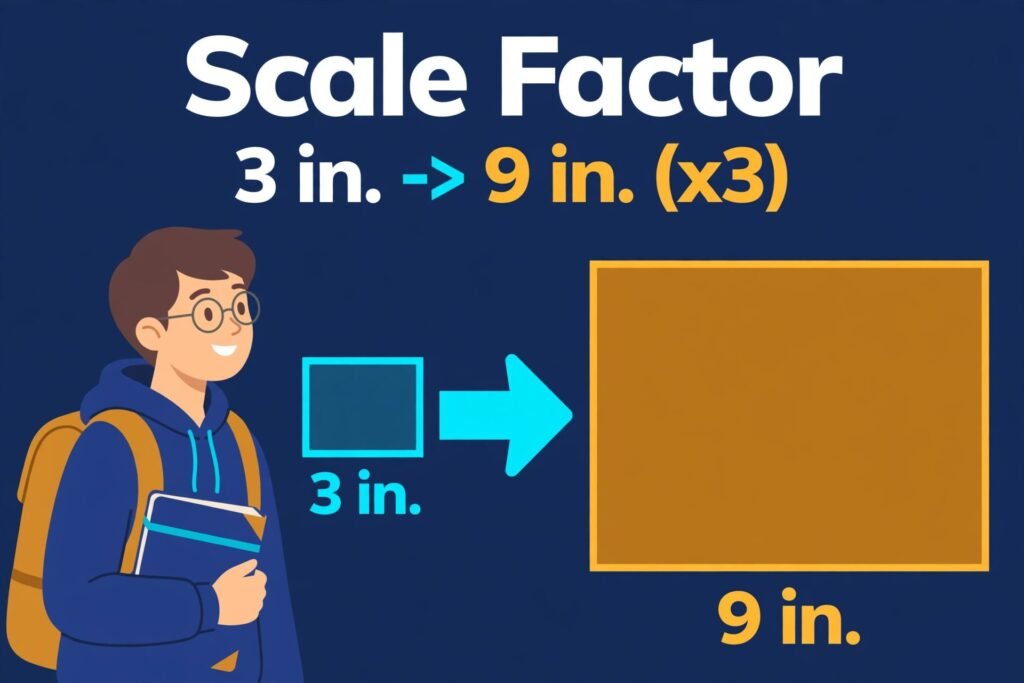
Try it. A drawing is 3 inches wide and 5 inches tall. It is enlarged so that the new width is 9 inches. What is the scale factor, and how tall is the enlarged drawing? New over original: 9 divided by 3 is 3, so the scale factor is 3. Height: 5 times 3 is 15 inches. Check: 3/5 is 0.6, and 9/15 is 0.6.
A poster that shrinks: 18 by 12 becomes 6 by 4
Not every scale factor is a whole number, and not every copy is bigger. A poster is 18 inches wide and 12 inches tall, and it is printed smaller for a flyer at a scale factor of 1/3. The fraction tells you straight away that this is a reduction, because 1/3 sits between 0 and 1. Multiply each side by 1/3: the width becomes 18 times 1/3, which is 6 inches, and the height becomes 12 times 1/3, which is 4 inches. The flyer is 6 inches wide and 4 inches tall. New over original. Check the result the same way as before, with a second pair. The original ratio of width to height is 18/12, which simplifies to 3/2. The flyer ratio is 6/4, which also simplifies to 3/2. The shape survived the shrink, which is exactly what a scale factor guarantees. Notice that the check used the same idea as simplifying ratios: both pairs of sides reduce to the same simplest ratio. Fractions like 1/3 are worth getting comfortable with, because they are the form a reduction usually takes in homework. A scale factor of 1/2 means halving every length, 1/4 means quartering them, and 2/3 means keeping two thirds of each length. If the fraction looks unfamiliar, turn it into a decimal for a moment (1/3 is about 0.333), and the size of the shrink becomes easy to picture.
Try it. A poster is 20 inches wide and 16 inches tall, printed smaller at a scale factor of 1/4. Width: 20 times 1/4 is 5 inches. Height: 16 times 1/4 is 4 inches. Check: 20/16 is 1.25, and 5/4 is 1.25.
A fraction above one: does 3/2 grow or shrink?
Scale factors between 1 and 2 often appear as fractions, and they trip students up because the number looks small while the figure is actually growing. Take a rectangle 8 inches wide and 5 inches tall, enlarged with a scale factor of 3/2. Since 3/2 is 1.5, which is greater than 1, this is an enlargement, even though the scale factor is written as a fraction. Multiply both sides by 3/2: the width becomes 8 times 3/2, which is 12 inches, and the height becomes 5 times 3/2, which is 7.5 inches. New over original. Check with the second pair again. The original ratio 8/5 is 1.6, and the new ratio 12/7.5 is also 1.6, because 12 divided by 7.5 equals 1.6. The two ratios match, so the copy is a true enlargement. The practical point is simple: never judge whether a figure grows or shrinks by whether the scale factor is a fraction. Judge it by whether the number is above or below 1. A fraction above 1, like 3/2 or 5/4, enlarges; a fraction below 1, like 1/3 or 2/5, reduces.
Try it. A rectangle is 6 inches wide and 4 inches tall, enlarged with a scale factor of 5/4. Width: 6 times 5/4 is 7.5 inches. Height: 4 times 5/4 is 5 inches. Check: 6/4 is 1.5, and 7.5/5 is 1.5.
How big is a bedroom on a floor plan?
Scale factors also run real drawings, and a floor plan is the example you are most likely to meet outside school. A house plan is drawn so that 1 inch on the paper stands for 4 feet in the real house. In inches, 4 feet is 48 inches, so the scale factor from the real house to the drawing is 1/48. Every real length is divided by 48 to fit on the paper. On the plan, a bedroom measures 2.5 inches wide. To find the real width, work backwards from the drawing: multiply the plan length by 48. That gives 2.5 times 48, which is 120 inches, and 120 inches is 10 feet, so the bedroom is 10 feet wide. The living room on the same plan measures 3.75 inches across, so its real width is 3.75 times 48, which is 180 inches, which is 15 feet. Check the bedroom with the ratio: 2.5 inches on paper to 120 inches in real life simplifies to 1/48, because 120 divided by 2.5 is 48. That is the scale factor again, which is what you want to see. If a plan question gives the scale the other way round, as “1 inch = 4 feet”, write it as a fraction in matching units first (1 inch to 48 inches) before you divide or multiply. Mixing inches and feet in the same calculation is how a 10-foot bedroom quietly becomes a 120-foot one.
Try it. A kitchen on the same plan measures 2 inches wide. What is its real width? Multiply the plan length by 48: 2 times 48 is 96 inches, which is 8 feet. Check: 96 divided by 2 is 48.
How do you go backwards?
Every scale factor has a reverse direction, and homework questions use both. The number from the original to the copy is one value; the number from the copy back to the original is its reciprocal, the fraction flipped over. If a photo was enlarged with a scale factor of 2.5, the number going back from the enlarged photo to the original is 1/2.5, which is 0.4. If a poster was reduced with a scale factor of 1/3, the number going back is 3. Use that when a question gives you the enlarged size and asks for the original. The enlarged photo from the first example is 10 inches wide with a scale factor of 2.5. The original width is 10 divided by 2.5, which is 4 inches. Knowing which direction you are traveling is the whole skill here, and it is also the most common place for a careful student to go wrong. Try it. An enlarged drawing is 18 inches tall with a scale factor of 3. What was the original height? Divide by the scale factor: 18 divided by 3 is 6 inches.
The same number as a percent
A scale factor can also be written as a percent, and questions sometimes do exactly that. A scale factor of 1.5 is the same as 150%, because 1.5 times 100 is 150. A scale factor of 0.25 is the same as 25%. To use a percent as a scale factor, divide it by 100 first and then multiply as usual: a side of 8 inches enlarged by 150% becomes 8 times 1.5, which is 12 inches, and a side of 20 inches reduced to 25% becomes 20 times 0.25, which is 5 inches. The percent form is just another way of writing the same multiplier, and converting it before you calculate keeps the arithmetic clean.
What about area?
One warning belongs here, and it is short because the detail lives elsewhere. A scale factor applies directly to lengths only. If you enlarge a figure with a scale factor of 3, its area does not grow by 3. It grows by 3 squared, which is 9. Students who multiply an area by the scale factor get an answer that is too small by exactly that square, and nothing in the working flags the error. For the full explanation with triangles, including why the area scales by the square of the scale factor, see proportions in similar triangles, which works through that case in detail.
Four mistakes that quietly change the answer
Flipping the division is the most common mistake in this topic. The scale factor is new length divided by original length, and swapping the two gives you the reciprocal (0.4 instead of 2.5), which then multiplies every other side in the wrong direction. That was the mistake at the top of this page. Before you divide, label the two lengths “original” and “new” in your head. If the figure is getting bigger and your scale factor comes out below 1, you have divided the wrong way round.
Matching the wrong sides is the second trap, and it is easy to fall into when the copy has been rotated. The longest side of the original must be paired with the longest side of the copy, and the shortest with the shortest. Pairing a long side with a short one gives a scale factor that looks reasonable but is wrong, and the second-pair check from the three steps is what catches it.
Mixed units are the third mistake, and the floor plan example shows why they matter. A scale factor only works when both lengths are in the same unit, so convert feet to inches, or inches to feet, before you divide. The same applies to centimeters and meters, or miles and inches on a map. Convert first, then calculate, and the answer comes out in the unit you converted to.
Finally, do not use the scale factor on an area or a volume as if it were a length. Lengths multiply by the scale factor, areas by its square, and volumes by its cube. That one distinction is the difference between a right answer and a confident wrong one, and it is the reason the warning above points to the similar triangles post instead of repeating the whole argument here.
Try these two yourself
Try these two before you read the answers. First, a drawing 5 inches tall is enlarged with a scale factor of 4. How tall is the enlarged drawing? Second, a photo 12 inches wide is reduced to 9 inches wide. What is the scale factor, and if the original height was 8 inches, how tall is the reduced photo? For the first question, multiply the original height by the scale factor: 5 times 4 is 20 inches, so the enlarged drawing is 20 inches tall. The scale factor is above 1, which matches an enlargement, so the answer passes the sense check. For the second, divide the new width by the original width: 9 divided by 12 is 3/4, so the scale factor is 3/4. Then multiply the original height by it: 8 times 3/4 is 6 inches, so the reduced photo is 6 inches tall. Notice that the scale factor 9/12 had to be simplified to 3/4. Leaving it unsimplified is not wrong, but the simplest form is the answer a teacher expects. If you got both, you can find a scale factor, use it forwards, and simplify it. If the second one tripped you up, look again at which width went on top of the division: new over original, never the other way round.
Questions students ask next
What is a scale factor in simple words? A scale factor is the number you multiply every length of a figure by to make a bigger or smaller copy of it. A scale factor of 2.5 makes each side 2.5 times as long, and a scale factor of 1/3 makes each side one third as long. The angles stay the same and the shape does not change.
How do I find the scale factor? Pick a pair of sides that match each other, then divide the length in the new figure by the matching length in the original figure. For example, if a side grows from 4 inches to 10 inches, the scale factor is 10 divided by 4, which is 2.5. Check your answer with a second pair of matching sides. Both divisions should give the same number.
What does a scale factor of 1/2 mean? It means every length is halved. A side of 8 inches becomes 4 inches, and a side of 6 inches becomes 3 inches. Any scale factor between 0 and 1 is a reduction, so 1/2 shrinks the figure to half its original size while keeping the same shape.
Can a scale factor be a decimal or a percent? Yes. A scale factor of 1.5 is the same as 150%, and a scale factor of 0.25 is the same as 25%. To use a percent, divide it by 100 first (150% becomes 1.5), and then multiply the lengths as usual. A scale factor can be a whole number, a fraction, a decimal, or a percent, and they all mean the same thing.
Can I use the scale factor on area the same way as on lengths? No. A scale factor multiplies lengths directly, but area grows by the square of the scale factor. With a scale factor of 3, lengths triple and area grows by 3 times 3, which is 9 times. Use the scale factor on the sides first, then work out the area from the new sides if you need it.
Try it on the calculator
The bedroom on the floor plan is 2.5 inches wide, and the real bedroom is 10 feet wide. Both numbers describe the same wall, so the scale factor is the number that turns the paper size into the real size. Change the units to match, 120 inches for 10 feet, and the paper and the room line up.