

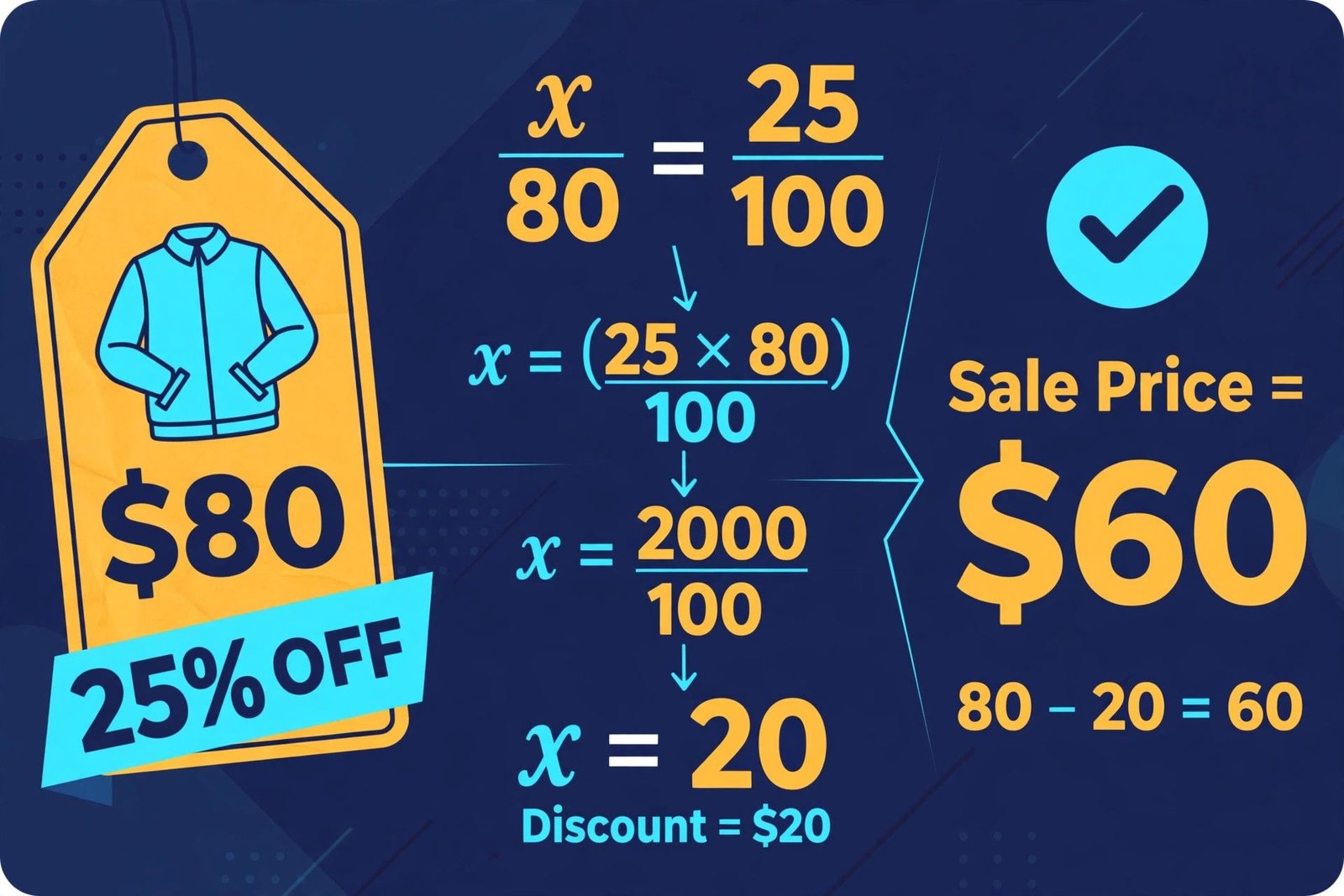
A jacket costs $80 and the sign says 25% off. How much do you actually pay? If your first thought is to subtract 25 from 80, you are not alone, and you are $5 out. The sign means 25 percent of the price comes off, and 25 percent of $80 is $20, so you pay $60. One proportion does that whole job.
I used to treat each percent question as a different trick to memorise, until I saw they all run through one setup. A percent is a part out of 100, so any percent question is a proportion: the part over the whole equals the percent over 100. The formula itself lives in the percent proportion guide, and here it only works, in real money, on real problems.
One setup for every percent question
Every percent question is one of three questions. The first asks for the part, when you know the percent, like the $20 discount on the $80 jacket. Another asks for the percent, when you know the part and the whole, like a test score. The third asks for the whole, when you know the percent and the part, like finding an original price from a sale part. Part over whole, percent over 100.
The table is the same setup answering three different questions.
| Question | Proportion setup | Solve | Answer |
|---|---|---|---|
| Find the part: 25% of $80 | x / 80 = 25 / 100 | x = 80 x 25 / 100 | $20 |
| Find the percent: 18 of 60 | x / 100 = 18 / 60 | x = 18 x 100 / 60 | 30% |
| Find the whole: 15% is 30 | 15 / 100 = 30 / x | x = 30 x 100 / 15 | 200 |
The setup never changes, only the unknown moves. Once you can spot which number is missing, the rest is cross multiplication and one division, as the cross multiplication guide shows.
Finding the part: discounts
Back to the jacket. The discount is the unknown part, so it sits on top: x / 80 = 25 / 100, and x = 80 x 25 / 100 = $20. That is the discount, not the price. Subtract it from the tag: $80 minus $20 is $60, and $60 is what you pay. Check it back: $20 / $80 = 0.25, which is 25%.
Try it: a $120 coat is 40% off: 120 x 40 / 100 = $48, so you pay $72.
Finding the part: tax and tips
Sales tax works like a discount, except you add the part instead of subtracting it. Shoes cost $60 and the tax is 8%: x / 60 = 8 / 100, so x = $4.80, and the total is $64.80. Check it back: $4.80 / $60 = 0.08, which is 8%. Part over whole, percent over 100.
Take a $45 meal with a 20% tip: x / 45 = 20 / 100, so x = $9, and the total is $54. Check it back: $9 / $45 = 0.20. Run the same numbers through the Proportion Calculator and see if your answer matches.
Try it: a $75 pair of jeans has 6% tax: 75 x 6 / 100 = $4.50, so the total is $79.50. A $30 lunch with a 15% tip adds $4.50, for a total of $34.50.
Finding the percent
Now the unknown moves to the percent side. Suppose you answered 18 questions right out of 60 on a quiz. The proportion is x / 100 = 18 / 60, so x = 30, and your score is 30%. Check it back: 30% of 60 is 18, which is the number of right answers.
Try it: 21 right out of 70 is what percent? Set up x / 100 = 21 / 70, so x = 21 x 100 / 70 = 30%.
Finding the whole
Sometimes the whole is the missing number. You know that 15% of a number is 30, and you want the number itself. Write it as 15 / 100 = 30 / x, cross multiply, and x = 200. Check it back: 15% of 200 is 30, which is the part you started with. Part over whole, percent over 100.
Try it: 40% of a number is 84. The number is 84 x 100 / 40 = 210.
Percent up, percent down
A percent change compares a change with the starting amount. A price rises from $40 to $50, a change of $10 against a starting amount of $40. Set up x / 100 = 10 / 40, so x = 25, and the price rose by 25%. Check it back: 25% of $40 is $10.
A fall works the same way. From $120, the price drops to $90, a change of $30 against a starting amount of $120. The proportion is x / 100 = 30 / 120, so x = 25, and the price fell by 25%. Check it back: 25% of $120 is $30. Both examples land on 25% because the change is always measured against the starting amount, never the new one.
Try it: a $25 ticket rises to $30. The change is $5, and 5 / 25 = 0.20, so the ticket rose by 20%.
Percent to proportion
A percent turns into a proportion in one step: write it over 100 and simplify. 35% is 35 / 100, which is 7 / 20, and 35% of 60 is 7 / 20 of 60, which is 7 x 3 = 21, because 60 / 20 = 3. The decimal way agrees: 0.35 x 60 = 21. More money proportions are worked the same way in the proportion word problems guide, with the answer checked after each one.
Try it: 45% as a fraction is 45 / 100 = 9 / 20. Then 45% of 80 is 9 / 20 of 80, which is 9 x 4 = 36.
The percent off trap
The mistake: a shirt costs $50 and the sign says 30% off. Subtract 30 from 50 and pay $20. That feels quick, and it is wrong, because 30% is a share of the price, not $30. Find the share first: 30% of $50 is $15, so you pay $35. Check it back: $15 / $50 = 0.30. The wrong answer, $20, would mean a 60% discount, which the sign never promised.
Putting it together
One last problem uses the setup twice. The $80 jacket at 25% off costs $60, as the opening showed. Sales tax of 8% is charged on the $60 sale price, not the $80 tag, because tax follows the price you actually pay. The tax is x / 60 = 8 / 100, so x = $4.80, and the total is $64.80. Checking back, $4.80 is 8% of $60, so the tax is right. That is two proportions on one receipt.
Two quick practice problems
First, 12 is what percent of 48? Set up x / 100 = 12 / 48, so x = 25. Second, 60% of 250 is 0.60 x 250 = 150, and 150 / 250 = 0.60 checks it. If both came out clean, the setup is yours now.
Key takeaways
- One setup answers every percent question: the part over the whole equals the percent over 100.
- Discounts, tax and tips all find the part first, then subtract it or add it to the price.
- A percent change is always measured against the starting amount, never the new one.
- Percent off is two steps, find the share, then subtract it, and skipping the first step gives the wrong price.
Take one real receipt, find one percent on it, and work it out with the proportion before trusting the total. Try the same numbers on the Proportion Calculator to check your working. That one habit turns every sale sign into a question you can answer yourself.
Proportions and percents questions, answered
How do you use a proportion to find a percent? Write the part over the whole, set it equal to the percent over 100, then cross multiply and divide. For 18 right out of 60, x/100 = 18/60 gives x = 30, so the score is 30 percent.
What is 25 percent off 80 dollars? The discount is 20 dollars, so you pay 60 dollars. As a proportion, x/80 = 25/100 gives x = 20, and 80 minus 20 is 60.
How do you add sales tax with a proportion? Work out the tax first, then add it to the price. For 8 percent tax on 60 dollars, x/60 = 8/100 gives x = 4.80, so the total is 64.80 dollars. Tax is charged on the sale price, not the original tag.
How do you turn a percent into a proportion? Write the percent over 100 and simplify it. 35 percent is 35/100, which is 7/20, and 7/20 of 60 is 21.
What is the difference between percent off and percent of? Percent of finds a share of a price, and percent off subtracts that share from the price. 30 percent of 50 dollars is 15 dollars, so 30 percent off 50 dollars means you pay 35 dollars, not 20 dollars.
How do you find the whole when you know the percent and the part? Put the percent over 100 and the part over the unknown whole, then cross multiply. If 15 percent of a number is 30, then 15/100 = 30/x gives x = 200.