
How do I calculate a proportion? That is the question I hear most, and the short answer fits in one line. You set the two ratios equal, you multiply across, you divide down, and you check the answer. Multiply across, divide down, check the answer. The rest of this guide is about doing those four moves without tripping over the arithmetic, because the arithmetic is where most marks are lost.
A proportion is just two ratios that are equal, written like 3/4 = 9/12. I read it as a promise: whatever you do to one side, the other side must match. The calculation keeps that promise when one number is missing, or tests whether it holds at all.
What does a proportion calculation ask you to do?
Most proportion problems ask for one of four calculations. I name the job before I touch a number, because each job has its own setup.
| The job | What you are asked | How the setup looks |
|---|---|---|
| Find the missing term | One of the four numbers is unknown | a/b = c/x, solve for x |
| Check two ratios | Are these two ratios equal? | Compare the cross products |
| Scale a quantity | Make something bigger or smaller in the same ratio | Old size over new size, on both sides |
| Round a decimal answer | The division does not come out whole | Divide, then round to the place asked |
Spot the job first and the rest is routine. The examples below work through each job once, with the numbers shown at every step.
How do you calculate a proportion?
I use the same three steps for every job, and I say them out loud while I work.
- Set it up. Write the two ratios as fractions with an equals sign between them, matching units on each side.
- Cross multiply. Multiply each numerator by the opposite denominator, which turns the fractions into one plain multiplication on each side. The full cross multiplication explained guide shows why this works.
- Divide and check. Divide to free the unknown, then put the answer back into the proportion and see whether both sides still agree.
Cross multiplication itself has a full guide on this site if you want the why behind it, not just the how. And if the unknown sits inside brackets or on both sides of the equals sign, my solve for x in a proportion guide walks through those cases one by one.
Example 1: find the missing number
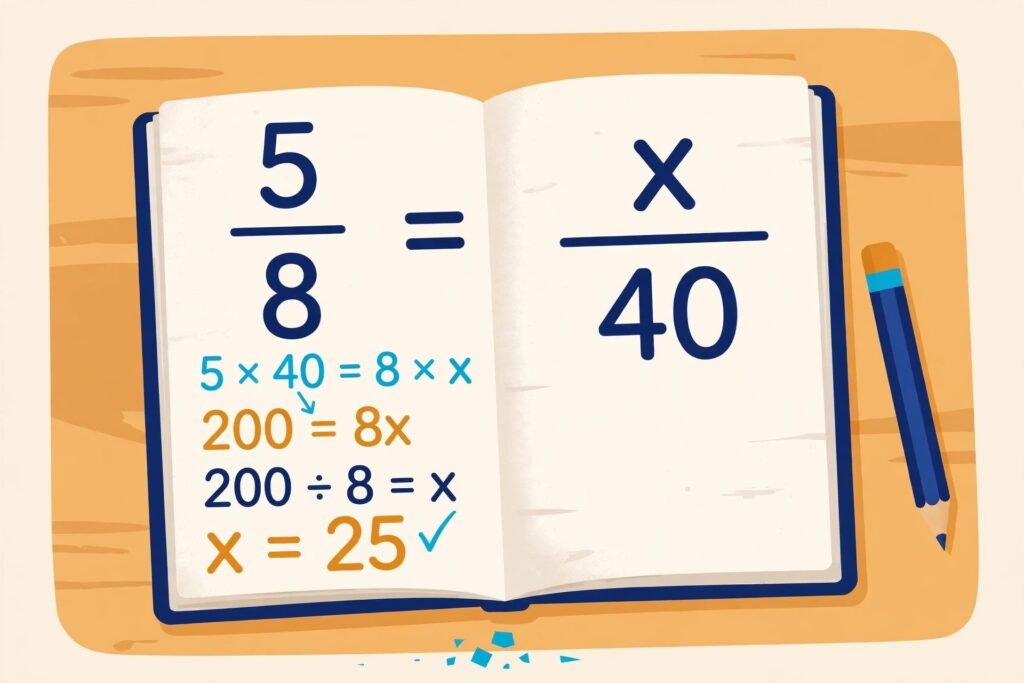
Five eighths equals x over forty, or 5/8 = x/40. I multiply across first: 8 times x equals 5 times 40, so 8x = 200. Then I divide down: 200 divided by 8 is 25, so x = 25. Multiply across, divide down, check the answer.
The check is quick: 25/40 simplifies to 5/8, because both numbers divide by 5. You can run the same numbers through the Proportion Calculator and watch it do the same cross multiplication.
Try it: 2/5 = x/35. Multiply across, divide down, and check. You should get x = 14, because 2 times 35 is 70 and 70 divided by 5 is 14.
Example 2: check whether two ratios form a proportion
Sometimes no number is missing. You only want to know whether 9/12 and 15/20 say the same thing. I multiply across both ways: 9 times 20 is 180, and 12 times 15 is 180. The two products match, so the ratios do form a proportion.
Try it: do 6/10 and 9/15 form a proportion? Multiply 6 by 15 and 10 by 9. Both give 90, so yes, they do.
Example 3: scale a number up or down
A photo is 4 inches wide and 3 inches tall. I print it 10 inches wide and want the height that keeps the same shape. Width over height on both sides gives 4/3 = 10/x. I multiply across: 4x = 30. I divide down: 30 divided by 4 is 7.5, so the print is 7.5 inches tall. Multiply across, divide down, check the answer.
The check here is a sense check. The width more than doubled, from 4 to 10, so the height should more than double too, from 3 to 7.5. It did.
Try it: 3 kilograms of apples cost $7.50. What should 8 kilograms cost at the same rate? Set 3/7.50 = 8/x. You should get $20.
What if the answer is a decimal?
Not every division comes out whole. Take 7/9 = x/5. I multiply across: 9x = 35. I divide down: 35 divided by 9 is 3.888…, a decimal that repeats forever. To the nearest hundredth, that is 3.89. I never round in the middle of the calculation, only at the end, because an early rounding carries its error through.
Try it: 4/11 = x/7. You should get 2.55 when you round to the nearest hundredth.
The shortcut I try first: simplify before you multiply
Big numbers make the multiplication ugly, and ugly multiplication invites mistakes. When I can, I simplify a ratio before I cross multiply. Take 12/18 = x/27. Both 12 and 18 divide by 6, so 12/18 is 2/3. Now the proportion is 2/3 = x/27: 3x = 54 and x = 18. The long way agrees: 12 times 27 is 324, and 18 times 18 is 324.
The shortcut only works when a ratio actually simplifies. If nothing divides out, I cross multiply straight away. For the full method, see how to solve proportions step by step.
Try it: 15/25 = x/35. Simplify 15/25 to 3/5 first, then solve. You should get x = 21.
The mistake I see most: dividing the wrong way
Here is the mistake I see most, and I have made it myself. Take 3/4 = 9/x. The wrong move is to divide the small numbers first: 4 divided by 9, times 3, gives 1.33. It feels like a calculation, and the calculator will happily give it to you, but it answers a question nobody asked.
The right move is the one you already know. Multiply across, divide down, check the answer. Cross multiply: 3 times x equals 4 times 9, so 3x = 36. Divide down: 36 divided by 3 is 12, so x = 12. The check settles it. 9/12 simplifies to 3/4, while 9 divided by 1.33 is nowhere near 3/4. When an answer looks oddly small, I stop and ask which number I divided by which.
How do I check my answer on the calculator?
After I work a proportion by hand, I check it on the Proportion Calculator. I type the three numbers I know, leave the missing one blank, and let the calculator show the same cross multiplication and division I just did. If its answer matches mine, I move on. If it does not, I rework the problem. The calculator also has a check mode: type all four numbers and it compares the cross products, exactly the test from Example 2.
Practice: four quick calculations
- 3/7 = x/28. Answer: x = 12.
- 7/8 = 21/x. Answer: x = 24.
- Do 5/8 and 9/14 form a proportion? Answer: no. 5 times 14 is 70, and 8 times 9 is 72.
- 5/6 = x/8, rounded to the nearest hundredth. Answer: x = 6.67.
Frequently asked questions
How do I calculate a proportion?
Write the two ratios as fractions with an equals sign between them, then cross multiply and divide. In a/b = c/d, multiply a by d and b by c, set the products equal, and divide to free the unknown. For 5/8 = x/40, 8x = 200, so x = 25. Check the answer by putting it back.
What is the formula for proportion calculation?
The formula is a/b = c/d, with the cross products equal: a times d equals b times c. To find a missing term, rearrange it. For the missing d, d equals b times c divided by a. For 3/4 = 9/x, x equals 4 times 9 divided by 3, which is 12.
How do you calculate a proportion with decimals?
Work it exactly the same way, then round only at the end. In 7/9 = x/5, cross multiply to get 9x = 35, then divide: 35 divided by 9 is 3.888 repeating. Rounded to the nearest hundredth, the answer is 3.89. Never round in the middle of the calculation.
How do I check my proportion calculation?
Put the answer back into the original proportion and compare the cross products. If 5/8 = 25/40, then 5 times 40 is 200 and 8 times 25 is 200, so the answer is right. You can also check with the Proportion Calculator by typing in all four numbers.
Do I always have to cross multiply?
No. Cross multiplication is the general route, but you can simplify a ratio first to make the numbers smaller, or use a unit rate when the numbers allow it. In 12/18 = x/27, simplifying 12/18 to 2/3 first gives the same answer, 18, with much easier arithmetic.
Why is my answer a long decimal?
Some divisions never end, like 35 divided by 9, which is 3.888 repeating. That is a normal result, not a mistake. Round it to the place the question asks for, usually the nearest hundredth. If the question wants an exact answer, leave it as a fraction instead.
Key takeaways
Name the job first, then set the ratios equal. Cross multiply, divide, and always check. Simplify a ratio before you multiply when you can, and round only at the very end. If the check fails, rework the setup before you blame the arithmetic.
Sources: OpenStax Prealgebra 2e, section 6.5, Solve Proportions and their Applications; Math is Fun, Proportions.