
Take 16/24 and divide only the top by 8. You get 2/24, and it looks tidy. It is also completely wrong, and this is the mistake a simplify calculator exists to stop.
A simplify calculator rewrites a fraction, ratio, mixed number or decimal in its simplest form, which means dividing the top and the bottom by the same number until nothing is left to divide by. It does four jobs, and this guide walks each one with a hand-check you can do in seconds.
What Does Simplest Form Mean?
A fraction is in simplest form when the top and bottom share no common factor bigger than 1. 3/5 is simplest form because 3 and 5 share nothing but 1. 36/60 is not, because both numbers divide by 12. Simplifying never changes the value, only the writing, so 36/60 and 3/5 are the same amount of pizza, the same share of a bill, the same number.
The Four Jobs a Simplify Calculator Does
Before you type anything, work out which job you need. The table below is the whole map, and every section after it walks one row.
| Job | What you type | What you get back |
|---|---|---|
| Simplify a fraction | 36/60 | 3/5 |
| Simplify a ratio | 48:72 | 2:3 |
| Simplify a mixed number | 18/4 | 4 1/2 |
| Simplify a decimal | 0.45 | 9/20 |
Every job below runs on one rule. Divide the top and the bottom by the same number. Learn that rule once, and every simplify job is the same job.
How Do You Simplify a Fraction?
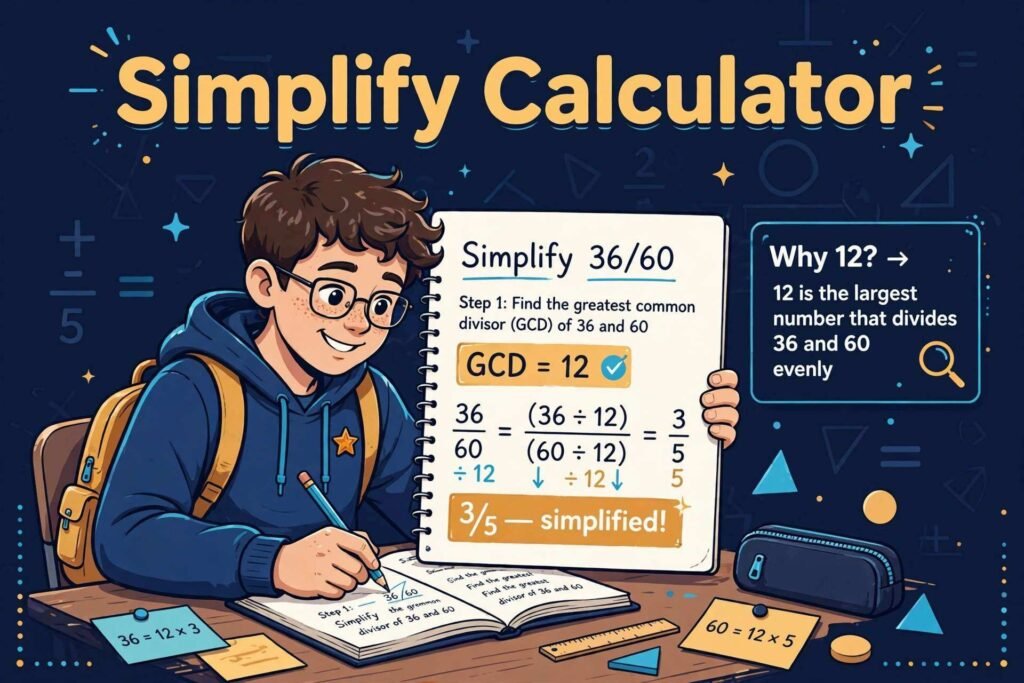
Find the greatest common divisor of the top and bottom, then divide both by it. For 36/60, I look for the biggest number that divides both: 12 goes into 36 three times and into 60 five times, so 36/60 becomes 3/5. One division does the whole job, because the GCD takes every shared factor out at once. Divide the top and the bottom by the same number.
Try It: simplify 28/42. (Answer: 2/3, because the GCD is 14.)
How Do You Simplify a Ratio?
A ratio simplifies exactly like a fraction, because a ratio is a fraction in different clothes. For 48:72, I divide both sides by 24: 48 divided by 24 is 2, and 72 divided by 24 is 3, so the ratio is 2:3. The order matters, so I never swap the sides. My guide to how to simplify ratios works through three-part ratios and units, and this job stays short on purpose.
Try It: simplify 60:84. (Answer: 5:7, because the GCD is 12.)
What About a Mixed Number or an Improper Fraction?
Simplify the fraction first, then convert back. For 18/4, I divide the top and bottom by 2 to get 9/2. Then I convert: 9 divided by 4 is 2 with 1 left over, so the answer is 4 1/2. The mixed number keeps the same value, it only reads more easily. Divide the top and the bottom by the same number.
Try It: simplify 26/8 as a mixed number. (Answer: 3 1/4.)
Can a Simplify Calculator Handle Decimals?
Yes, and the move is simple: write the decimal as a fraction first. For 0.45, I write 45/100, then divide the top and bottom by 5 to get 9/20. My guide to the decimal to fraction calculator covers repeating decimals too, and this job borrows its first step only.
Try It: simplify 0.28 as a fraction. (Answer: 7/25.)
What If the Numbers Are Big?
Big numbers get the Euclidean algorithm, which finds the GCD without factoring anything. Take 96/144. I divide 144 by 96 and keep the remainder: 144 = 96 × 1 + 48. Then I divide 96 by 48: 96 = 48 × 2 + 0. The last number that is not zero is 48, so the GCD is 48, and 96/144 becomes 2/3. Two divisions, no factoring, and the answer is exact. Divide the top and the bottom by the same number.
Try It: use the Euclidean algorithm on 84/108. (Answer: 7/9. The GCD is 12.)
The Mistake I See Most Often
Wrong answer first: 15/25 = 3/25. This feels right because you divided the top by 5 and stopped there. It is wrong because the value changed: 3/25 is 0.12, while 15/25 is 0.6. The right move divides both numbers by 5: 15 ÷ 5 = 3 and 25 ÷ 5 = 5, so the answer is 3/5. A fraction is one value, so whatever you do to the top, you must do to the bottom.
What If a Fraction Is Already in Simplest Form?
Then the calculator hands it straight back, and that is the right answer. 13/17 stays 13/17 because 13 and 17 are both prime and different, so their GCD is 1. Dividing by 1 changes nothing. I check by asking one question: is there any number bigger than 1 that divides both? If the answer is no, the fraction is done.
I check every simplification as a proportion on the Proportion Calculator. For 36/60 = 3/5, the cross products match: 36 × 5 = 180 and 60 × 3 = 180. My guide to proportion calculation shows the full check.
Practice Problems (With Answers)
- Simplify 24/40.
- Simplify the ratio 81:108.
- Write 0.35 as a fraction in simplest form.
- Write 35/6 as a mixed number in simplest form.
- Simplify 132/180.
Answers: 1. 3/5. 2. 3:4. 3. 7/20. 4. 5 5/6. 5. 11/15.
Frequently Asked Questions
What does a simplify calculator do?
It rewrites a fraction, ratio, mixed number or decimal in its simplest form. You type a value like 36/60, and it divides the top and bottom by their greatest common divisor, then shows the answer, here 3/5, with the steps.
What is simplest form?
It is the form where the top and bottom share no common factor bigger than 1. 3/5 is in simplest form because 3 and 5 share only 1. Simplifying changes how the value is written, never the value itself.
How do you simplify a ratio with a calculator?
You type the ratio, like 48:72, and the calculator divides both sides by their greatest common divisor, here 24, to give 2:3. The order of the sides never changes, because swapping them would change what the ratio means.
Can a simplify calculator work with decimals and mixed numbers?
Yes. A decimal like 0.45 becomes 45/100 first, then simplifies to 9/20 by dividing both numbers by 5. A mixed number is handled through its improper fraction, so 4 1/2 starts as 9/2, simplifies there if needed, then converts back to 4 1/2.
What is the GCD, and why does it matter?
The GCD is the greatest common divisor, the biggest number that divides both the top and bottom evenly. Dividing both by the GCD removes every shared factor in one step, which is why it lands on simplest form at once.
How do I know my simplified answer is right?
Test it as a proportion: the original and the answer must cross-multiply to the same number. For 36/60 = 3/5, 36 times 5 is 180 and 60 times 3 is 180, so the answer checks out.
Key Takeaways
- Simplest form means the top and bottom share nothing bigger than 1.
- Every simplify job runs on one rule, applied to the top and the bottom together.
- A ratio simplifies like a fraction, and the order of the sides never changes.
- Big numbers need the Euclidean algorithm, not factoring.
- If the GCD is 1, the fraction is already done. Check every answer as a proportion before you move on.