
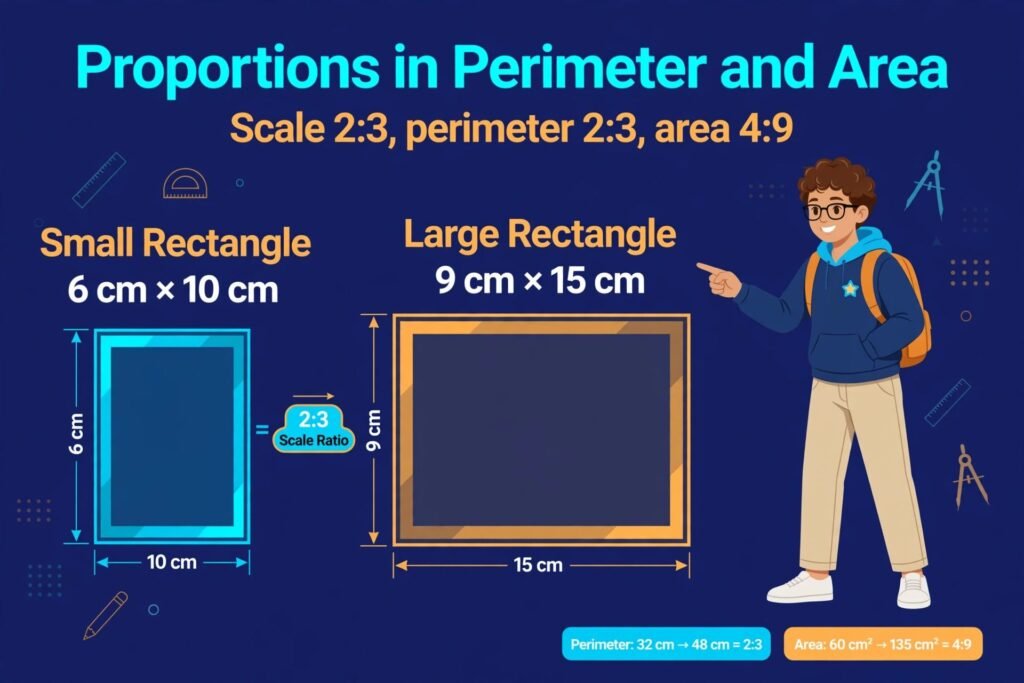
Two similar rectangles. The small one is 6 cm by 10 cm and the large one is 9 cm by 15 cm. Work out the area ratio first: 4:9. Then use 4:9 as the scale factor to find a missing side. The small side is 6 cm, so the large side should be 6 times 4/9, which is 2.67 cm. Stop. The large figure is bigger than the small one, so its side cannot be smaller than 6 cm. The area ratio was used as if it were the scale factor. Perimeter once, area twice. That is the whole post.
When two figures are similar, one scale factor controls both the perimeter and the area, but it controls them differently. The perimeters are in the same ratio as the sides. The areas are in the ratio of the sides squared. So a scale factor of 2:3 gives a perimeter ratio of 2:3 and an area ratio of 4:9. Mixing those two up is the most common mistake in this topic, and this guide keeps them apart with the same pair of figures worked both ways. Similar means the same shape in a different size. The corresponding angles are equal and the corresponding sides are in proportion. That last part is the precondition for everything below. Before you use any ratio rule, check that the sides really are in proportion. A pair of rectangles that only looks similar will break every rule in this guide, and the trap section shows one. The similar triangles guide teaches how to check similarity and find a missing side. This guide starts where that one leaves off: you already know the figures are similar, and now you want the perimeter and the area of the second one without measuring every side.
One scale factor, two different ratios
Think of the scale factor as a number that multiplies every length. If the scale factor from a small figure to a large one is 3:2, every side of the large figure is 1.5 times the matching side of the small one. The perimeter is a sum of sides, so it is multiplied by 1.5 as well. The area is a length times a length, so it is multiplied by 1.5 twice, which is 2.25. That is the whole idea: perimeter follows the scale factor once, area follows it twice. The table below is the whole guide in three rows. Keep it beside you while you work through the examples, and come back to it whenever a question gives you one ratio and asks for the other.
| Scale factor | Perimeter ratio | Area ratio | Example |
|---|---|---|---|
| 2:3 | 2:3 | 4:9 | Rectangles 6 by 10 cm and 9 by 15 cm |
| 2:5 | 2:5 | 4:25 | Triangles with sides 6, 8, 10 in and 15, 20, 25 in |
| 1:2 | 1:2 | 1:4 | Squares with areas 49 and 196 sq ft |
Read the row you need, then square or un-square only the area column, never the perimeter column. The perimeter ratio is the scale factor itself, and the area ratio is the scale factor squared. That one sentence answers most homework questions in this topic. Here is a trick I say out loud, every time. “Perimeter once, area twice.” Say it before you write the ratio, and the two columns stay apart.
Perimeter follows the scale factor
Take two similar rectangles. The small one is 6 cm by 10 cm and the large one is 9 cm by 15 cm. Check similarity first: 6/9 simplifies to 2/3 and 10/15 simplifies to 2/3, so the sides are in proportion and the figures are similar. The scale factor from small to large is 9 divided by 6, which is 1.5, or 3:2.
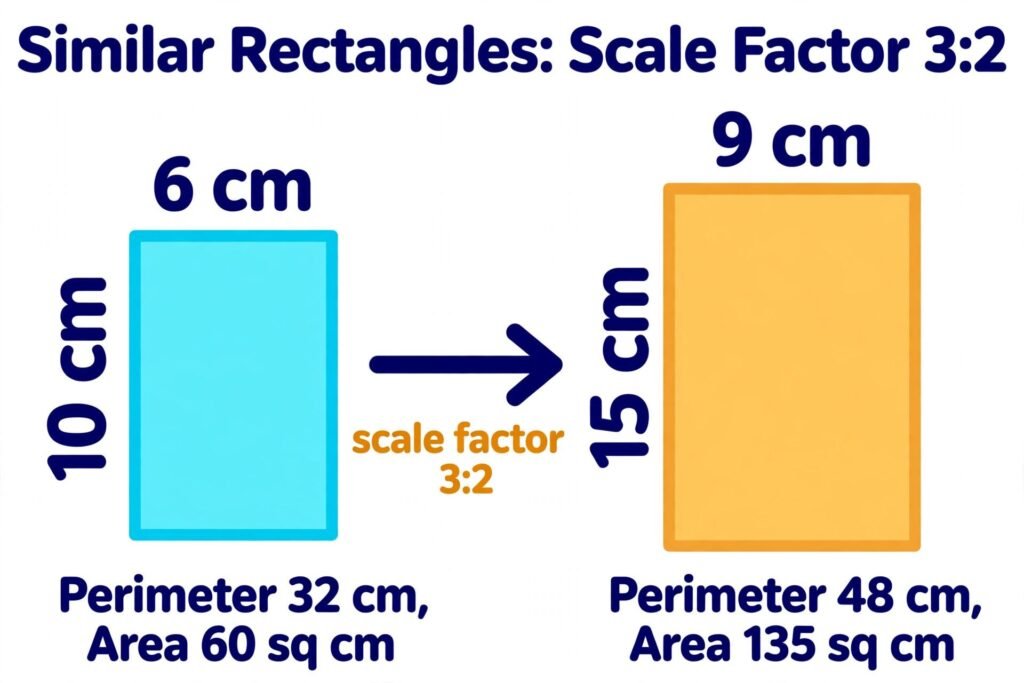
Now work out both perimeters. The small perimeter is 2 times (6 + 10), which is 32 cm. The large perimeter is 2 times (9 + 15), which is 48 cm. The ratio is 32:48, which simplifies to 2:3. That is the scale factor exactly. No squaring, no extra step. Every side grew by 1.5, so the sum of the sides grew by 1.5 as well. Try the same numbers on the Proportion Calculator and solve for x in 32/48 = 2/x. The calculator should give 3, which is the scale factor written as a ratio. The perimeter rule is really a proportion between the perimeters and the sides, and the calculator solves it the same way. Perimeter once, area twice.
Try it. Two similar rectangles: the small one is 4 cm by 7 cm and the large one is 6 cm by 10.5 cm. Check similarity first: 4/6 simplifies to 2/3, and 7/10.5 simplifies to 2/3, so the figures are similar. The scale factor is 6 divided by 4, which is 1.5. The small perimeter is 2 times (4 + 7), which is 22 cm. The large perimeter is 2 times (6 + 10.5), which is 33 cm. The ratio is 22:33, which simplifies to 2:3, the scale factor.
Area follows the square
Use the same two rectangles. The small area is 6 times 10, which is 60 square centimeters. The large area is 9 times 15, which is 135 square centimeters. The ratio is 60:135, which simplifies to 4:9. That is (2:3) squared: 2 squared is 4 and 3 squared is 9. The area grew by more than the sides did, because both the length and the width grew. A pair of triangles shows the same pattern with different numbers. The small triangle has sides 6, 8, and 10 inches, with a base of 8 inches and a height of 6 inches. Its perimeter is 6 + 8 + 10, which is 24 inches. Its area is half of 8 times 6, which is 24 square inches. The scale factor to the large triangle is 2.5, so the large triangle has sides 15, 20, and 25 inches. Its perimeter is 15 + 20 + 25, which is 60 inches. The perimeter ratio is 24:60, which simplifies to 2:5, the scale factor. The large base is 20 inches and the large height is 15 inches, so the large area is half of 20 times 15, which is 150 square inches. The area ratio is 24:150, which simplifies to 4:25, and that is (2:5) squared. Notice the habit that makes both examples safe. Work out the perimeter ratio and the area ratio separately, from the figures themselves, and only then compare them with the scale factor. If you guess the area ratio from the perimeter ratio without squaring, you get 2:3 where the answer is 4:9, and the error is silent until a check catches it.
Try it. Use the same two rectangles from the Try it above: small 4 cm by 7 cm, large 6 cm by 10.5 cm. The small area is 4 times 7, which is 28 square centimeters. The large area is 6 times 10.5, which is 63 square centimeters. The ratio is 28:63, which simplifies to 4:9, the square of the scale factor 2:3. Check the simplification: 28 divided by 7 is 4, and 63 divided by 7 is 9.
Working backwards from an area
Homework questions often give the areas and ask for the scale factor, which means working backwards. The rule runs in reverse: the scale factor is the square root of the area ratio. Two examples show how that works, one with squares and one with perimeters.
From two areas to the sides
Two similar squares have areas 49 and 196 square feet. First find the area ratio: 49:196 simplifies to 1:4. The scale factor is the square root of that ratio, which is 1:2, because 1 squared is 1 and 2 squared is 4. So the sides are in the ratio 1:2. The small side is the square root of 49, which is 7 feet, and the large side is the square root of 196, which is 14 feet. Check the perimeters: the small perimeter is 4 times 7, which is 28 feet, and the large perimeter is 4 times 14, which is 56 feet. The ratio 28:56 simplifies to 1:2, which matches the scale factor, so the backwards step is confirmed. Perimeter once, area twice.
Try it. Two similar squares have areas 25 and 100 square feet. The area ratio is 25:100, which simplifies to 1:4. The scale factor is the square root of 1:4, which is 1:2. The small side is the square root of 25, which is 5 feet, and the large side is the square root of 100, which is 10 feet. Check the perimeters: 4 times 5 is 20 feet, and 4 times 10 is 40 feet, a ratio of 1:2.
From two perimeters to the areas
Two similar squares have perimeters 36 m and 54 m. The perimeter ratio is 36:54, which simplifies to 2:3, and the perimeter ratio is the scale factor itself, so the scale factor is 2:3. The small side is 36 divided by 4, which is 9 m, and the large side is 9 times 1.5, which is 13.5 m. The small area is 9 times 9, which is 81 square meters. The large area is 13.5 times 13.5, which is 182.25 square meters. The area ratio is 81:182.25, which simplifies to 4:9, and that is (2:3) squared. Check it with cross multiplication: 81 times 9 equals 729, and 182.25 times 4 equals 729. Both products match, so the area ratio is right. The scale factor guide covers finding a scale factor from matching sides in detail. The backwards step here is the same idea with areas instead of sides: un-square the ratio first, then use it like any other scale factor.
Try it. Two similar squares have perimeters 20 m and 30 m. The perimeter ratio is 20:30, which simplifies to 2:3, so the scale factor is 2:3. The small side is 20 divided by 4, which is 5 m, and the large side is 5 times 1.5, which is 7.5 m. The small area is 5 times 5, which is 25 square meters. The large area is 7.5 times 7.5, which is 56.25 square meters. The area ratio is 25:56.25, which simplifies to 4:9. Check: 25 times 9 is 225, and 56.25 times 4 is also 225.
The trap: squaring the wrong ratio
The most common mistake in this topic is squaring the perimeter ratio, or using the area ratio as if it were the scale factor. Both mistakes come from treating the two ratios as the same thing. They are not. Perimeter is one dimensional, so it scales once. Area is two dimensional, so it scales twice. Here is the trap in numbers. The rectangles from the first example have a perimeter ratio of 2:3. A student who squares it gets 4:9 and calls that the perimeter ratio. But 4:9 is the area ratio, and the real perimeter ratio is 2:3. The other way round is just as common: the area ratio is 4:9, and a student uses 4:9 as the scale factor to find a missing side. The true scale factor is 2:3, so the side comes out wrong by a factor of 2/3. That was the mistake at the top of this page. There is a second trap that sits before any ratio is used. Rectangles 4 inches by 6 inches and 5 inches by 9 inches look similar, but check the sides: 4/5 is 0.8 and 6/9 is 0.67, not equal, so the figures are not similar and neither ratio rule applies. Scaling the first rectangle by 1.5 would give 6 by 9, not 5 by 9. When the sides do not match, stop. No perimeter or area ratio can fix a pair that is not similar.
Two real rooms and pictures
The rules earn their keep outside homework, where the difference between scaling once and scaling twice is money. Fencing follows the scale factor. Paint, soil, and carpet follow the square.
A photo enlargement
A photo 4 inches by 6 inches is enlarged by a scale factor of 3. The new size is 12 inches by 18 inches. The perimeter goes from 20 inches to 60 inches, a ratio of 1:3, the scale factor. The area goes from 24 square inches to 216 square inches, a ratio of 1:9, the square. That is why the frame and the mat board do not scale together: the frame follows the perimeter, so it needs three times the material, while the mat board follows the area, so it needs nine times the material. Try the numbers on the Proportion Calculator with 4/12 = 6/x to confirm the enlarged width is 18 inches before you trust the area.
Try it. A photo 5 inches by 7 inches is enlarged by a scale factor of 2. The new size is 10 inches by 14 inches. The perimeter goes from 24 inches to 48 inches, a ratio of 1:2. The area goes from 35 square inches to 140 square inches, a ratio of 1:4. Check the perimeter: 2 times (5 + 7) is 24, and 2 times (10 + 14) is 48.
Two garden beds
Two similar rectangular garden beds are planted the same way. The small bed is 8 feet by 6 feet and the large bed is built at a scale factor of 2, so it is 16 feet by 12 feet. The small perimeter is 28 feet and the large perimeter is 56 feet, a ratio of 1:2, the scale factor. Fencing for the large bed costs twice as much, because fencing runs around the edge. The small area is 48 square feet and the large area is 192 square feet, a ratio of 1:4, the square. Soil for the large bed costs four times as much, because soil covers the surface. A gardener who budgets twice the soil has only half of what the large bed needs. Perimeter once, area twice.
Try it. Two similar garden beds: the small one is 5 feet by 4 feet and the large one is built at a scale factor of 3, so it is 15 feet by 12 feet. The small perimeter is 18 feet and the large perimeter is 54 feet, a ratio of 1:3. The small area is 20 square feet and the large area is 180 square feet, a ratio of 1:9. Check the area: 5 times 4 is 20, and 15 times 12 is 180.
Check yourself with two figures
Try these two without looking at the answers first, and check each one against the table at the top of this guide. First, two similar rectangles. The small one is 5 cm by 8 cm and the scale factor to the large one is 3. The large rectangle is 15 cm by 24 cm. The small perimeter is 26 cm and the large perimeter is 78 cm, a ratio of 1:3, the scale factor. The small area is 40 square centimeters and the large area is 360 square centimeters, a ratio of 1:9, the square. Second, two similar figures have areas 36 and 144 square centimeters. The area ratio is 1:4, so the scale factor is 1:2. The perimeters are therefore in the ratio 1:2. If the small perimeter is 30 cm, the large perimeter is 60 cm.
Perimeter and area questions, answered
How are the perimeters of two similar figures related? The ratio of the perimeters equals the scale factor. If the scale factor is 2:3, the perimeters are also in the ratio 2:3, because every side is multiplied by the same factor and the perimeter is the sum of the sides.
How are the areas of two similar figures related? The ratio of the areas equals the square of the scale factor. If the scale factor is 2:3, the areas are in the ratio 4:9, because area multiplies two lengths and each one is scaled.
How do you find the scale factor from the areas? Take the square root of the area ratio. If the areas are in the ratio 1:4, the scale factor is 1:2, because 1 squared is 1 and 2 squared is 4.
Why is the area ratio not the same as the perimeter ratio? Because perimeter measures one length and area measures two lengths multiplied together. When each length is multiplied by the scale factor, the area is multiplied by the scale factor twice, so it is squared.
Can you use these ratio rules if the figures are not similar? No. The rules only work for similar figures, where the corresponding sides are in proportion. Check the sides first. If they are not in the same ratio, the figures are not similar and the rules do not apply.
Measure a photo and its enlargement at home, work out the perimeter ratio and the area ratio, and see which one matches the scale factor and which one matches its square. Try the side numbers on the Proportion Calculator as you go, and let the two ratios tell you whether the enlargement is truly similar.