
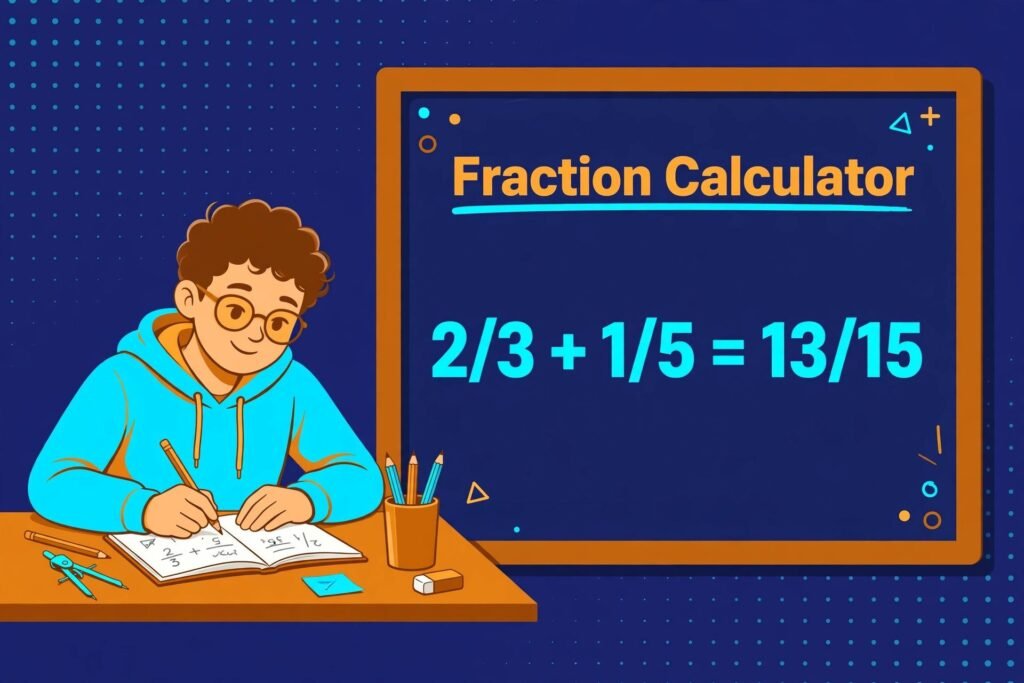
Your homework says add 2/3 and 1/5. You type both fractions into a fraction calculator, and it answers 13/15 in less than a second. You copy the answer down, and a small doubt follows you. Is that number right, or did you type something wrong?
A fraction calculator does seven jobs for you. It adds, subtracts, multiplies, and divides fractions. It simplifies them, turns them into mixed numbers, decimals, or percents, and it compares two fractions to tell you which one is bigger. The trick is knowing which job your question needs, because the calculator only does what you ask it to do.
My verdict is simple. If you only need one answer fast, type the numbers in and trust the steps it shows you. If your teacher asks for working, do the sum on paper first and let the calculator check you.
What does a fraction calculator actually do for you?
A fraction calculator takes the numbers you type and works with them as fractions, not as decimals. It keeps the exact value all the way through, and it gives the answer back in simplest form. That matters, because 1/3 as a decimal never ends, while 1/3 as a fraction is exact.
Before you trust any answer, run one quick sense check. A sum of two positive fractions must be bigger than each one alone. A difference must be smaller than the fraction you started with. If the answer breaks that rule, you typed something wrong, and no calculator can fix that for you.
Which fraction job do you need?
Most students open a calculator and stare at the tabs. Each tab is one job, and your question tells you which one to pick.
| Job | Your question sounds like | What you type |
|---|---|---|
| Add | What is 2/3 + 1/5? | Two fractions, plus |
| Subtract | How much is left? | Two fractions, minus |
| Multiply | What is 4/9 of 3/7? | Two fractions, times |
| Divide | How many 3/8s fit in 5/7? | Two fractions, divide |
| Simplify | Write 45/60 in simplest form | One fraction |
| Mixed numbers | Write 3 2/7 as an improper fraction | Whole number plus fraction |
| Compare | Which is bigger, 4/9 or 5/11? | Two fractions |
| To decimal or percent | Write 13/25 as a decimal | One fraction |
When your question asks for a sum, a difference, or a product, the job sits in the first four rows. When it asks for one fraction in a new form, look at the last four rows instead.
How do you add fractions?
Adding needs a shared bottom number first. Two fractions can only join when their denominators match, so you find the least common denominator, rewrite both fractions over it, and then add the tops. The bottom number stays the same.
I will add 2/3 and 1/5. The denominators are 3 and 5, and their least common denominator is 15. I rewrite 2/3 as 10/15, because 3 times 5 is 15 and 2 times 5 is 10. I rewrite 1/5 as 3/15, because 5 times 3 is 15 and 1 times 3 is 3. Now I add the tops: 10 plus 3 is 13, so the answer is 13/15. It cannot simplify further, because 13 and 15 share no common factor above 1.
Do it by hand first, then check it on the calculator.
Try it: add 3/5 and 1/4 on paper, then type the same numbers into the calculator. You should get 17/20.
How do you subtract fractions?
Subtracting follows the same path as adding, with one change at the end. You still need the shared denominator, and you still rewrite both fractions over it. Then you subtract the tops instead of adding them.
I will work out 7/8 minus 1/6. The denominators are 8 and 6, and their least common denominator is 24. I rewrite 7/8 as 21/24, because 8 times 3 is 24 and 7 times 3 is 21. I rewrite 1/6 as 4/24, because 6 times 4 is 24 and 1 times 4 is 4. Now I subtract the tops: 21 minus 4 is 17, so the answer is 17/24.
Try it: work out 5/6 minus 1/3 on paper, then check it. The least common denominator is 6, so 5/6 stays 5/6 and 1/3 becomes 2/6. The answer is 3/6, which simplifies to 1/2.
How do you multiply fractions?
Multiplying is the easiest job of all, because it needs no shared denominator. You multiply the tops together and the bottoms together, and then you simplify what you get. I always look for a cancellation before I multiply, because smaller numbers are easier to finish.
I will multiply 4/9 by 3/7. Straight across, the tops give 4 times 3, which is 12, and the bottoms give 9 times 7, which is 63. That leaves 12/63, and both numbers share a factor of 3. I divide the top by 3 to get 4, and the bottom by 3 to get 21, so the answer is 4/21.
Do it by hand first, then check it on the calculator.
Try it: multiply 2/5 by 5/6. The 5s cancel before you start, so the tops give 2 times 1 and the bottoms give 1 times 6. Your answer should be 2/6, which simplifies to 1/3.
How do you divide fractions?
Dividing looks strange until you learn the one move that runs it. You keep the first fraction exactly as it is, you flip the second fraction upside down, and then you multiply. Teachers call the flipped fraction the reciprocal, and the rule is short: keep, change, flip.
I will divide 5/7 by 3/8. I keep 5/7, I change the division sign to multiplication, and I flip 3/8 into 8/3. Now I multiply: the tops give 5 times 8, which is 40, and the bottoms give 7 times 3, which is 21. The answer is 40/21, an improper fraction, so I write it as a mixed number: 21 goes into 40 once with 19 left over, so it is 1 19/21.
Try it: divide 3/4 by 2/5. Flip 2/5 into 5/2, then multiply: 3 times 5 is 15, and 4 times 2 is 8. Your answer should be 15/8, which is 1 7/8 as a mixed number.
How do you simplify a fraction?
Simplifying shrinks a fraction without changing its value. You divide the top and the bottom by the same number, the greatest common factor, and you stop when no number above 1 divides both. My guide to the method behind the answer lives in my post on the fraction simplifier, and here I will only show the typing part.
I will simplify 45/60. The greatest common factor of 45 and 60 is 15. I divide the top by 15 to get 3, and the bottom by 15 to get 4, so the answer is 3/4. On a calculator, you type 45 over 60, pick the simplify job, and it gives you the same 3/4, usually with the factor 15 shown in the steps.
Do it by hand first, then check it on the calculator.
Try it: simplify 24/36. Both numbers share 12, so divide the top by 12 to get 2 and the bottom by 12 to get 3. Your answer should be 2/3.
What about mixed numbers?
A mixed number is a whole number plus a fraction, like 3 2/7. A calculator usually wants it in one of two forms: either as a mixed number with a whole number box, or as an improper fraction with the top bigger than the bottom. Changing between the two forms takes one short calculation.
I will change 3 2/7 into an improper fraction. I multiply the whole number by the denominator: 3 times 7 is 21. I add the numerator: 21 plus 2 is 23. I keep the same denominator, 7, so the answer is 23/7. Going the other way, I will change 29/6 into a mixed number. I divide 29 by 6: 6 goes in 4 times, which is 24, and 5 is left over. The mixed number is 4 5/6.
My mixed fraction guide walks through adding and subtracting mixed numbers step by step, and it is the right next read when your question mixes whole numbers with fractions.
Try it: change 2 3/5 into an improper fraction. Multiply 2 by 5 to get 10, add 3 to get 13, and keep the denominator 5. Your answer should be 13/5.
How do you compare two fractions?
Comparing asks which fraction is bigger, and the fair way to judge is to give both fractions the same bottom number. Once the denominators match, the bigger top wins, because both pieces are cut from the same size whole.
I will compare 4/9 and 5/11. Their least common denominator is 99. I rewrite 4/9 as 44/99, because 9 times 11 is 99 and 4 times 11 is 44. I rewrite 5/11 as 45/99, because 11 times 9 is 99 and 5 times 9 is 45. Now I compare the tops: 45 is bigger than 44, so 5/11 is the bigger fraction, by exactly 1/99.
Try it: compare 3/7 and 2/5. Their least common denominator is 35, so 3/7 becomes 15/35 and 2/5 becomes 14/35. The top 15 beats 14, so 3/7 is bigger.
How do you turn a fraction into a decimal or a percent?
A fraction is a division problem in disguise, so turning it into a decimal means dividing the top by the bottom. The percent follows at once, because a percent is a decimal times 100. My fraction to decimal guide covers the long division in detail, and here is the short version.
I will turn 13/25 into a decimal and a percent. I divide 13 by 25, which gives 0.52. I multiply by 100 to get the percent, so the answer is 52%. The same job works backwards too, and my decimal to fraction guide shows that trip in the other direction.
Try it: turn 7/8 into a decimal and a percent. Divide 7 by 8 to get 0.875, then multiply by 100 to get 87.5%.
What mistake catches almost everyone?
The most common mistake is adding the tops and the bottoms separately. It feels right, because it copies what multiplication does, but it breaks the meaning of a fraction. Watch it fail: 1/3 + 1/4 done the wrong way gives 2/7. That cannot be right, because 1/3 alone is already bigger than 2/7, and adding a positive number cannot shrink the total. The right way uses the least common denominator, 12: 1/3 becomes 4/12 and 1/4 becomes 3/12, so the answer is 7/12. The wrong answer is smaller than one of the parts. The right answer is bigger than both.
How do you check your answer before you trust it?
I check every calculator answer with one of three quick tests, and I pick the test that fits the job. For adding and subtracting, I check the size: a sum must beat each part, and a difference must sit below the starting fraction. For multiplying, I check that the answer is smaller than each part when both fractions are below 1. For dividing, I multiply the answer by the second fraction and I must get the first fraction back.
- Read the question again and name the job.
- Work it on paper with the hand method above.
- Type the same numbers into the Proportion Calculator and read its steps.
- Compare the two answers. If they match, you are done. If they differ, recheck your typing first, because a mistyped number is the usual cause.
Do it by hand first, then check it on the calculator.
Practice problems
Try these six on paper first, then check each one on the calculator. The answers sit right after the list, so cover them while you work.
- Add 5/7 and 1/3.
- Subtract 7/9 minus 1/4.
- Multiply 4/7 by 3/5.
- Divide 5/6 by 3/4.
- Simplify 35/49.
- Write 11/20 as a decimal and a percent.
Answers: (a) 22/21, which is 1 1/21. (b) 19/36. (c) 12/35. (d) 10/9, which is 1 1/9. (e) 5/7. (f) 0.55, which is 55%.
Key takeaways
A fraction calculator runs seven jobs, and the question names the job. Add and subtract need a shared bottom number. Multiply straight across, and divide by flipping the second fraction. Simplify with the greatest common factor, and read mixed numbers, decimals, and percents as the same value in a new form. Work it by hand, check it on the machine, and trust the answer only when both agree.
Frequently asked questions
What does a fraction calculator do?
A fraction calculator adds, subtracts, multiplies, and divides fractions, and it simplifies them, converts them to mixed numbers, decimals, or percents, and compares two fractions. You type the numbers, pick the job, and it shows the answer with steps in seconds.
How do I add fractions on a fraction calculator?
Type the first fraction, choose the plus sign, type the second fraction, and press calculate. The calculator finds the least common denominator, rewrites both fractions, adds the tops, and simplifies the answer. Check its steps against your own hand work before you copy the result.
Can a fraction calculator do mixed numbers?
Yes, most fraction calculators accept mixed numbers in a whole number box, or as an improper fraction when there is no such box. Change 3 2/7 to 23/7 first if your calculator only takes one top and one bottom number. The answer can come back as a mixed number too.
How do I simplify a fraction on a calculator?
Type the fraction, pick the simplify job, and read the answer in simplest form. The calculator divides the top and bottom by their greatest common factor, often showing that factor in the steps. If it returns your fraction unchanged, the fraction was already in simplest form.
How do I turn a fraction into a decimal or a percent?
Divide the top number by the bottom number to get the decimal, then multiply that decimal by 100 to get the percent. A fraction calculator does both steps at once and shows the decimal beside the percent. For 13/25, the decimal is 0.52 and the percent is 52%.
How do I know which fraction calculator job to use?
Read the question first and name what it asks for: a sum, a difference, a product, a quotient, a simpler form, or a new form like a decimal. Match that word to the calculator tab with the same name. When the question asks which fraction is bigger, use the compare job.