
Add 1/2 and 1/3. Cross-multiply, the way it is always done. One times 3 is 3, two times 1 is 2, so the answer is 3/2. It is wrong. Adding fractions needs a common denominator, and 1/2 + 1/3 is 5/6, not 3/2. Cross multiplication is a tool for proportions, and it was used on something that was not a proportion at all.
That mistake is the whole point of this page. Cross multiplication is fast and it works, but only when two fractions are joined by an equals sign. I always write the labels into the proportion before I multiply anything. Cross it, solve it, check it. That is the method, and the check is part of it, not an optional extra.
Why does it actually work?
Cross multiplication looks like a trick, and that is exactly why so many students use it without trusting it. Part of the reason for that is that most worked examples stop at the arithmetic. This post slows down because the method is short and the idea behind it is even shorter. Start with a proportion, two fractions set equal: a/b = c/d, where b and d are not zero. Multiply both sides by b, and the b on the left cancels. Multiply both sides by d, and the d on the right cancels. What is left is a times d on one side and c times b on the other, so a times d = b times c. The cross shape is just what remains after both denominators have cancelled. That is the whole proof, and it matters for two reasons. First, the method is safe whenever you genuinely have a proportion, because every step keeps the two sides equal. Second, it tells you exactly when the method does not apply: if there is no equals sign between two fractions, there is nothing to clear, and cross multiplying will quietly give you a wrong answer.
There is also an older way of saying the same thing that still shows up in textbooks. In a proportion a/b = c/d, the outer terms a and d are called the extremes, and the inner terms b and c are called the means. Cross multiplication says the product of the means equals the product of the extremes. It is the same rule in words, and remembering either form is enough. What matters is the picture: each numerator pairs with the denominator across from it, never with the one beside it.
The three steps, worked slowly
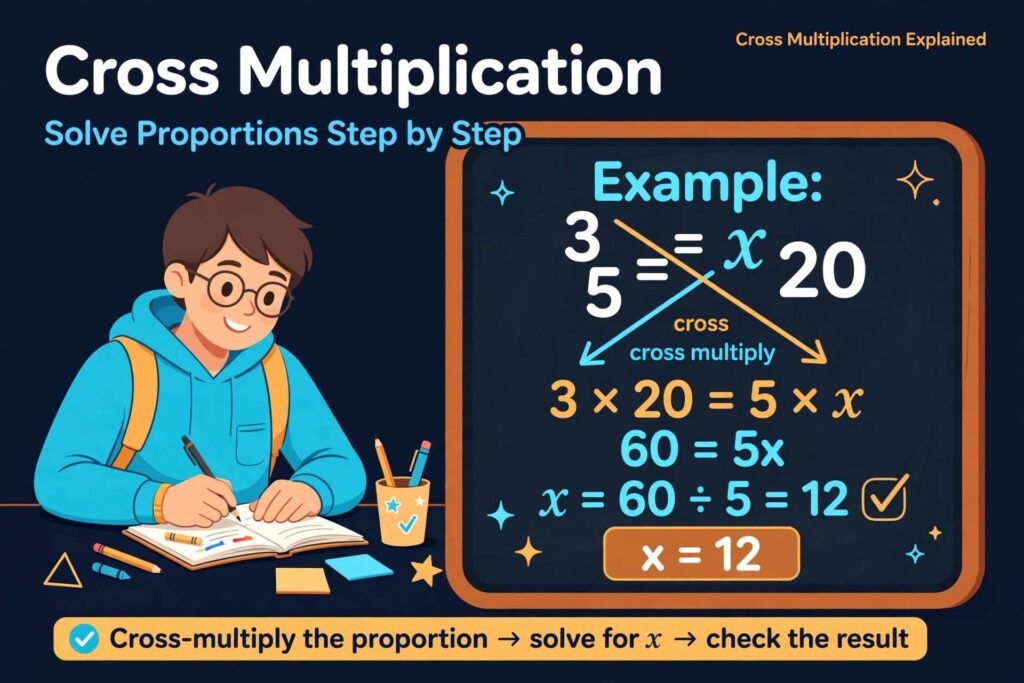
Every cross multiplication problem follows the same three steps. First, write the proportion as two fractions with an equals sign between them, making sure the labels line up on both sides. Second, cross multiply: multiply the numerator of the first fraction by the denominator of the second, and the denominator of the first by the numerator of the second, then set those two products equal. Third, solve the equation you get, usually by dividing both sides by the number in front of x, and then check the answer by putting it back into the original proportion.
Worked example: solve 3/5 = x/20. Cross multiply: 3 times 20 = 5 times x, so 60 = 5x. Divide both sides by 5, and x = 12. Check it by putting 12 back in: 12/20 simplifies to 3/5, because both 12 and 20 divide by 4, so the answer is right. Notice that the check is part of the method, not an optional extra. A wrong setup produces a confident wrong answer, and only the check catches it. Cross it, solve it, check it.
Your turn. Solve 2/7 = x/21. Cross multiply: 2 times 21 = 7 times x, so 42 = 7x, and x = 6. Check: 6/21 simplifies to 2/7, because both 6 and 21 divide by 3.
Money: 5 notebooks cost $7.50
Five notebooks cost $7.50. How much do 8 notebooks cost at the same price? Set up the proportion with the same labels on both sides: 5 notebooks / $7.50 = 8 notebooks / x dollars. Cross multiply: 5 times x = 7.50 times 8, so 5x = 60. Divide both sides by 5, and x = 12, so 8 notebooks cost $12. The sense check agrees: each notebook costs $7.50 divided by 5, which is $1.50, and 8 times $1.50 is $12. When the unit price comes out as a clean number like $1.50, that is a second confirmation that the setup was right. Try those same numbers on the Proportion Calculator in Solve mode and see whether you get 12. If your answer matches, you have used the method correctly. If it does not, look at the setup first, before you doubt the multiplication: most cross multiplication errors are label errors, not arithmetic errors.
Now you try. 6 notebooks cost $9.00. How much for 4 notebooks? The unit price is $9.00 / 6 = $1.50 per notebook, so 4 times 1.50 is $6.00. Check: 6/9 = 4/x, so 6x = 36, x = 6. Cross it, solve it, check it.
A map example, where the numbers do not divide cleanly
Cross multiplication earns its keep when the numbers refuse to divide neatly. Simplifying first is faster when a clean factor is staring at you, but when there is none, cross multiplication still works in exactly the same three steps. Worked example: on a road map, 3 inches represent 120 miles. How many miles do 7 inches represent? Set it up as 3 inches / 120 miles = 7 inches / x miles. Cross multiply: 3 times x = 120 times 7, so 3x = 840. Divide both sides by 3, and x = 280 miles. The check is a unit rate: 120 miles divided by 3 inches is 40 miles per inch, and 7 inches times 40 miles per inch is 280 miles. Both routes land on the same answer, which is what you want to see before you trust a result on a test.
That example also shows why the label check comes before the multiplication. If the inches and miles had been swapped on one side, the cross products would still multiply out to a number, and nothing in the arithmetic would complain. The answer would simply be wrong. Write the labels into the proportion, in the same order on both sides, and the method protects you.
Try one. On a map, 2 inches represent 50 miles. How many miles do 9 inches represent? Set it up as 2/50 = 9/x. Cross multiply: 2x = 450, so x = 225 miles. Check: 50 miles divided by 2 inches is 25 miles per inch, and 9 times 25 is 225.
When the answer does not stop
Some proportions give an answer that goes on forever as a decimal. That is normal, and it is the situation behind a very common homework instruction: solve the proportion, and if necessary, round to the nearest hundredth. The rule is simple: solve first with cross multiplication, keep the full value, and round only at the last step. Worked example: solve the proportion 4/7 = x/9, rounding to the nearest hundredth if necessary. Cross multiply: 4 times 9 = 7 times x, so 36 = 7x. Divide both sides by 7, and x = 36/7, which is 5.142857… To the nearest hundredth, look at the third decimal place, which is 2, so the answer is x = 5.14. Now here is the check that most students skip, and the one that causes the most confusion: 7 times 5.14 = 35.98, which is close to 36 but not exact. That small gap is the rounding, not a mistake. The exact value before rounding, 5.142857…, gives 7 times 5.142857… = 36 exactly. A rounded answer will almost never check back exactly, and that is expected.
Try one more. Solve 5/8 = x/11, rounding to the nearest hundredth if necessary. Cross multiply: 5 times 11 = 8 times x, so 55 = 8x, and x = 55/8, which is 6.875. To the nearest hundredth, look at the third decimal place, which is 5, so the answer rounds up to x = 6.88. Check: 8 times 6.88 = 55.04, which is close to 55 but not exact. That small gap is the rounding. Cross it, solve it, check it.
When x appears on both sides, or the numbers are decimals
Homework sometimes puts x on both sides of the proportion, or uses decimals instead of whole numbers. Cross multiplication still works the same way; the equation you get after crossing simply needs one more step of ordinary algebra. Worked example: solve the proportion (5x + 2)/4 = (2x + 7)/3, rounding to the nearest hundredth if necessary. Cross multiply: 3(5x + 2) = 4(2x + 7), so 15x + 6 = 8x + 28. Move all the x terms to one side and the plain numbers to the other: 15x – 8x = 28 – 6, so 7x = 22. Then x = 22/7, which is 3.142857…, so to the nearest hundredth x = 3.14. Check with the rounded value: (5 times 3.14 + 2)/4 = 17.7/4 = 4.425, and (2 times 3.14 + 7)/3 = 13.28/3 = 4.4267. The two sides are close, and the tiny gap is the rounding. With the exact value 22/7, both sides are exactly 4.428571…
Try another one. Solve (3x + 1)/5 = (x + 4)/2. Cross multiply: 2(3x + 1) = 5(x + 4), so 6x + 2 = 5x + 20. Move the x terms to one side: 6x – 5x = 20 – 2, so x = 18. Check: (3 times 18 + 1)/5 = 55/5 = 11, and (18 + 4)/2 = 22/2 = 11. Both sides are 11, so the answer is exact.
Worked example with decimals: solve the proportion 0.7/1.3 = x/2.1, rounding to the nearest hundredth if necessary. Cross multiply: 1.3x = 0.7 times 2.1 = 1.47, so x = 1.47/1.3, which is 1.130769… To the nearest hundredth, x = 1.13. Check: 0.7/1.3 = 0.538461…, and 1.13/2.1 = 0.538095… The two decimals agree to two places, and the rest of the difference is the rounding. Decimals do not change the method at all; they only make the final division messier, which is exactly when cross multiplication is the right tool.
One more. Solve 0.6/1.4 = x/2.8, rounding to the nearest hundredth if necessary. Cross multiply: 1.4x = 0.6 times 2.8 = 1.68, so x = 1.68/1.4 = 1.2. Check: 0.6/1.4 = 0.428571…, and 1.2/2.8 = 0.428571… The two decimals agree exactly.
One warning belongs here, because it is the most common rounding mistake. Never round in the middle of the working. If you round 22/7 to 3.14 before you finish, and then use 3.14 in the next step, the small error grows. Keep the fraction or the full decimal until the last step, and round once, at the end.
When not to cross multiply
Cross multiplication only works on a proportion: two fractions joined by an equals sign. It does not work on fractions that are being added or subtracted, and it does not work on an equation that is not a proportion at all. This is the gap most short explanations skip, and it is where the method causes the most damage. Adding fractions is the classic trap. To add 1/2 + 1/3, cross multiplying the numerators and denominators gives something that looks like an answer but is not one. The correct move is a common denominator: 1/2 is 3/6, 1/3 is 2/6, and 3/6 + 2/6 = 5/6. Likewise, an equation such as 2x + 3 = 7 is not a proportion, so there is nothing to cross. Solve it by undoing the operations, not by multiplying diagonally. If you ever catch yourself cross multiplying and there is a plus sign, a minus sign, or no equals sign between two fractions, stop: you are using the wrong tool.
There is one extra use worth knowing, because it looks like a different job but uses the same idea. To compare two fractions, cross multiply and compare the products instead of the fractions. For 5/8 and 7/11, the cross products are 5 times 11 = 55 and 8 times 7 = 56. Since 55 is smaller than 56, 5/8 is smaller than 7/11. That comparison is the same rule as the check you already know from checking whether two ratios form a proportion, where equal cross products mean the ratios are equal. Equal products mean equal fractions, and unequal products tell you which fraction is larger.
Which way fits the numbers in front of you?
Cross multiplication is not the only way to solve a proportion, and it is not always the fastest. Choose by the numbers rather than by habit. When the numbers divide cleanly, like 3/5 = x/20, simplify first, then read off x: one division gives x = 12 with no big multiplication. When the numbers do not divide cleanly, like 3 inches to 120 miles, cross multiply: it works the same way whatever the numbers are. When the question asks for one unit’s price or rate, find the unit rate: the unit price, such as $1.50 a notebook, also checks the answer. When you only need to know whether two ratios are equal, compare the cross products: equal products mean equal ratios, with no solving needed. All four moves agree, because they are all the same proportion seen from different angles. On a test, pick the route that fits the numbers, and use a second route as your check. Here is a trick I say out loud, every time. “Numerator pairs with the denominator across from it, never the one beside it.” Say it before you multiply, and you will never draw the wrong lines.
Mistakes that quietly change the answer
Flipped labels are the most common mistake, and the hardest to spot, because the arithmetic still works. If a question asks for the cost of 8 notebooks and you write notebooks over dollars on one side and dollars over notebooks on the other, cross multiplication will hand you a confident wrong number. Keep the same order on both sides: notebooks over dollars, and notebooks over dollars again. If the units do not match across the equals sign, fix the setup before you multiply anything. Multiplying straight across is the second trap. Cross multiplication is diagonal: each numerator pairs with the denominator across from it. Multiplying numerator by numerator and denominator by denominator is a different operation entirely, the one used for multiplying fractions, and it answers a different question. If your cross products look like the fractions themselves multiplied together, you have drawn the wrong lines. A third mistake is forgetting that a denominator can never be zero. If your answer makes any denominator zero, it is not a solution at all, because division by zero is undefined. That case is rare in school proportions, but it is the reason the proof above says “where b and d are not zero.” Finally, remember the rounding warning: rounding in the middle of the working, instead of once at the end, lets a small error grow into a wrong answer. Solve with the exact fraction, round once, and check with the rounded value while allowing for the small gap that rounding leaves behind. That gap is expected, and knowing it is expected stops you from “fixing” a correct answer.
Practice, with answers to confirm
Try these two before you read the answers. First, solve 7/9 = x/27. Second, solve 6/x = 9/12. For the first, cross multiply: 7 times 27 = 9 times x, so 189 = 9x, and x = 21. Check: 21/27 simplifies to 7/9, because both 21 and 27 divide by 3. For the second, cross multiply: 6 times 12 = 9 times x, so 72 = 9x, and x = 8. Check: 6/8 simplifies to 3/4, and 9/12 simplifies to 3/4 as well, so the two fractions are equal. If you got both, the three steps are working. If the second one tripped you up, look again at which product goes on which side: the x is in a denominator here, so it lands in a product on the other side of the equals sign.
Cross multiplication is the solving step, and it sits between two skills you may already know: what a proportion is, which is the difference between a ratio and a proportion, and the check for whether two ratios are really equal.
Questions students ask next
Why does cross multiplication work? Because it is the rule of doing the same thing to both sides of an equation, written in shorthand. Starting from a/b = c/d, multiplying both sides by b and then by d cancels both denominators, leaving a times d = b times c. It only applies when one fraction equals another fraction.
Can I cross multiply when fractions are being added? No. Cross multiplication only works on a proportion, two fractions joined by an equals sign. To add fractions, use a common denominator instead: 1/2 + 1/3 is 3/6 + 2/6, which is 5/6.
Do I have to round my answer when I solve a proportion? Only when the question asks for it, or when the exact answer does not stop. Solve first with cross multiplication, keep the full value, and round only at the last step. For example, 36/7 is 5.142857…, which is 5.14 to the nearest hundredth. Rounding too early, or checking a rounded answer as if it were exact, is the mistake to avoid.
Can a proportion have x on both sides? Yes. Cross multiply first, then move all the x terms to one side and the plain numbers to the other side, and divide to find x. For example, (5x + 2)/4 = (2x + 7)/3 gives 7x = 22, so x is 3.14 to the nearest hundredth. Round only at the last step, after you have the exact value.
What does it mean if the cross products are not equal? It means the two fractions are not equal, so they do not form a proportion. If the products are close but not equal, the fractions are close but not equal either: the answer is still no, and no amount of rounding makes them equal.
Try it on the calculator
In the map problem, 3 inches stand for 120 miles, and the missing distance is 280 miles because the two cross products are equal. Set the products equal, solve for the unknown, and the same steps work on any proportion. Cross it, solve it, check it.