
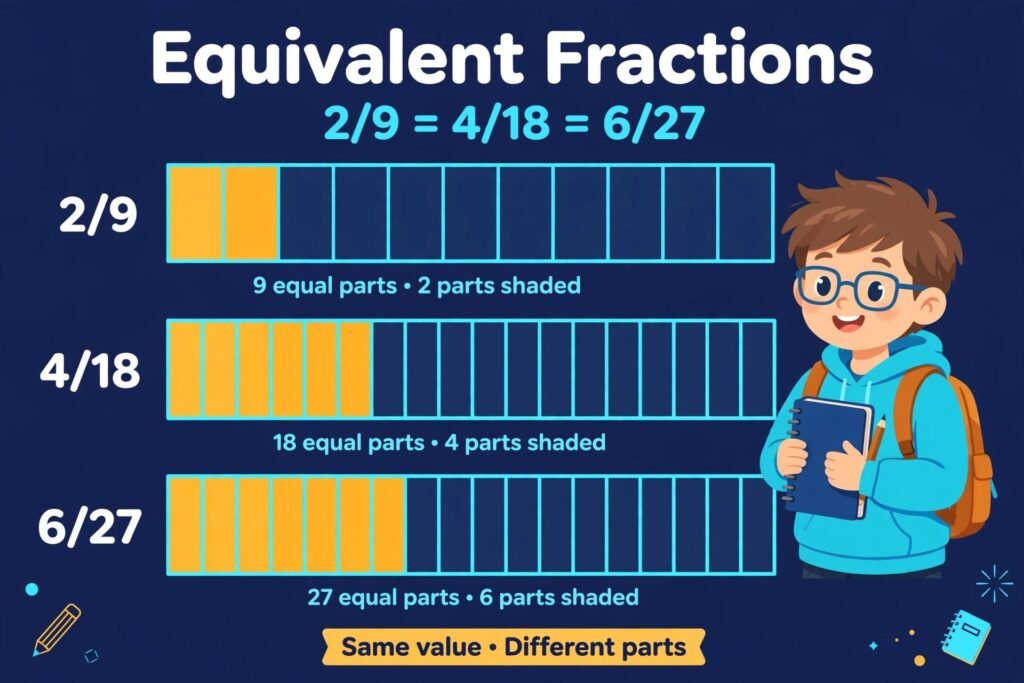
A chocolate bar is cut into 9 pieces. Eat 2 of them. A friend has the same bar cut into 18 smaller pieces and eats 4. Four is bigger than 2, so the friend ate more. Wrong. Then try to make an equivalent fraction of 2/3 by adding 1 to the top and 1 to the bottom, and you get 3/4. Wrong again, and both mistakes come from the same place. Reading the numbers instead of the value. Same value, different look. That is the whole post.
Equivalent fractions are fractions that look different but hold the same value. The fractions 2/9, 4/18, and 6/27 all name the same part of a whole. Below, you will build a family of equivalent fractions, find a missing numerator or denominator, and spot a pair that only looks equivalent. Picture the chocolate bar again, cut into 9 equal pieces. You eat 2 of them, so you have eaten 2/9 of the bar. Now imagine the same bar cut into 18 smaller pieces, with each old piece split in two. You would need to eat 4 of the small pieces to eat the same amount, so 4/18 names the same share. Cut each piece into three instead, and the same share becomes 6/27. Nothing about the amount changed. Only the size of the pieces changed, and the count of pieces changed to match. That is the whole idea. An equivalent fraction is a new name for the same value, made by cutting the whole into more pieces or fewer pieces and counting again. The value stays put because the top and bottom change together, by the same factor. Multiply the top and bottom of 2/9 by 2 and you get 4/18. Multiply them by 3 and you get 6/27. Multiply them by 5 and you get 10/45. Every one of those fractions sits at the same spot on a number line, and every one of them equals the same decimal, about 0.22. The family grows as far as you like, and each member is just 2/9 written with different numbers. Same value, different look.
Same value, different look
Multiplying the top and bottom by the same number is really multiplying the fraction by 1. The fraction 2/2 equals 1, and so do 3/3 and 5/5. When you multiply 2/9 by 2/2, you get 4/18, and multiplying by 1 never changes a value. That is why the family works, and it is also why the rule has one hard edge. The number you use must be the same on top and bottom, and it cannot be zero. Dividing by zero has no meaning, and multiplying by different numbers moves the value. A quick picture helps. Draw two rectangles the same size. Split the first into 9 equal strips and shade 2. Split the second into 18 equal strips and shade 4. The shaded area is the same in both drawings, even though the counts differ. That shaded area is the value the fractions share. If the shaded areas match, the fractions are equivalent. If one shaded area is bigger, they are not. The same test works with a pizza, a strip of paper, or a number line. On a number line from 0 to 1, the fractions 2/9, 4/18, and 6/27 all land on the same point. Different names, one location. Keep that picture in mind whenever a fraction question asks whether two fractions are equal, because it turns an abstract rule into something you can see. Here is a trick I say out loud, every time. “Top and bottom, same number, every time.” Say the words as you write it, and the rule stays right.
Try it. Build the family of 3/5. Multiply the top and bottom by 2 and you get 6/10. Multiply them by 3 and you get 9/15. Multiply them by 4 and you get 12/20. All of them equal 0.6, the same value as 3/5. Same value, different look.
Finding the missing number by scaling
Most homework questions hide one number. A fraction is given with a blank top or a blank bottom, and the other fraction is complete. The fix is to look at the side you can compare, work out the factor, and use the same factor on the other side. The two examples below each hide a different number, so you can see how the side you look at changes.
A missing numerator
Find x in x/28 = 5/7. Start with the denominators, because both are known. The denominator grew from 7 to 28. Dividing 28 by 7 gives 4, so the whole fraction was multiplied by 4. Do the same to the numerator: 5 times 4 gives 20, so x is 20. The pair is 20/28 = 5/7. A cross multiplication check confirms it. 20 times 7 is 140, and 28 times 5 is also 140, so the two fractions agree. Try the same numbers on the Proportion Calculator and solve for x in 5/7 = x/28. The calculator should give 20, and the check above shows why that answer is right.
Try it. Find x in x/30 = 4/5. Start with the denominators. The denominator grew from 5 to 30, and 30 divided by 5 gives 6. Do the same to the numerator: 4 times 6 gives 24, so x is 24. Check: 24 times 5 is 120, and 30 times 4 is also 120.
A missing denominator
Find y in 9/y = 3/8. This time the numerators are the side you can compare. The numerator grew from 3 to 9. Dividing 9 by 3 gives 3, so the whole fraction was multiplied by 3. Do the same to the denominator: 8 times 3 gives 24, so y is 24. The pair is 9/24 = 3/8. Check it by cross multiplying. 9 times 8 is 72, and 24 times 3 is also 72. Notice the habit that makes both examples work. You always look at the known side first, find the factor, and then apply that same factor to the unknown side. If you start with the unknown side, there is nothing to compare, and the question feels harder than it is. Same value, different look.
Try it. Find y in 7/y = 14/20. Start with the numerators. The numerator grew from 7 to 14, and 14 divided by 7 gives 2. Do the same to the denominator: 20 divided by 2 gives 10, so y is 10. Check: 7 times 20 is 140, and 10 times 14 is also 140.
Scaling down to the simplest form
Scaling works in both directions. Dividing the top and bottom by the same number also keeps the value, and it leads to the simplest form of a fraction. Take 36/48. Both numbers share the factor 12. Divide the top by 12 and you get 3. Divide the bottom by 12 and you get 4. So 36/48 equals 3/4 in lowest terms. The check works the same way: 3 times 48 is 144, and 4 times 36 is also 144. If 12 does not jump out at you, divide in stages. Divide 36 and 48 by 6 first to get 6/8, then divide 6 and 8 by 2 to get 3/4. The result is the same, and the stages are easier to spot. The full steps for shrinking a fraction this way are in the guide to simplifying ratios on this site. Decimals convert the same way: our decimal to fraction calculator turns a decimal into its simplest fraction form.
Try it. Simplify 24/36. Both numbers share the factor 12. Divide the top by 12 and you get 2. Divide the bottom by 12 and you get 3. So 24/36 equals 2/3 in lowest terms. Check: 2 times 36 is 72, and 3 times 24 is also 72.
When scaling is not clear, cross multiply
Scaling is fast when the factor is easy to see. Sometimes it is not, and that is when cross multiplication earns its keep. Cross multiplication multiplies each numerator by the other fraction’s denominator. If the two products match, the fractions are equivalent. If they differ, the fractions are not equivalent, no matter how close they look. Is 7/11 equal to 21/33? Scaling gives a clean answer here, because 7 times 3 is 21 and 11 times 3 is 33. Cross multiplication agrees: 7 times 33 is 231, and 11 times 21 is also 231. Both methods say yes, and scaling was faster because the factor 3 was easy to see. The full cross multiplication steps are in the guide to checking whether two ratios form a proportion. Try scaling first when the factor is easy to see. When it is not, cross multiply. The table below runs both checks on three pairs, so you can see where each method shines.
| Pair | Scaling check | Cross multiplication check | Verdict |
|---|---|---|---|
| 7/11 and 21/33 | Top and bottom both times 3 | 7 times 33 equals 231 and 11 times 21 equals 231 | Equivalent |
| 5/11 and 15/32 | Top times 3, but bottom would need 33, not 32 | 5 times 32 equals 160 and 11 times 15 equals 165 | Not equivalent |
| 36/48 and 3/4 | Top and bottom both divided by 12 | 36 times 4 equals 144 and 48 times 3 equals 144 | Equivalent |
Cross multiplication is the safer check when the factor is not clear. It needs no guessing about which number divides which, and it works on decimals too. Scaling is the quicker check when the factor jumps out, as it did for 7/11 and 21/33. Use scaling to build a family fast, and use cross multiplication to settle any doubt.
Try it. Is 6/7 equal to 18/21? Scaling: 6 times 3 is 18, and 7 times 3 is 21, so the factor is 3 on both sides. Cross multiplication agrees: 6 times 21 is 126, and 7 times 18 is also 126. Both methods say yes.
A pair that only looks equivalent
Some pairs look equivalent and are not. Is 5/11 equal to 15/32? The tops suggest times 3, because 5 times 3 is 15. But the bottoms do not follow: 11 times 3 is 33, not 32. The pair fails, and the cross products show by how much. 5 times 32 is 160, and 11 times 15 is 165. The products differ by 5, so the fractions are not equivalent. A near miss like this is easy to accept on a quick look, which is why the check matters. One number off in the denominator is enough to break the equality. Three mistakes cause most wrong answers here. The first is adding the same number to the top and bottom. Adding 1 to both parts of 2/3 gives 3/4, and 3/4 is a bigger fraction, not an equivalent one. Adding changes the value. Only multiplying or dividing by the same number keeps it. That was the second mistake at the top of this page. The second is multiplying the top and bottom by different numbers, which changes the value too. The third is checking only one side. A pair is equivalent only when both the top and the bottom follow the same factor, so always check both. Same value, different look.
Try it. Is 4/9 equal to 12/26? The tops suggest times 3, because 4 times 3 is 12. But the bottoms do not follow: 9 times 3 is 27, not 26. The cross products show it too: 4 times 26 is 104, and 9 times 12 is 108. The products differ, so the fractions are not equivalent.
Equivalent fractions are proportions
There is one more idea worth naming. An equivalent fraction pair is a proportion. The statement 4/18 = 2/9 says two ratios are equal, and that is exactly what a proportion is. You can also set up any of these pairs as a proportion on the Proportion Calculator and watch the cross products match. For the proportion behind every example here, OpenStax Prealgebra, section 6.5, Solve Proportions and Their Applications explains the same cross multiplication steps used in the examples above. Seeing the link saves work later. Every skill in this guide, scaling, cross multiplying, and finding a missing number, is a proportion skill with fraction numbers. Once the connection clicks, the two topics stop feeling like separate chapters, and each new proportion question starts from a method you already know.
Try it yourself
Two short questions use the same steps as the examples above. Work each one on paper first, then check your answer. Find the missing number in ?/36 = 7/9. Answer: the denominator grew from 9 to 36, which is times 4, so the numerator is 7 times 4, which is 28. Check: 28 times 9 is 252, and 36 times 7 is 252. Find y in 11/y = 33/45. Answer: the numerator grew from 11 to 33, which is times 3, so y is 45 divided by 3, which is 15. Check: 11 times 45 is 495, and 15 times 33 is 495. Now take any fraction from your homework, write three equivalents for it, and check one of them with cross multiplication. If the products match, the family is sound. Run the same numbers through the Proportion Calculator to see each step confirmed, and the method will feel like second nature the next time a blank numerator or denominator shows up.
Questions students ask next
What are equivalent fractions in simple words? Fractions that look different but hold the same value. 2/9, 4/18 and 6/27 are equivalent because each one names the same part of a whole.
How do you find a missing numerator in an equivalent fraction? Look at the denominators first. Work out what the known denominator was multiplied or divided by to reach the new denominator, then do the same to the known numerator. For x/28 = 5/7, the denominator was multiplied by 4, so x is 5 times 4, which is 20.
How do you find a missing denominator in an equivalent fraction? Look at the numerators first. Work out what the known numerator was multiplied or divided by, then do the same to the known denominator. For 9/y = 3/8, the numerator was multiplied by 3, so y is 8 times 3, which is 24.
How do you check whether two fractions are equivalent? Cross multiply. If the two cross products are equal, the fractions are equivalent. For 7/11 and 21/33, both products are 231, so they are equivalent.
Can you multiply the top and bottom by different numbers? No. Multiplying the top and bottom by the same number keeps the value the same. Multiplying them by different numbers changes the value, so the new fraction is not equivalent.